
Your company has 400,000 euros in excess cash. Your accountant asks what you'd like to do with it. You answer "we'll see next month," then the quarter passes, and the money sits in your current account. Or worse: you invest in a rush, in a product you barely understand, because a sales rep called at just the right moment.
This scenario plays out across hundreds of SMEs. Not from negligence, but because no decision-making framework exists. The CEO doesn't have time to analyze every option, the accountant has no clear mandate, and each investment becomes a decision to make from scratch.
A formal cash management policy solves this problem. It's a short document, three to five pages maximum, that sets the rules of the game once and for all. It's not a catalog of financial products, but a shared strategic framework between the CEO and their accountant. Let's see how to structure it.
Cash objectives: what do you expect from your excess funds
The first section defines what the company is trying to achieve. This question may seem obvious, but it rarely is. A CEO preparing an investment twelve months out has different priorities than a business owner accumulating cash with no specific project in mind.
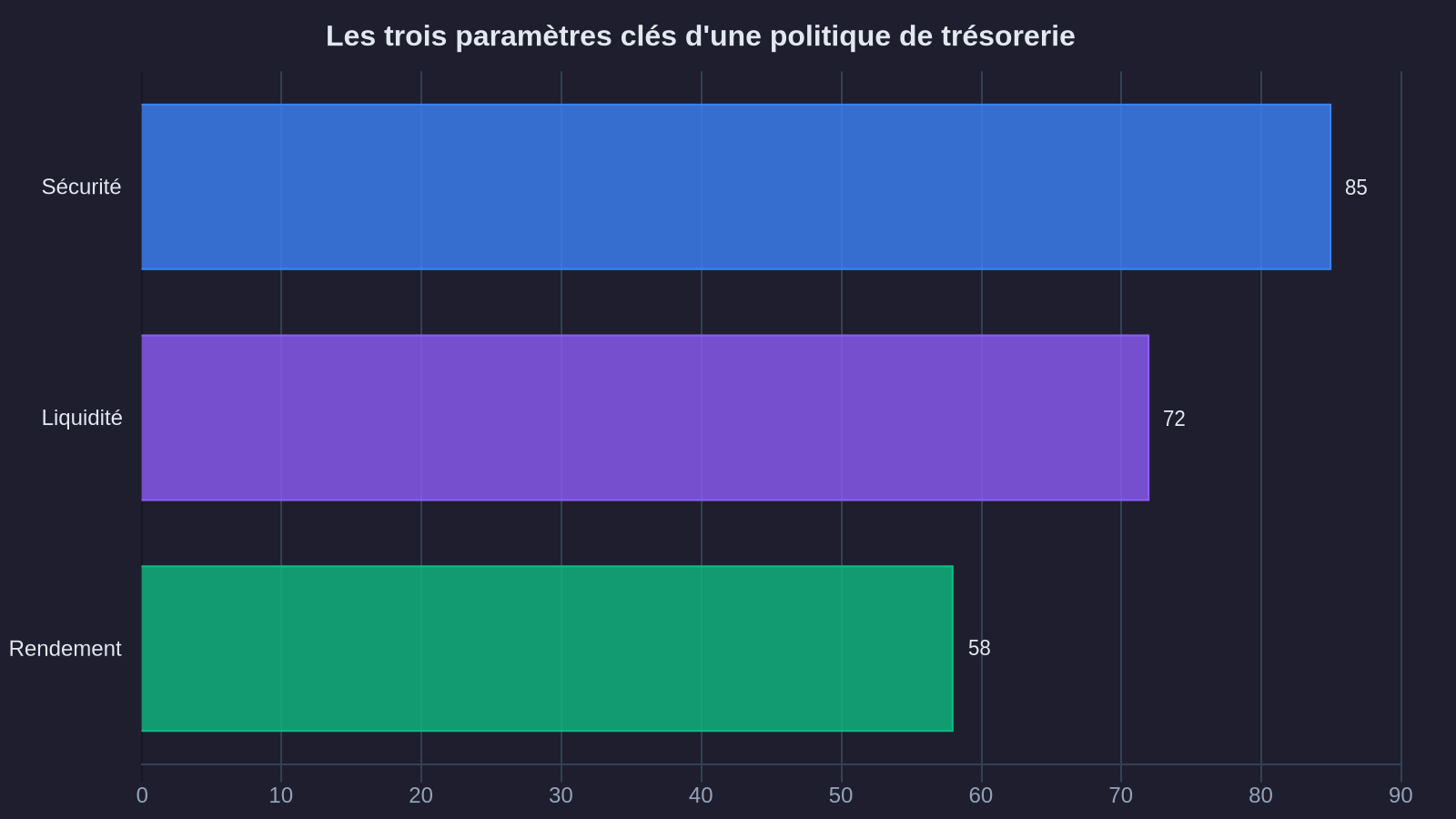
The investment policy therefore begins by formalizing three parameters: the level of safety required, the liquidity needed, and the target return. These three criteria form a triangle where trade-offs are inevitable. An SME financing a real estate project in six months will prioritize liquidity and safety, even if it reduces returns. A holding company with no near-term deadlines can accept a longer timeframe.
In this section, record your typical investment horizon. For example: "The company distinguishes three pools. A safety reserve equivalent to three months of fixed costs, available at any time. Operating surplus, invested over six to twelve months. Structural surplus, with no defined maturity, which can be invested over three years or more." This distinction allows you to tailor investment choices to each situation without having to redefine strategy each time. Before any decision, ask yourself the right questions about your excess cash.
Authorized asset classes and their limits
The second section defines the scope of possible investments. This isn't about listing every product on the market, but defining the broad categories of assets the company will accept or reject. This section answers a simple question: where can the company's money go, and where should it never go.
A typical framework for a cautious SME might look like this: "Regulated money market investments (fixed-term accounts, term deposits with French or European credit institutions rated A- minimum) are authorized without limit. Money market or low-duration bond funds are authorized up to 30% of total excess funds. Equities, structured products, and unregulated investments are excluded."
If the company considers exposure to digital assets via decentralized finance, this section sets strict conditions: for example, "An allocation to crypto-assets may be considered for structural surplus only, limited to 5% of total excess funds, through a regulated custodian, with segregated assets. This allocation carries a risk of capital loss and can only be decided after board approval." The MiCA framework, applicable since 2024, imposes compliance criteria for providers. Building these requirements into the policy avoids reinventing the wheel each time.
This section should also spell out prohibitions. For example: "No investment may be made through an unregulated intermediary. No investment may be made without the company retaining ownership of its assets. Non-capital-guaranteed products must be subject to documented risk analysis." These guardrails protect the company against hasty decisions.
The decision-making process and approval thresholds
The third section describes who decides what, and above which amount. This is often the most useful part of a formal cash management policy, as it prevents back-and-forth between the CEO and accountant.
An example process: "Any investment below 50,000 euros and complying with authorized categories may be executed by the accountant after informing the CEO. Any investment between 50,000 and 200,000 euros requires prior CEO approval. Any investment above 200,000 euros, or any allocation outside authorized categories, requires board resolution."
This tiering allows you to balance responsiveness with control. The accountant can act quickly on limited amounts without blocking day-to-day management. The CEO retains authority over major decisions. The board intervenes on strategic trade-offs.
Also add a review clause: "The investment policy is reviewed annually, or whenever a significant cash change occurs (fundraising, asset sale, substantial borrowing)." This regular review ensures the framework remains aligned with the company's reality.
Selection criteria and performance monitoring
The fourth section specifies how to choose an investment and track its performance. It prevents you from ending up with forgotten investments or discovering too late that a promised return doesn't materialize.
List the minimum criteria for any new investment: "Before any subscription, the company verifies the provider's regulation (ACPR approval, MiCA European passport for digital assets), fee transparency, availability of monthly or quarterly reporting, and compatibility with the company's accounting. No investment will be made if any of these criteria is not met."
Also define a reporting cadence. For example: "The accountant provides quarterly a summary statement of active investments: amount, remaining duration, realized return, valuation change for variable-capital investments. Any variance exceeding 5% between expected and realized return is analyzed." This monitoring allows you to spot problems quickly, without waiting for year-end closing.
Finally, include an exit clause: "Any investment whose perceived risk increases significantly (provider rating downgrade, unfavorable regulatory change, provider default) must be liquidated within thirty days, or be subject to a documented board resolution to maintain it." This clause protects against inertia.
Tax and accounting aspects of cash management
A short but essential section reminds you of the tax and accounting treatment of investments. Many CEOs discover too late that certain investments create complex tax consequences or heavy accounting burdens.
Clarify the key points: "Investment income from cash placements is subject to corporate income tax at the standard rate. Capital gains on securities or digital asset sales are taxable under the professional capital gains regime. The accountant ensures each investment is tracked separately in the accounts, allowing traceability of flows and performance."
For crypto-assets, corporate tax treatment differs from individual taxation. Digital asset sales by a company are subject to corporate income tax, with no preferential regime. This must be explicitly stated in the policy: "Any allocation to digital assets must account for the absence of special tax treatment for companies, and the need to document each transaction to justify valuation in the accounts."
A living document, not a static text
A formal cash management policy is not a rulebook you file away in a drawer. It's a management tool the CEO and accountant consult regularly, and adjust whenever the company's situation changes.
Writing this document takes a few hours, but it saves dozens of hours of discussion and hesitation. It establishes a clear framework, prevents improvised decisions, and protects your company against poor instincts. Most importantly, it transforms cash management into a process, not a perpetual judgment call.
If your company has structural excess cash, start by meeting with your accountant and draft the five sections outlined here together. You won't have to ask yourself every quarter what to do with your cash. You'll have an answer, built in calm moments, ready to apply in hectic ones.