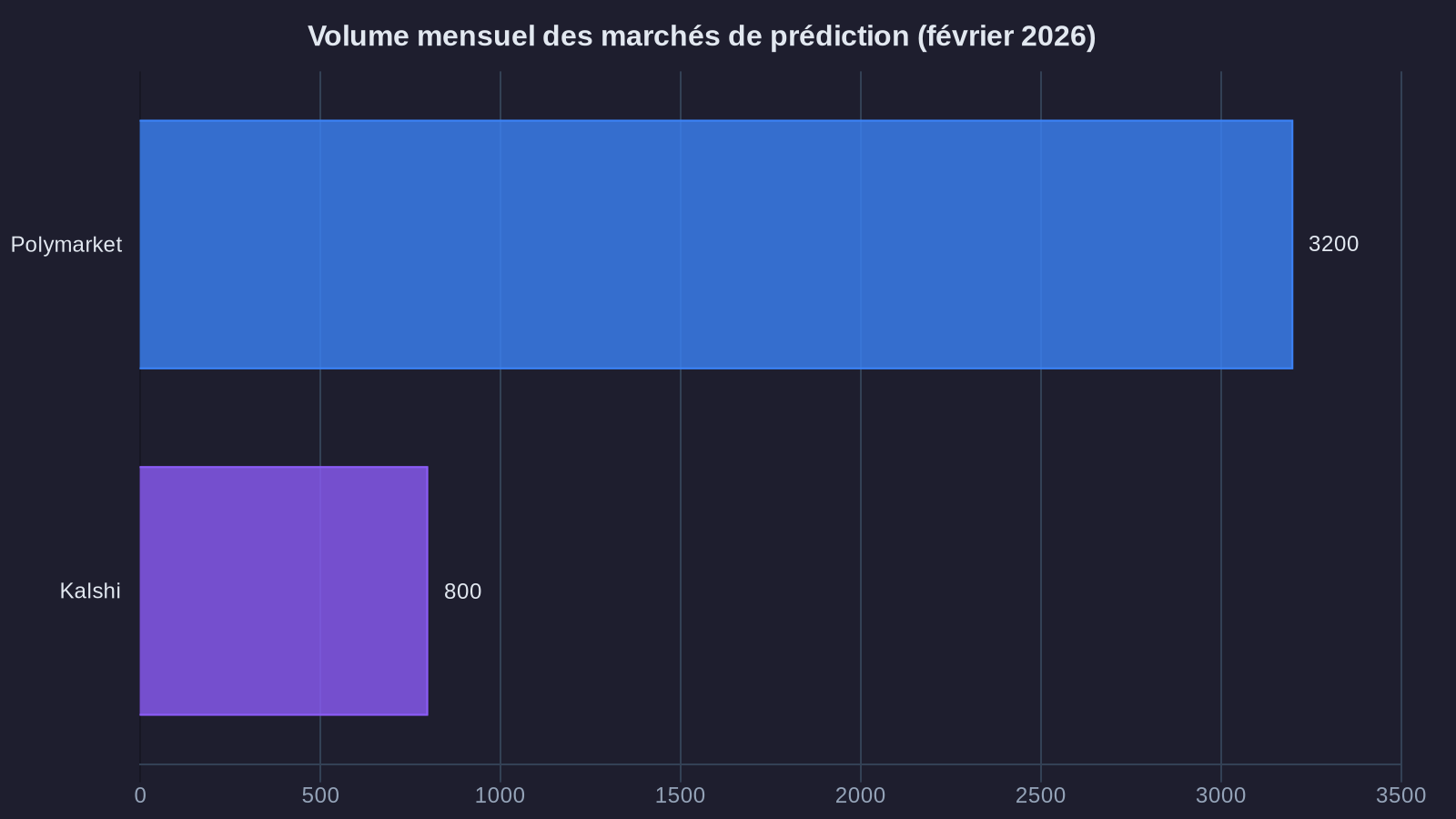
Polymarket surpassed $3.2 billion in monthly volume in February 2026. Kalshi crossed the $800 million threshold. Prediction markets, long confined to the financial margins, are now establishing themselves in the mainstream landscape. Yet this growth is catching regulators' attention. On March 12, 2026, the U.S. Senate's financial markets commission announced an investigation into these platforms' practices. The reason: suspicions of insider trading and market manipulation on sports and political events.
The industry faces a critical inflection point. On one hand, these platforms democratize access to sophisticated financial instruments. On the other, they operate in a legal vacuum that facilitates abuse. The coming months will determine whether prediction markets evolve toward a regulated framework comparable to traditional exchanges, or remain a gray zone prone to exploitation.
The regulatory paradox of crypto prediction markets
Prediction markets occupy ambiguous legal terrain. In the United States, the CFTC (Commodity Futures Trading Commission) treats them as derivative contracts. Kalshi obtained formal authorization to operate under this classification in 2021. Polymarket, based in the Bahamas but widely used by Americans, paid a $1.4 million fine in 2022 for operating without a license. The platform subsequently pivoted toward crypto markets, partially escaping direct oversight.
This difference in status creates distortions. On Kalshi, a regulated platform, you can bet on U.S. inflation or Federal Reserve decisions. But not on presidential elections—the CFTC considers such markets could influence the democratic process. On Polymarket, no restrictions: elections, sports results, geopolitical events. Everything is tradeable. This freedom attracts traders but exposes the platform to accusations of facilitating manipulation.
The Senate points to three major issues: the absence of strict KYC controls, opaque large orders, and lack of monitoring of concentrated positions. On the 2027 French presidential election, a single Polymarket account holds 18% of "yes" positions on a specific candidate, worth $4.2 million. There's no way to know who's behind it. No way to verify if it's an insider close to the campaign. This situation echoes the regulatory clarification stakes between the SEC and CFTC on crypto assets.
Insider trading: the cases alarming Washington
On February 8, 2026, twelve hours before the official announcement of Kylian Mbappé's transfer to Real Madrid, "yes" positions on Polymarket exploded by 340%. Volume traded: $2.1 million in less than 6 hours. Estimated gains for early positions: between $800,000 and $1.2 million. Coincidence? Possible. Insider trading? Probable. Proof? None.
This pattern repeats. January 2026: 48 hours before Amazon announces its market exit in India, contracts on Kalshi for "Amazon leaves India in 2026" jumped 220%. November 2025: the day before the surprising resignation of the British Prime Minister, corresponding bets on Polymarket surged 400% in volume. Each time, the same pattern: brutal moves, concentrated buying, suspicious timing.
The platforms claim they monitor anomalies. Polymarket froze 127 accounts in 2025 on suspicion of manipulation. Kalshi implemented an automatic alert system for price movements exceeding 15% in less than an hour. Yet these measures remain reactive. They don't prevent trading; they penalize after the fact—once profits have already been pocketed.
The real issue? The status of information itself. On traditional stock markets, insider trading rests on a clear definition: material non-public information obtained by a fiduciary position. On Polymarket, what constitutes material information about a footballer's transfer? About a lawsuit outcome? About a political decision? The legal framework simply doesn't exist.
Strengthened regulation: new rules for prediction markets
Facing pressure, platforms are moving. Kalshi announced on March 5, 2026, a partnership with Chainalysis to trace suspicious money flows. Polymarket has deployed enhanced KYC since January for any position exceeding $50,000. Both platforms are testing position limits per account and per event—5% maximum of total volume for a single trader.
These measures bring prediction markets closer to regulated exchange standards. But they also create friction. Strict KYC alienates users attached to privacy—a significant portion of the crypto user base. Position limits reduce liquidity on niche markets. An institutional trader wanting to take a $200,000 position on a niche event must now fragment orders across multiple accounts or abstain. These challenges echo those encountered in institutional adoption of tokenized assets.
The CFTC is preparing its own regulatory framework. According to documents reviewed by Reuters on March 10, the agency envisions three pillars: licensing requirements for any platform serving U.S. clients, real-time order book surveillance, and prohibition on markets covering events where manipulation is deemed too easy (minor league sports results, local events). If this framework passes, Polymarket must choose: comply and lose part of its user base, or definitively block U.S. access.
ForYield's take
Prediction markets are in their regulatory adolescence phase. Like crypto exchanges between 2017 and 2020, they grew fast, in a legal vacuum favorable to innovation but also to abuse. Normalization is coming. It will be painful for some players but necessary for the sector's credibility.
We're monitoring these developments closely because they foreshadow the evolution of crypto markets broadly. The questions raised—how to define material information on non-traditional assets? How to reconcile regulatory transparency with privacy protection? How to surveil decentralized markets?—apply directly to our domain.
Data as of March 18, 2026: Polymarket: $3.2B monthly volume (-8% since the investigation announcement). Kalshi: $810M (+3% over the same period). Bitcoin: $118,400, stable. Ethereum: $6,240, +2% over 7 days.
Our position: platforms that invest now in regulatory compliance will emerge strengthened from this transition. Others will disappear or remain confined to gray markets. For investors, it's a signal: favor players who anticipate regulation rather than those who run from it. In a year, the landscape will have shifted. Winners will be those who understood that regulation isn't the enemy of growth, but its foundation.
```