
BlackRock has just crossed a milestone that many were waiting for: the launch of ETHB, a Bitcoin Ethereum ETF with integrated staking. The announcement came on March 15, 2026, and it marks a turning point for institutional crypto exposure. Why? Because it solves an equation that has been problematic until now: how to capture Ethereum's native yield (staking) in a regulated vehicle accessible to traditional investors.
Until now, spot Ethereum ETFs simply replicated the price of the underlying asset. You gained exposure to Bitcoin or Ethereum, but without benefiting from the revenues naturally generated by the Ethereum network through staking. It's like owning a stock without collecting dividends. ETHB changes the game by directly integrating this yield mechanism into the ETF structure.
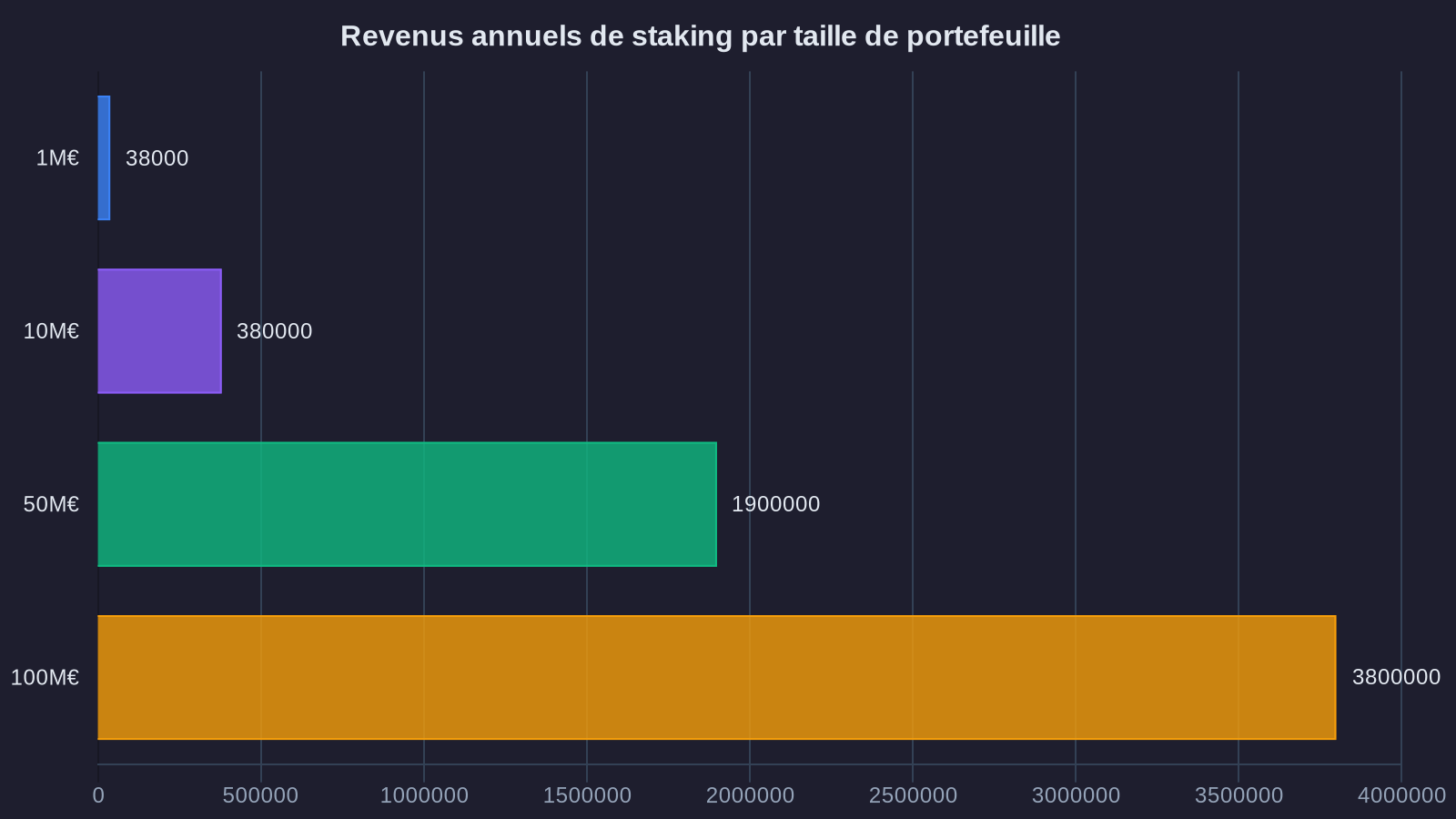
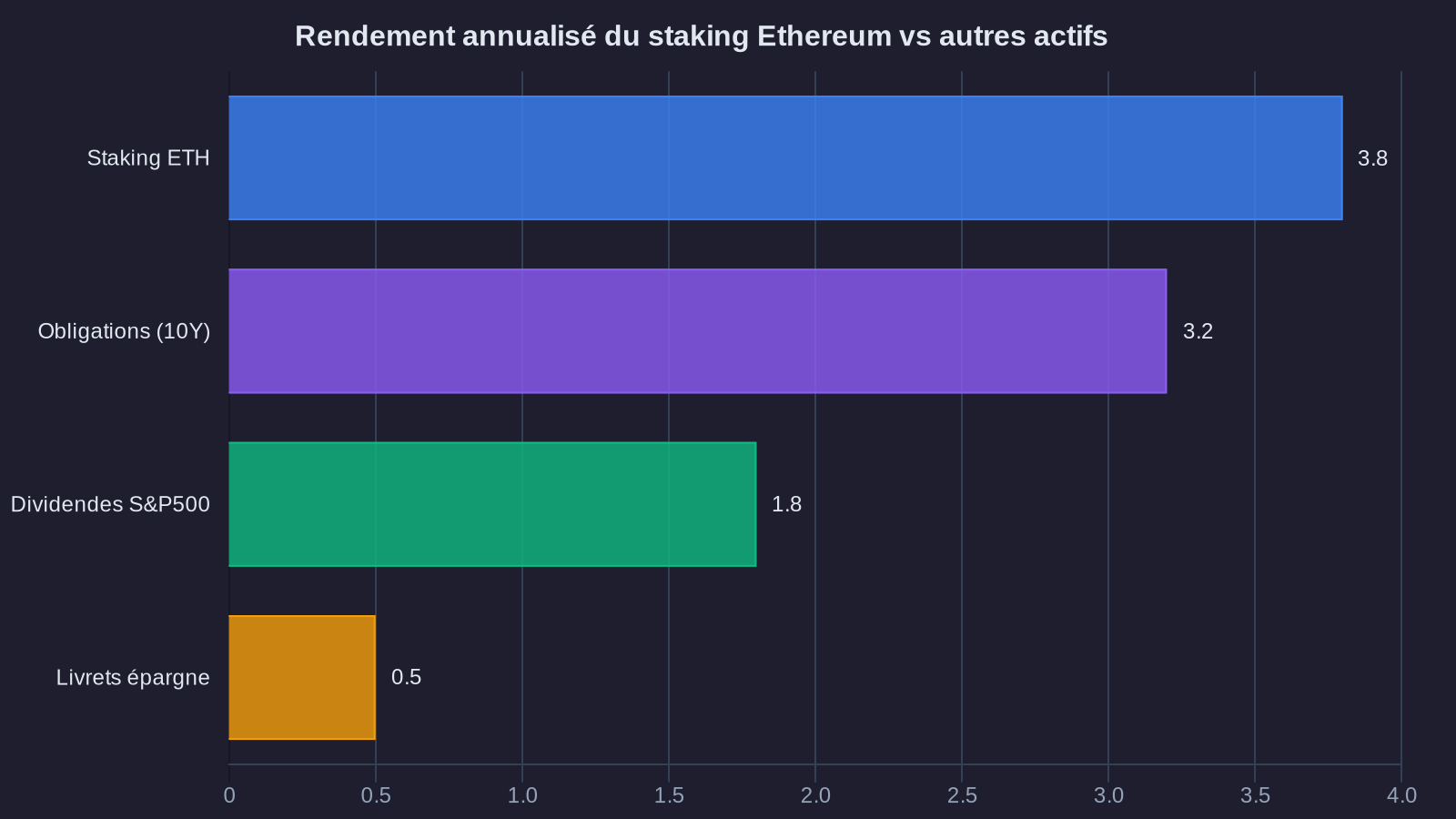
The numbers speak for themselves. As of March 18, 2026, Ethereum shows an annualized staking yield of 3.8%. That's not negligible when we're talking about institutional volumes. On a €10 million portfolio, this represents €380,000 in additional annual income. For family offices and asset managers looking to justify crypto allocation to their clients, this dimension fundamentally shifts the conversation. The outlook for Bitcoin and crypto-assets over the long term further reinforces interest in these investment vehicles.
The mechanics of staking: what actually changes
Ethereum staking is the mechanism by which the network secures its transactions since the transition to Proof of Stake in September 2022. ETH holders can lock up their tokens to validate transactions and receive compensation in return. It's equivalent to interest, but paid directly by the protocol.
The problem: for a traditional investor, setting up staking involves technical infrastructure, private key management, and understanding slashing risks (penalties if the validator malfunctions). For an institutional player subject to compliance and reporting obligations, it's an operational headache.
ETHB solves this friction. BlackRock handles all the technical dimensions: validator selection, performance monitoring, operational risk management. The investor simply holds ETF shares that automatically benefit from staking yields. The generated revenues are reinvested in the fund, mechanically increasing the share value.
Concretely, here's how it works. BlackRock has set up a partnership with Coinbase Institutional for the staking layer. The ETH held by the fund is delegated to professional validators selected according to strict criteria: uptime greater than 99.5%, performance history, geographic diversification. The net yield (after the fund's management fees) is capitalized daily into the ETF's net asset value.
ETHB's management fees are set at 0.25% annually, plus approximately 0.15% in staking-related costs (validator compensation, technical infrastructure). This brings the total to a TER (Total Expense Ratio) of 0.40% annually. Compared to the gross staking yield of 3.8%, this gives an estimated net yield of 3.4% for the investor.
What staking rewards ETFs change for institutional allocations
The most immediate impact is on how investment committees will evaluate Ethereum. Until now, ETH was perceived as a purely speculative asset with no predictable revenue stream. With integrated staking, we move to a model that looks more like a variable-yield bond or a dividend-paying stock.
Portfolio managers can now directly compare Ethereum to other revenue-generating asset classes. A net yield of 3.4%, in an environment where 10-year government bonds hover around 2.8% and S&P 500 dividends cap out at 1.6%, positions Ethereum in an interesting competitive zone. Plus the upside potential of ETH price appreciation itself.
We're already seeing early effects. Since the ETHB announcement, three European family offices that ForYield advises have revised their allocation frameworks to include an Ethereum staking pocket. The logic is straightforward: for a profile seeking yield with moderate to high risk tolerance, a 60% investment-grade bonds / 30% equities / 10% Ethereum with staking mix offers a more attractive risk-return profile than a traditional 70/30 allocation.
The other dimension that changes is regulatory compliance. An listed ETF, even if it invests in crypto-assets, fits perfectly into existing reporting frameworks. Managers can include it in mutual funds, life insurance contracts, retirement savings plans (PERs) subject to eligibility constraints. It's crypto access without having to build an entire dedicated custody and compliance architecture.
Limitations and points to watch
Now let's talk about the blind spots. Because ETHB solves certain problems but creates others.
First point: Ethereum staking liquidity. Technically, staked ETH is locked. It cannot be withdrawn instantly from the network. There are queues for entering and exiting staking, which can grow considerably during periods of high volatility. BlackRock has managed this risk by maintaining a pool of non-staked liquidity (approximately 10% of the fund), but this reduces overall yield accordingly. It's a trade-off between liquidity and performance.
Second limitation: slashing risk. Even though BlackRock selects professional validators, zero risk doesn't exist. A validator that signs two conflicting blocks or goes offline for too long gets penalized by the network. Staked ETH can be partially confiscated. This risk is low (historically less than 0.01% of staked ETH), but it exists. ETHB's prospectus explicitly mentions this risk, without being able to quantify it precisely.
Third point to watch: taxation. In many jurisdictions, the tax treatment of staking remains unclear. Is it taxable income when generated, or only upon resale? For a capitalizing ETF like ETHB, the question is less acute (no revenue distribution), but it will arise when selling shares. Investors should anticipate this with their tax advisors.
Finally, there's the question of counterparty dependency. By delegating staking to Coinbase Institutional, BlackRock introduces counterparty risk. If Coinbase encounters difficulties (cyberattack, bankruptcy, regulatory sanctions), it could impact fund performance. BlackRock has implemented backup mechanisms (secondary validators, service provider diversification), but concentration remains a point to watch.
ForYield's take
At ForYield, we're following this development with measured interest. ETHB is a genuine innovation for institutional crypto exposure, but it's not necessarily the optimal solution for all profiles.
For an investor starting a crypto allocation and primarily seeking simplicity and regulatory compliance, ETHB does the job perfectly. It's a clean, liquid vehicle with integrated yield. It integrates frictionlessly into an existing portfolio.
For a more experienced investor capable of managing wallets directly and prepared to handle technical complexity, direct staking remains more performant. By setting up your own validator or using services like Lido or Rocket Pool, you avoid the ETF management fee layer (0.40% annually) and maintain full control of your assets. Over a long horizon, this fee difference compounds and can represent several performance percentage points.
Our approach at ForYield is to combine both models. For the core of the crypto portfolio (60-70% of allocation), we favor direct staking or optimized liquid staking strategies that maximize net yield. For the satellite portion (30-40%), we integrate vehicles like ETHB that bring liquidity and flexibility. It's a balance between performance and practicality.
The other dimension that interests us is the arbitrage between different staking protocols. Ethereum at 3.8% is interesting, but it's not the only network offering yield. Solana hovers around 7.2%, Avalanche oscillates between 8% and 10% depending on periods, Polkadot offers between 12% and 15%. The question isn't just "should I stake?" but "on which network, with what diversification strategy, and over what holding period?" ETHB simplifies access to Ethereum, but it doesn't replace a true multi-protocol passive yield strategy on crypto-assets.
Flow data already shows market appetite. Within 48 hours of ETHB's launch, BlackRock collected $340 million. That's less spectacular than the first days of spot Bitcoin ETFs (which exceeded $1 billion), but significant for an Ethereum product. We're on a trajectory that could reach $2-3 billion in assets under management by year-end if the trend continues. This represents approximately 0.5% of the currently staked Ethereum market cap, a not insignificant share.
What will be decisive in the coming months is ETHB's relative performance against other Ethereum investment vehicles. If the net staking yield stays above 3%, and if ETH price volatility remains contained, we can expect a gradual migration of institutional investors toward this type of product. Conversely, if management fees significantly erode performance, or if slashing incidents undermine confidence, the enthusiasm could quickly fade.
For now, ETHB places an important stone in building institutional crypto infrastructure. It doesn't revolutionize the market, but it normalizes access to a yield that already existed, and makes it compatible with traditional investment processes. It's another step toward full integration of crypto-assets into diversified portfolios. And it's probably just the beginning: we can bet that other issuers (Fidelity, Invesco, VanEck) will quickly offer similar products with different fee structures and staking strategies. Competition will intensify, and that's good news for investors.