In October 2008, a certain Satoshi Nakamoto published a nine-page document that would change the history of currency. The title: Bitcoin: A Peer-to-Peer Electronic Cash System. A few months later, in January 2009, he launched the Bitcoin network. Then, in 2011, he disappeared without a trace.
Since then, the identity of Satoshi Nakamoto has fueled one of the greatest mysteries of the twenty-first century. Who is behind this pseudonym? A solitary genius? A collective of cryptographers? A government agency? And most importantly: why has this absence of an identifiable creator had such profound consequences on how Bitcoin operates today?
Imagine discovering a new continent, mapping it, establishing its fundamental rules... then vanishing, leaving the inhabitants to fend for themselves. That's exactly what Satoshi Nakamoto did with Bitcoin.
Clues left by Bitcoin's phantom creator
Satoshi Nakamoto didn't completely erase his tracks. Between 2008 and 2011, he left behind hundreds of emails, forum messages, and roughly 80 public communications. These elements provide some clues about his personality, skills, and possibly his origins.
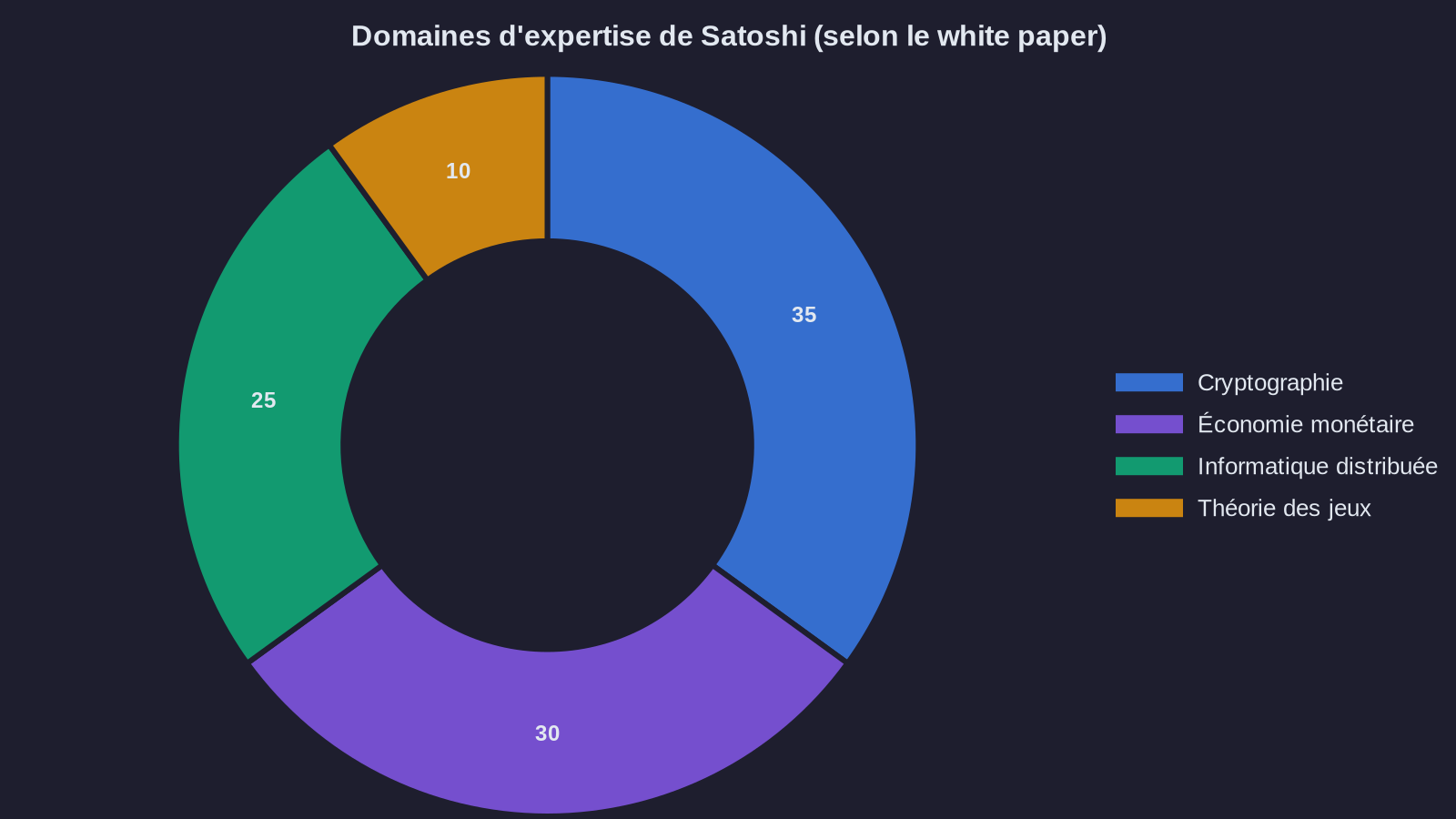
First observation: Satoshi mastered cryptography, monetary economics, and software development perfectly. Bitcoin's white paper demonstrates a rare understanding of several complex technical domains. He cites cutting-edge academic work, uses game theory concepts, and solves problems that researchers had been working on for years.
Second clue: his English. Linguistic analysts who studied his writings note British English usage (he writes "bloody hard" rather than "really hard," uses "favour" rather than "favor"). His forum posting times suggest a time zone compatible with Europe or the East Coast of the United States. Yet, in his P2P Foundation profile, he identifies as Japanese and born in April 1975.
Third troubling detail: Satoshi owns approximately one million bitcoins, mined in the network's early months. These funds have never moved. At Bitcoin's current value, that represents tens of billions of dollars sitting untouched. This behavior is, to say the least, unusual.
Theories about Satoshi's identity: from plausible to far-fetched
Over the years, several candidates have been proposed to be Satoshi Nakamoto. Some leads are serious, others pure speculation.
Hal Finney, an American developer and cryptographer, is one of the most credible candidates. He was the first person to receive a Bitcoin transaction from Satoshi. He lived just a few kilometers from a man actually named... Dorian Satoshi Nakamoto. A troubling coincidence. Hal Finney passed away in 2014 without ever confirming or denying being Satoshi.
Nick Szabo, a legal scholar and computer scientist, had designed a system called "Bit Gold" as early as 1998, a conceptual precursor to Bitcoin. Stylometric analyses of his writings show striking similarities to Satoshi's. But Szabo has consistently and categorically denied being Bitcoin's creator.
Craig Wright, an Australian entrepreneur, has claimed since 2016 to be Satoshi Nakamoto. He produced cryptographic evidence supposedly proving it, but the Bitcoin community largely discredited it. His legal claims led to several high-profile lawsuits, without ever providing definitive proof.
Other names circulate: Adam Back, creator of the Hashcash system used by Bitcoin. Wei Dai, inventor of B-money. Or even collectives like the Cypherpunks cryptographer group, which advocated in the 1990s for decentralized electronic currency.
A less discussed but fascinating hypothesis: what if Satoshi was multiple people? Bitcoin's white paper compiles years of scattered research. It simultaneously solves cryptographic, economic, and computational problems that few people master all at once. A collective would explain this exceptional versatility.
Why Satoshi's anonymity guarantees Bitcoin's decentralization
The absence of an identifiable creator is not accidental. It's probably the most strategic decision Satoshi ever made. And here's why it's fundamental to Bitcoin.
Imagine a monetary system where the creator is known, accessible, alive. What happens when an important decision needs to be made? Everyone turns to him. He becomes the reference point, the ultimate authority. People expect him to decide. They solicit him. They threaten him. They try to corrupt him. They drag him to court.
By disappearing, Satoshi eliminated this central point of control. There is no one that governments can subpoena to "shut down" Bitcoin. No one investors can influence. No one whose ego might shape the protocol's development. Bitcoin became truly decentralized, including in its intellectual governance.
This absence forced the Bitcoin community to develop its own mechanisms for collective decision-making. When a protocol improvement is proposed (via Bitcoin Improvement Proposals, or BIPs), it must convince developers, miners, companies, and users. It's a slow process, sometimes frustrating, but profoundly democratic. No one can impose their vision through the force of "creator" status.
Take the example of the "block size wars" that shook Bitcoin between 2015 and 2017. Two visions clashed over the optimal transaction block size. The debate was intense, technical, sometimes fierce. It resulted in a split (the Bitcoin Cash "fork"). But at no point could anyone say "let's ask Satoshi to decide." The community had to own its responsibilities.
The risks of revealing Satoshi's identity
What would happen if Satoshi's identity were revealed tomorrow? The consequences would likely be destabilizing for Bitcoin.
First scenario: Satoshi moves his bitcoins. The market would panic immediately. One million bitcoins hitting the market would represent considerable selling pressure. Even if he sold only a fraction, the uncertainty created would durably affect confidence. A situation that underscores the importance of understanding Bitcoin's fundamentals beyond simple price movements.
Second risk: Satoshi becomes a target. Governments could subpoena him, ask him to modify the code, create "backdoors." The media would hound him. Interest groups would try to influence him. Bitcoin would lose its character as a neutral and unseizable tool.
Third danger: Satoshi speaks out on Bitcoin's evolution. His opinions would carry tremendous weight. Even if he held no technical power, his word would influence debates. We'd fall back into a form of intellectual centralization, exactly what Bitcoin seeks to avoid.
Recent history of other cryptographic projects illustrates this risk. Ethereum is closely associated with Vitalik Buterin, its highly media-visible creator. Every statement from Vitalik moves markets. Every proposal he supports is more likely to be adopted. This isn't necessarily negative, but it creates a form of psychological dependence on a central figure.
Bitcoin, on the other hand, has no Vitalik. It has no founder giving conferences, granting interviews, defending the project on Twitter. This vacant symbolic power is actually a strength: it forces everyone to forge their own opinions, to study the code, to participate in technical debates without relying on a person's authority. An approach that contrasts with Bitcoin's recent evolution, particularly the growing institutionalization of Bitcoin in traditional financial services.
What if we never find out who Satoshi Nakamoto is?
Fifteen years after his disappearance, Satoshi Nakamoto remains untraceable. Perhaps he's deceased. Perhaps he observes from afar, amused or concerned. Perhaps he deliberately destroyed all evidence of his identity to ensure Bitcoin remains free from any personal control.
This perpetual uncertainty is now part of Bitcoin's identity. It reminds us that this network rests on no leader, no company, no state. Bitcoin exists because thousands of developers maintain its code, because millions of users find it useful, because miners worldwide secure its network.
Satoshi's anonymity raises a profound philosophical question: can a technology exist without its creator? Bitcoin proves it can. Like a message in a bottle, the protocol continues to function, adapt, and evolve, carried by a community that has transcended its founder's guiding figure.
So, who is Satoshi Nakamoto? Perhaps the true answer is: it no longer matters. The work has outlived its author. And that's precisely what makes Bitcoin unique.