
On March 17, 2025, Hyperliquid announced the launch of perpetual contracts on the S&P 500, officially licensed by S&P Dow Jones Indices. A first in the crypto ecosystem. For the first time, the benchmark index of American markets becomes tradable 24 hours a day, 7 days a week, without any banking intermediary or traditional clearing house.
This development raises a strategic question for diversified portfolios: do you still need to go through CME futures that close each evening at 4:15 PM (New York time)? When economic news never stops, continuous access to indices changes the game entirely.
What perpetual contracts are — and why they come from crypto
A perpetual contract (or perpetual swap) is a derivative product with no expiration date. Unlike traditional futures that expire quarterly, you can keep a position open indefinitely. The price stays close to the underlying asset thanks to a funding rate mechanism: every 8 hours, long positions pay short positions (or vice versa) based on the gap between the contract price and the spot price.
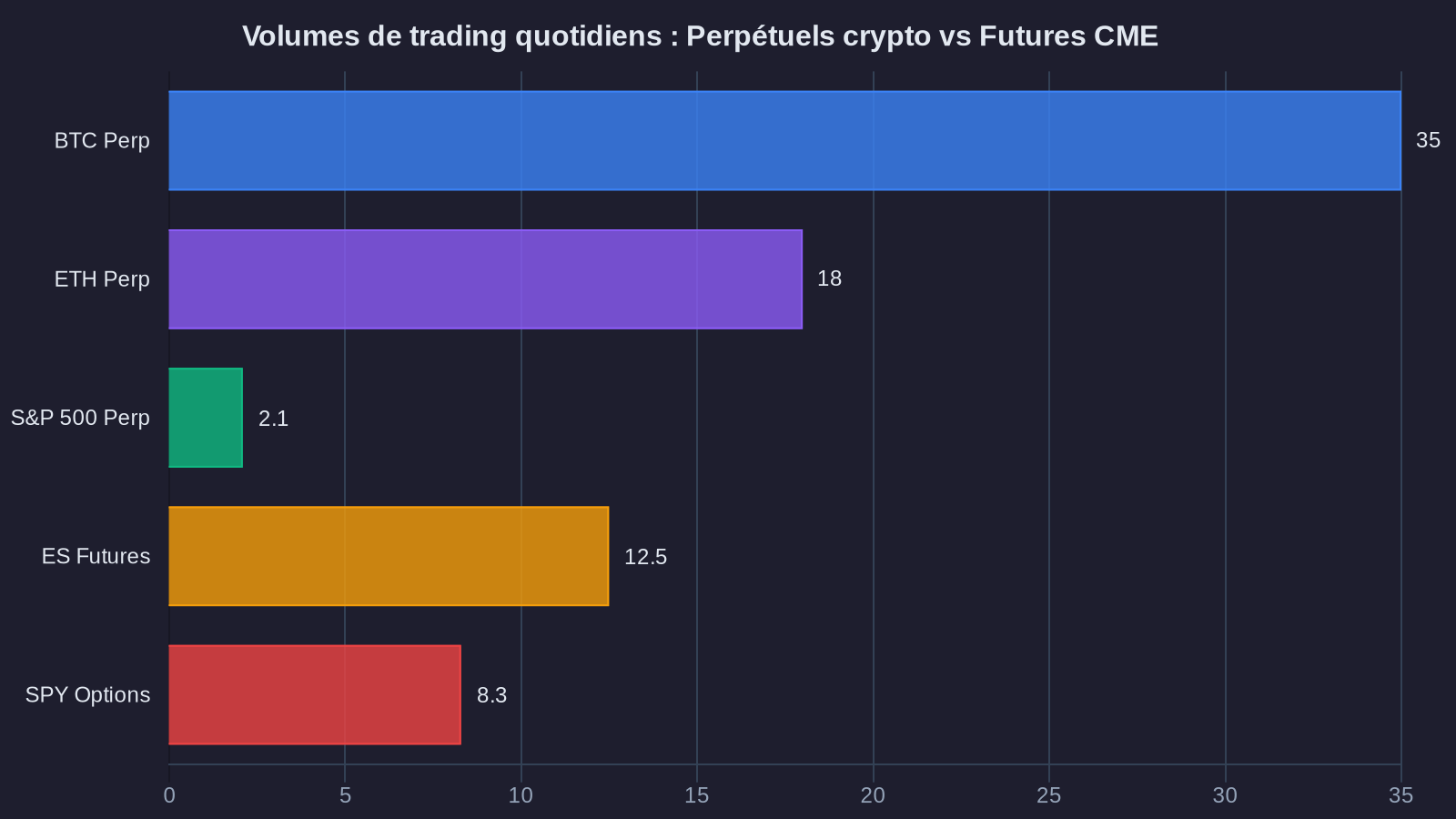
This format was created by BitMEX in 2016 for Bitcoin. Since then, it has become the standard for crypto trading. Daily volumes of BTC/ETH perpetuals regularly exceed $50 billion on major platforms. Hyperliquid, launched in 2023, quickly captured 15% of the on-chain perpetuals market share thanks to its latency below 20 milliseconds and its fully decentralized order book.
Until now, these perpetuals concerned exclusively crypto-assets. The agreement with S&P Dow Jones changes everything: Hyperliquid can now offer perpetual contracts on the S&P 500, the Nasdaq-100, and the Dow Jones Industrial Average. With official licensing, not a synthetic copy.
24/7 trading: real advantage or marketing gimmick?
S&P 500 futures traded on the CME (ES contract) are accessible from 6 PM Sunday to 5 PM Friday (New York time), with a daily break from 4:15 PM to 5 PM. This 45-minute pause may seem insignificant. It isn't.
On August 6, 2024, at 10:30 PM (Paris time), Japan unexpectedly raised its benchmark rates. The Nikkei collapsed 12% at the next opening. European and American investors holding long positions on indices could only react when the CME reopened, with a 3.2% gap on the S&P 500. On Hyperliquid, the 24-hour S&P 500 perpetual contracts would have allowed exiting or hedging positions immediately upon the announcement, without waiting for the official opening.
Market data shows that 18% of significant S&P 500 moves (movements exceeding 1%) occur outside regular trading hours, often triggered by Asian or European macroeconomic announcements. 24/7 perpetuals eliminate this gap risk.
The other tangible advantage: operational simplification. CME futures expire quarterly. You must "roll" your position, meaning closing the expiring contract and opening a new one. This process generates fees and slippage risk. With a perpetual, you keep the same position indefinitely. No rollover, no calendar management.
The risks you need to understand before diving in
The funding rate is the mechanism that keeps the perpetual contract price aligned with the underlying index. If the contract trades above the spot price, long positions pay interest to short positions (and vice versa). This rate is recalculated every 8 hours.
On volatile crypto markets, the funding rate can reach 0.1% per period (or 10.95% annualized). On more stable assets like the S&P 500, early Hyperliquid data shows an average funding rate of 0.005% per period (approximately 0.55% annualized). This remains a cost to factor into your profitability calculation, especially if you hold a position for several months.
The other point to watch concerns liquidity. At launch, daily volumes of S&P 500 perpetuals on Hyperliquid are around $120 million. That's 40 times less than CME ES futures ($4.8 billion per day on average). A liquidity gap that translates into wider bid-ask spreads: 0.08% on Hyperliquid versus 0.01% on the CME at the time of writing.
For positions under $500,000, this gap remains acceptable. Beyond that, slippage can matter. Large institutional accounts will likely continue to favor the CME for their main exposures, and use Hyperliquid for tactical adjustments outside market hours.
Finally, counterparty risk. Hyperliquid operates on a dedicated layer 1 blockchain, with an on-chain order book and a validator system. Unlike the CME, which relies on regulated clearing houses (CME Clearing), Hyperliquid relies on smart contracts. The code has been audited by Zellic and Trail of Bits. The platform has recorded no security incidents since its launch. But technological risk remains higher than traditional infrastructure.
What this changes for a diversification strategy
24/7 access to indices allows rethinking tactical allocation. Many portfolios use S&P 500 exposure as a stability anchor against crypto-asset volatility. Until now, adjusting this exposure in real-time was impossible outside CME hours.
With Hyperliquid's perpetual futures indices, you can now:
- Instantly hedge a crypto position against a nighttime bond crash (like the one on April 2, 2025 after the Fed's surprise announcement)
- Rebalance your allocation without waiting for the American opening
- Arbitrage price gaps between CME futures and on-chain perpetuals
For risk parity strategies, this hourly flexibility reduces the risk of lag between the allocation signal and actual execution. Backtests conducted by several quantitative desks show that eliminating overnight gaps can improve the Sharpe ratio by 0.15 to 0.22 points on multi-asset strategies.
On the tax side, crypto perpetuals remain subject to the 30% flat tax in France (or progressive rates on request). CME futures fall under the derivatives regime. At equivalent returns, tax optimization may favor futures depending on your marginal tax rate. A point to validate with your tax advisor.
What ForYield thinks
We've been closely following this development since the S&P Dow Jones × Hyperliquid partnership announcement. For our clients seeking to diversify a crypto portfolio with US equity exposure, the 24-hour Hyperliquid S&P 500 perpetual contracts offer real operational value.
In our management strategies, we already use perpetuals to occasionally hedge crypto positions against macro shocks. The arrival of the S&P 500 allows us to extend this logic: maintain stable strategic allocation while keeping the flexibility to react at any time.
Our recommendations for those wanting to test this format:
- Start with limited exposure (5 to 10% of your total portfolio) to familiarize yourself with the funding rate mechanism
- Compare actual costs (funding + spread) with those of an S&P 500 ETF or CME future before shifting significant allocation
- Keep part of your exposure in traditional regulated products to diversify platform risk
The goal is not to entirely replace traditional futures, but to have a complementary tool that addresses a specific need: managing equity exposure 24 hours a day, with the same infrastructure as your crypto positions.
Market data is clear: volumes are increasing weekly on these index perpetuals. Institutions are starting to test the product. If liquidity continues to grow, we will progressively integrate these instruments into our tactical allocations.
This week's action: Open a Hyperliquid account (KYC required), deposit $1,000 USDC, and test a micro position on the S&P 500 perpetual (0.01 contract). Observe the funding rate for a week. Compare the real cost with that of a CME future or ETF. You'll have the factual data to decide whether this format fits your strategy.