On March 17, 2025, the New York Stock Exchange and Securitize announced the launch of a securities tokenization platform available 24 hours a day, 7 days a week. This is not a simple experiment: it's an operational, regulated market infrastructure open to U.S. institutional investors.
What this means in practice: shares of listed companies, bonds, and other traditional financial instruments become continuously accessible via blockchain. No more 4 p.m. closing. No more frozen weekends. The market operates when you need it.
This evolution is not a technological gimmick. It marks a fundamental shift in how financial markets have been structured for decades, comparable to the transformations seen in institutional Wall Street's adoption of crypto. Here's what you need to understand about this change and what it means for professional asset management.
How tokenization is changing market operations
Tokenized trading involves representing a traditional financial asset as a digital token on a blockchain. This token carries the same rights as the underlying asset: dividends, voting rights, claims. But it operates in a different technical environment with new operational rules.
On the NYSE-Securitize platform, each tokenized security corresponds to a real asset held by a regulated custodian. Transactions are recorded on a private, permissioned blockchain that meets SEC requirements. No pseudonymity, no legal gray areas: every participant is identified, every transaction is traced.
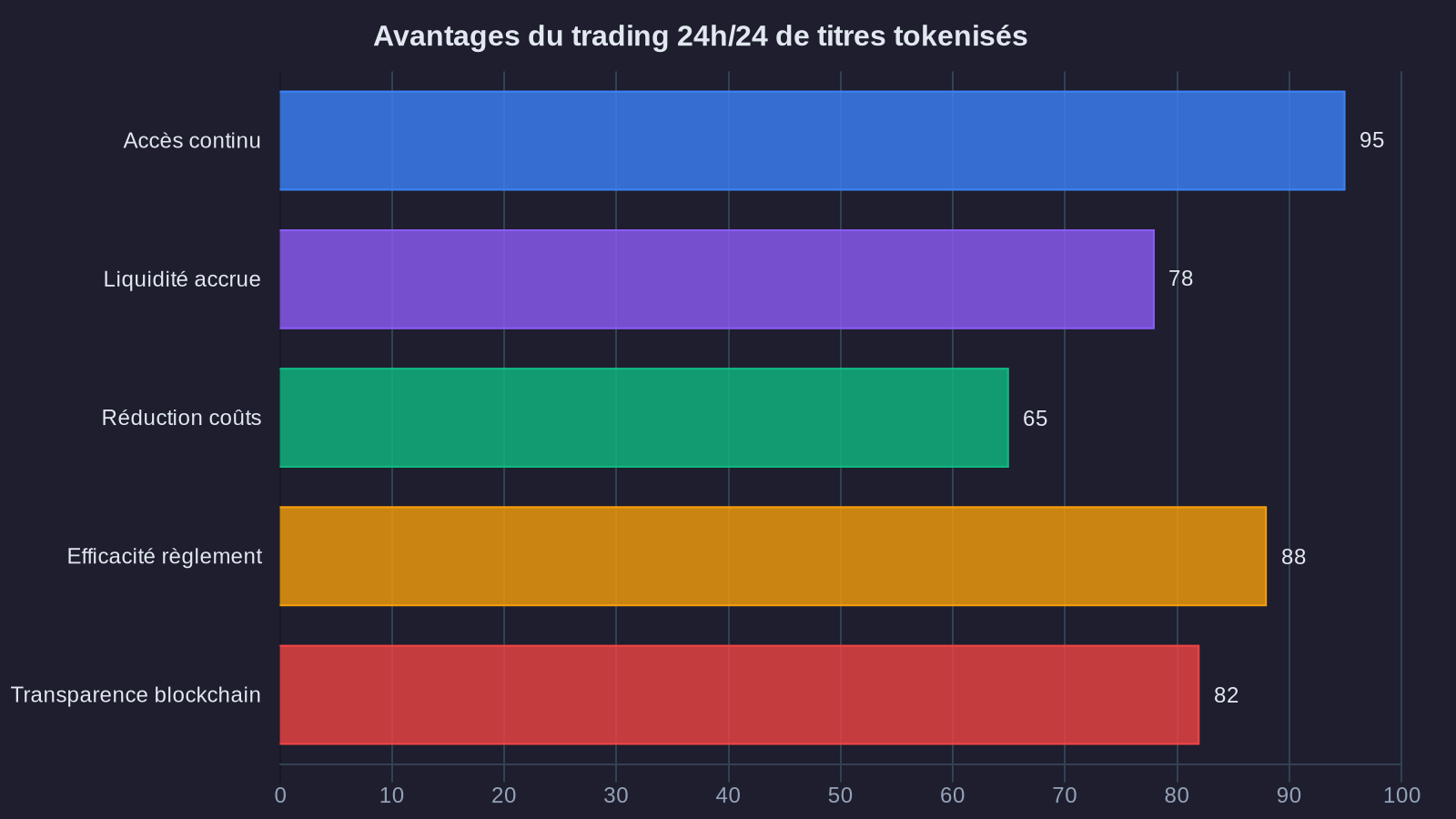
The main change? Settlement and delivery. On traditional markets, when you buy a stock at 10 a.m., the actual transfer of ownership happens two business days later (T+2). With tokenization, settlement is nearly instantaneous. You buy at 10 a.m., you own it at 10:01 a.m. This compression of settlement time reduces counterparty risk and frees up capital that would otherwise be immobilized as collateral.
Another transformation: divisibility. A tokenized security can be split into smaller units than on classical markets. A stock worth $5,000 can be divided into fractions of $10 or less. This opens access to assets previously reserved for large-scale portfolios, without resorting to derivatives or mutual funds.
24/7 trading: operational advantage or added constraint?
The argument put forward by NYSE and Securitize is straightforward: institutional investors now manage multi-jurisdictional portfolios with positions across Asian, European, and American markets. When Tokyo opens, New York sleeps. When major news breaks in Hong Kong at 3 a.m. Paris time, it's impossible to react on U.S. positions before 3:30 p.m.
With a 24/7 trading platform, this friction disappears. Material news about an issuer can be addressed immediately, regardless of the hour. The risk of gap-opening volatility — that sharp fluctuation at the first trade of the day — diminishes because the market adjusts prices in real time, even at night.
But this model also raises operational questions. Should asset management teams monitor positions 24/7? How do you manage alerts and stop orders outside regular business hours? Will liquidity be sufficient at 3 a.m. to execute a significant order without excessive slippage?
Early feedback from institutional players testing the platform shows a pragmatic approach. They use overnight trading for tactical, low-volume adjustments, not for major repositioning. Liquidity remains concentrated during the overlap hours between major zones (1:30 p.m.–4 p.m. GMT, when Europe and the United States are both open). Outside these windows, bid-ask spreads widen. Technical availability doesn't guarantee market depth.
Implications for asset management: what becomes possible
Beyond hourly availability, tokenization opens new structural possibilities for portfolio construction.
First evolution: asset composability. On a blockchain, blockchain securities can be integrated into smart contracts that automate certain operations. A concrete example: you set a rule for automatic portfolio rebalancing when an asset's weight exceeds 15%. The smart contract executes the adjustments without manual intervention, in real time. This reduces delays, intermediation fees, and the risk of human error.
Second transformation: programmable liquidity. Tokenized securities can be used as collateral in decentralized lending or liquidity protocols. You hold tokenized Microsoft shares? You can pledge them as collateral to borrow stablecoins without selling your positions and without going through a bank. The loan settles in minutes, with rates determined by real-time supply and demand.
Third benefit: flow transparency. Every blockchain transaction leaves a timestamped, immutable, auditable trace. For managers subject to strict reporting obligations (as under MiFID II in Europe or SEC regulations in the United States), this significantly simplifies audits and evidence production. No more reconciling dozens of data sources: everything is recorded in a single registry.
These features aren't theoretical. Several U.S. institutional funds are already testing automated carry strategies on tokenized securities, with measurable results: transaction cost reductions of 30 to 40% compared to traditional channels, settlement times cut by a factor of 10.
Current limitations and areas of caution
Despite widespread enthusiasm, several structural constraints still slow broad adoption of digital assets trading.
Infrastructure fragmentation. The NYSE-Securitize platform runs on a private blockchain with its own technical standards. Other players (like tZERO, Backed Finance, or European initiatives led by Euroclear) are developing their own solutions, often incompatible with one another. Result: an investor wanting to diversify tokenized positions must navigate multiple platforms, multiple wallets, multiple interfaces. This fragmentation hampers operational efficiency.
The tax question. How are gains realized on tokenized securities taxed? In the United States, the answer still depends on each local jurisdiction's interpretation. The IRS hasn't yet issued clear guidance on the tax treatment of gains realized via smart contracts. In Europe, it's even more fragmented: each country applies its own rules, as detailed in our analysis of tax compliance for digital assets. This uncertainty slows large-scale deployment.
Regulation still being built. The SEC strictly oversees the NYSE-Securitize platform, but the broader regulatory framework for tokenized securities is still under construction. The European MiCA directive (Markets in Crypto-Assets), which came into force in early 2025, doesn't yet cover all use cases. Rules on custody, asset segregation, and investor protection are evolving month by month. For a professional manager, this requires constant regulatory monitoring.
Residual liquidity. As mentioned earlier, 24/7 technical availability doesn't guarantee constant liquidity. On certain overnight sessions, traded volumes represent only 2 to 5% of daytime volumes. If you need to exit a significant position at 4 a.m., you risk substantial slippage. This liquidity asymmetry requires careful order management and anticipation of cash needs.
ForYield's perspective
At ForYield, we closely follow the evolution of tokenized market infrastructures. Not out of technological fascination, but because these tools concretely change the conditions for executing and managing crypto and multi-asset portfolios.
Our approach remains pragmatic. We integrate tokenized securities into our strategies only when three conditions are met: sufficient liquidity during relevant hours, clear regulatory compliance, and total holding costs equal to or lower than traditional channels. At this stage, only a few asset classes—notably certain U.S. corporate bonds and a few large-cap stocks—meet these criteria.
We use tokenization for two main use cases. First, collateral optimization: certain tokenized securities allow us to generate yield on collateral positions via decentralized lending protocols while maintaining exposure to the underlying asset. Second, tactical reactivity: being able to adjust certain positions during Asian and European market overlaps without waiting for New York's opening reduces gap risk and improves our entry points.
But we remain vigilant. Platform fragmentation, tax uncertainty, and liquidity gaps outside peak hours impose rigorous operational risk management. Tokenization isn't a miracle revolution: it's an additional tool, with its advantages and constraints, that we integrate into a broader multi-asset management strategy.
If you're an institutional investor or family office considering integrating tokenized securities into your allocation, the key is the same as with any other instrument: understand the underlying mechanics, measure the true costs (not just stated fees, but also slippage and capital immobilization), and test at small scale before deploying significant positions. Blockchain technology offers real efficiency gains, but only if used with method and operational rigor.
```