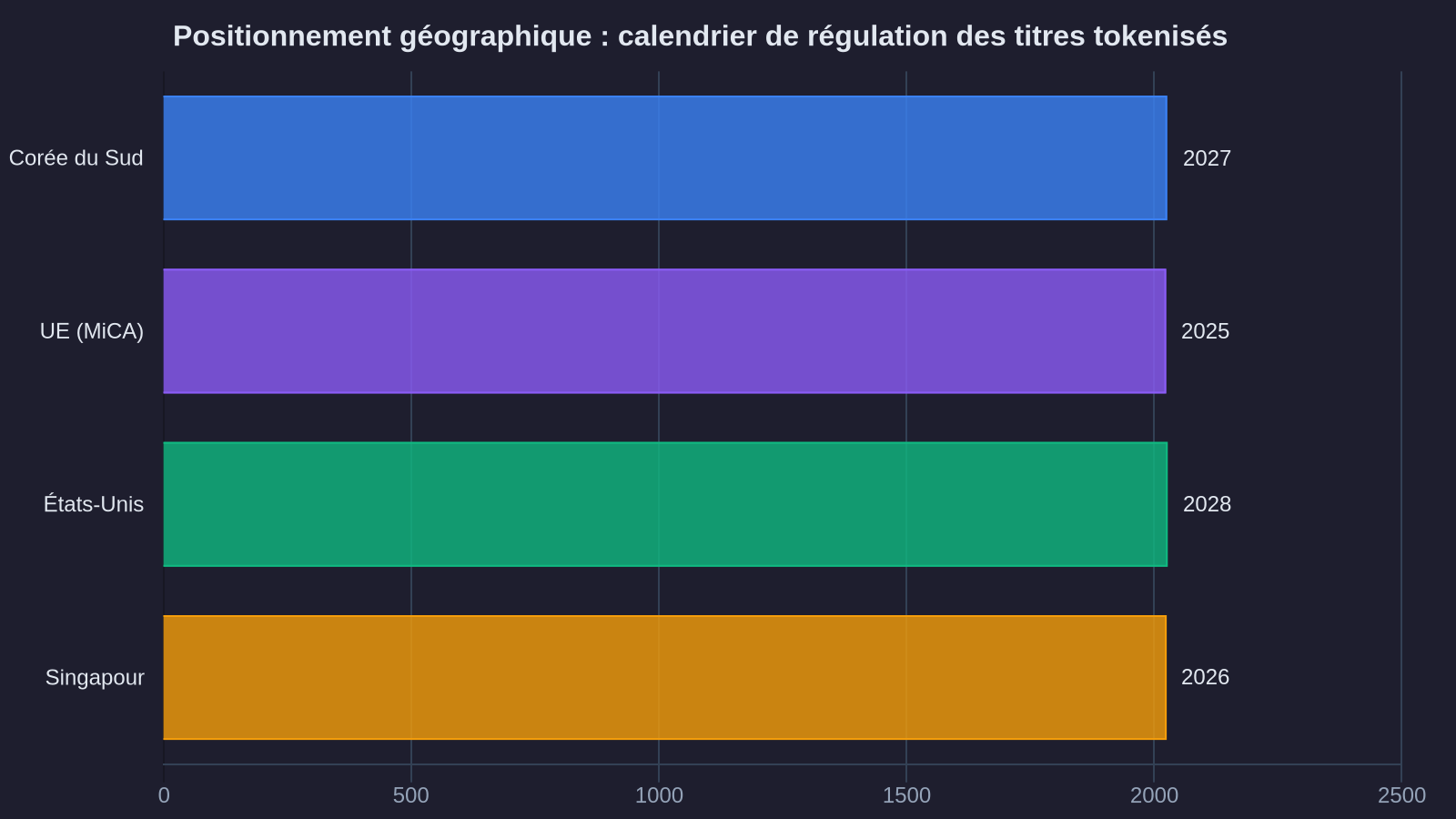
While Europe refines its MiCA regulation and the United States continues to debate crypto-asset classification, South Korea is making its move. The Korean government has just announced the full deployment of a national tokenized securities market by February 2027. A precise timeline, rapidly emerging legislative framework, and clear ambition: to become the first country to fully integrate tokenized securities into its traditional financial infrastructure.
For CFOs and institutional investors, this announcement warrants attention. Not because it offers immediate investment opportunities in the Korean market — cross-border regulatory constraints remain significant — but because it sets a legislative and operational precedent that other jurisdictions will inevitably draw from.
An accelerated legislative framework shaking up Western timelines
The Korean strategy rests on a pragmatic approach: integrating tokenized securities into the existing Capital Markets Act framework rather than creating parallel legislation. This decision significantly streamlines the process. Tokenized securities are treated as traditional securities, subject to the same compliance obligations, reporting requirements, and investor protections.
Concretely, this means a tokenized bond issued by a Korean company will be subject to the same rules as a conventional bond: prospectus approved by the Financial Services Commission, possible rating by recognized agencies, eligibility for institutional portfolios under the same prudential criteria. The only difference lies in the technical infrastructure — the blockchain — and settlement-delivery procedures.
This approach contrasts with Europe, where MiCA treats crypto-assets as a separate class, with its own marketing rules and emitter statuses. It contrasts even more sharply with the United States, where the Securities and Exchange Commission and the Commodity Futures Trading Commission still compete over jurisdiction for certain digital assets.
The Korean timeline also accelerates the pace. February 2027 is around the corner for a complete regulatory rollout. This requires technical infrastructure — authorized trading platforms, approved custodians, on-chain settlement systems — to be operational within less than two years. A tight schedule that demonstrates clear political will.
Concrete implications for issuers and investors
For a Korean company raising capital, tokenization offers several operational advantages. First, reduced intermediary costs. Settlement-delivery processes move from T+2 to near-instantaneous, reducing counterparty risk and collateral requirements. Second, ticket granularity. A tokenized bond can be fractioned into much smaller denominations than a conventional bond, potentially widening the investor base.
Take a concrete example. A Korean mid-sized manufacturing company wants to raise $10 million through a bond offering. With a traditional structure, the minimum ticket typically sits between $50,000 and $100,000, limiting access to a few dozen institutional or wealthy investors. With a tokenized version, the same instrument can be split into $1,000 units or less, opening access to hundreds of qualified retail investors or family offices who wouldn't otherwise participate.
This democratization of access remains regulated. The Korean framework maintains distinctions between qualified and non-qualified investors, with differentiated investment thresholds based on risk profile. But tokenization technically facilitates this segmentation, where paper bonds imposed logistical constraints that made small-holder issuance economically unviable.
For foreign investors, the equation is more complex. The Korean tokenized securities market will initially be a domestic market. Cross-border marketing rules for tokenized securities remain unclear in most jurisdictions. A CFO of a French company cannot simply purchase Korean tokenized bonds on a foreign platform without verifying compliance with French and European law. Regulatory passports between jurisdictions don't yet exist for these instruments.
Korean competitive advantage amid Western hesitation
The speed of Korean deployment creates a ripple effect. Seoul already attracts tech players developing market infrastructure for tokenized securities. Several international trading platforms have announced opening offices in South Korea to support this rollout. Traditional Korean custodian banks are investing heavily in digital asset custody capabilities to obtain necessary approvals.
This emerging ecosystem gives South Korea a head start in operational expertise. When Europe and the United States launch their own tokenized securities markets — likely not before 2028 or 2029 — Korean players will already have capitalized several years of experience managing settlement processes, custody standards, and corporate action procedures (dividends, voting, takeovers) on tokenized instruments.
This advantage is far from trivial. Tokenized securities raise complex operational questions that current legislative frameworks don't fully resolve. How do you manage shareholder voting when securities change hands continuously and near-instantaneously? How do you ensure the blockchain ledger remains the single source of truth in litigation, when legal systems don't yet formally recognize cryptographic proof? How do you manage an issuer's bankruptcy when securities are dispersed across a public or private blockchain?
South Korea will have to solve these questions in real conditions. The solutions it finds — good or bad — will serve as reference points for other jurisdictions. This is exactly what happened with Singapore on stablecoins or with Switzerland on tokenized funds: early large-scale deploying jurisdictions shape de facto market standards.
What CFOs should monitor
For a French or European company, the Korean tokenized securities market remains an observation case for now, not immediate action. But several signals merit attention.
First signal: how South Korea manages coexistence between tokenized and conventional securities. If the framework allows smooth migration between formats, if tokenized bonds integrate seamlessly into traditional institutional portfolios, this validates the progressive integration model many European financial actors envision. If instead the tokenized market remains a parallel segment with its own liquidity and players, it strengthens skeptics' arguments who view tokenization as niche innovation.
Second signal: actual volumes. A complete regulatory infrastructure doesn't guarantee adoption. Switzerland's tokenized securities market has existed since 2021 with a solid legislative framework, but volumes remain modest. If South Korea generates significant volumes — say several billion dollars in issuances per quarter — this would demonstrate that a good regulatory framework plus adapted technical infrastructure actually creates a liquid market. If volumes remain anecdotal, it would indicate other barriers persist, likely from institutional investors who don't yet see operational value justifying compliance costs.
Third signal: tax and prudential arbitrage. How do Korean authorities treat tokenized securities for corporate and individual taxation? How do Korean banking regulators weight these assets in banks' prudential ratios? These decisions will directly impact market attractiveness. Favorable tax treatment can substantially offset technical constraints. Conversely, punitive prudential treatment can kill market development in its cradle, even with flawless infrastructure.
For CFOs managing corporate treasury, the Korean market won't be directly accessible in the short term. But it will provide valuable indicators about the economic viability of tokenized securities as an asset class. If mid-sized Korean companies successfully raise funds at competitive terms through tokenized issuances, if Korean institutional investors integrate these instruments into standard allocations, this will strengthen the case for preparing finance teams now for future tokenized issuances in the European market.
A legislative precedent to watch closely
South Korea plants an important milestone in the still-short history of tokenized securities. By setting a precise timeline and integrating these instruments into existing regulatory frameworks rather than creating parallel legislation, it offers a pragmatic adoption model that could inspire other jurisdictions.
For European companies, the challenge isn't investing in the Korean market — cross-border regulatory barriers remain high — but understanding how a digital asset securities market operates under real conditions, with actual issuers, actual investors, and actual operational constraints. The lessons drawn from this rollout will fuel regulatory debates in Europe and the United States over the next two to three years.
The remaining open question: will South Korea stick to its timeline? February 2027 is ambitious. But simply announcing a firm deadline forces Korea's entire financial ecosystem to organize itself. And in a sector where announcements have succeeded each other without delivery for years, a clear calendar commitment changes everything.