
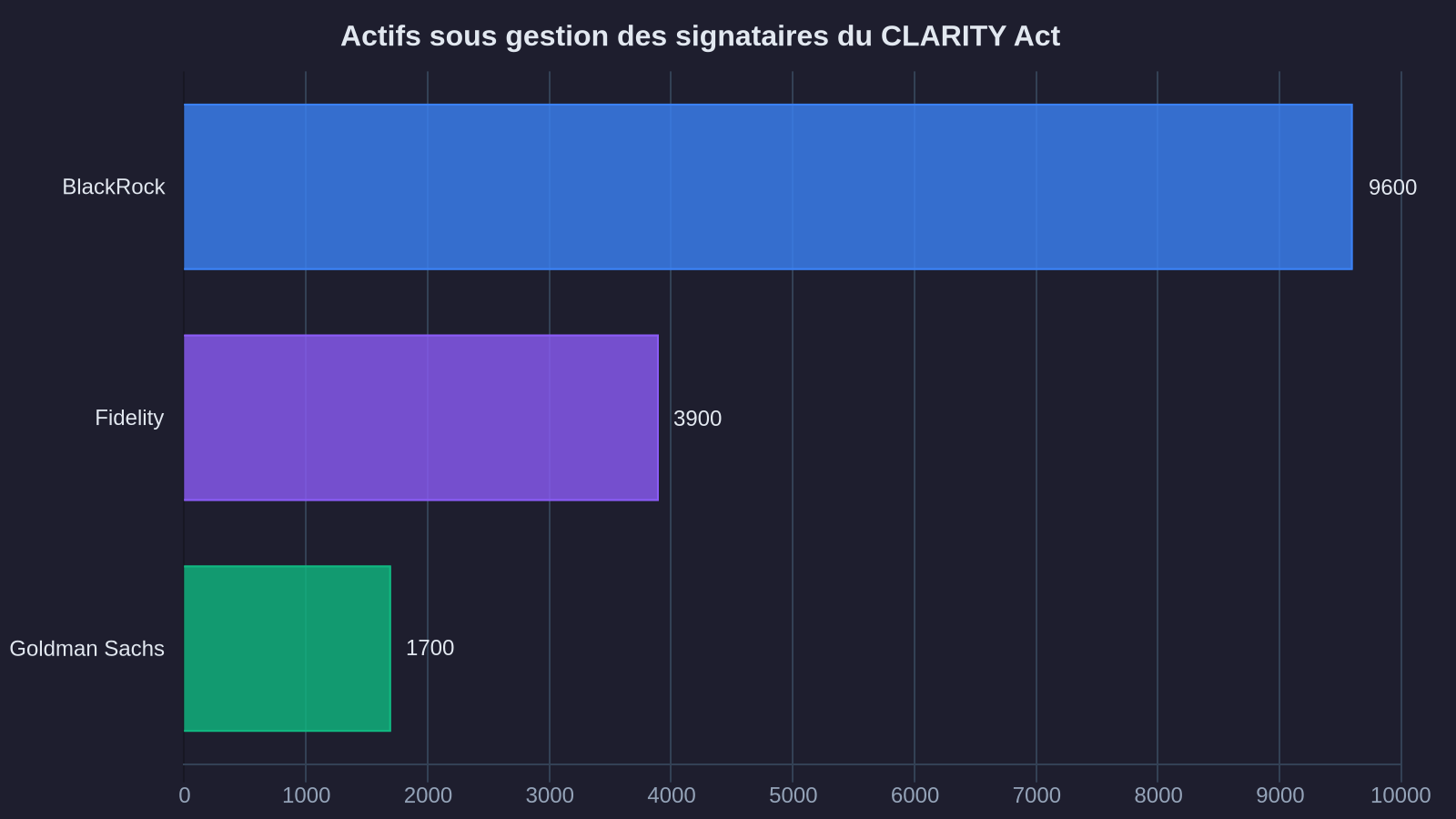
On January 29, 2025, an open letter signed by BlackRock, Fidelity Investments, and Goldman Sachs was addressed to the U.S. Congress. The subject: providing strong support for the CLARITY Act, a bill aimed at regulating crypto-assets in the United States. Three giants collectively managing over $15 trillion in assets don't sign such letters by accident. The CLARITY Act represents a decisive step in U.S. crypto legislation, with major implications for institutional adoption.
This initiative comes at a time when Europe has already rolled out its regulatory framework MiCA since June 2023, while the United States lags strategically by several years. But beyond catching up, an entirely new regulatory philosophy is taking shape. And it diverges fundamentally from the European approach.
For you, as an investor or economic player exposed to crypto-assets, this divergence is far from trivial. It determines the rules of the game, protection levels, and operational constraints depending on your jurisdiction of exposure. A breakdown of a regulatory showdown that's redefining global governance of digital assets.
The CLARITY Act: a tailored regulation for the financial industry
The CLARITY Act (Clarifying Law Around Insurance of Technological Assets, Yield and Reserve Investments) lives up to its name, but perhaps not in the way you'd imagine. It does clarify the American regulatory framework, but by adopting an approach that structurally favors institutional players.
Concretely, the bill establishes a fundamental distinction between securities tokens (digital financial securities, under SEC jurisdiction) and commodities tokens (treated as commodities, under CFTC jurisdiction). Bitcoin and Ethereum are explicitly classified as commodities. This classification isn't neutral: it exempts them from substantial portions of traditional financial regulation.
The letter from BlackRock, Fidelity, and Goldman Sachs emphasizes one specific point: the importance of this distinction to enable the development of institutional investment products. Translation: Bitcoin and Ethereum ETFs without the regulatory constraints applicable to traditional securities. A considerable competitive advantage for institutional adoption.
The bill also provides a safe harbor mechanism for projects in decentralization phases. Over a defined period, a project can benefit from a regulatory exemption if it demonstrates credible progress toward decentralization. This tool, requested for years by the crypto industry, has faced sharp criticism from regulators like former SEC chair Gary Gensler, who saw it as an open door to regulatory evasion.
MiCA: a radically different European approach to U.S. crypto legislation
While the United States negotiates its framework with market participants, Europe has already decided. The MiCA regulation (Markets in Crypto-Assets), applicable since June 30, 2023 for certain provisions and fully deployed since December 2024, imposes a comprehensive and binding framework.
Unlike the CLARITY Act, MiCA doesn't distinguish between securities and commodities through binary classification logic. The European regulation categorizes crypto-assets based on their functional characteristics: electronic money tokens (EMT), asset-referenced tokens (ART), utility tokens, etc. Each category triggers a specific regulatory regime with requirements for capital, governance, and transparency.
Article 59 of the MiCA regulation requires crypto-asset service providers (CASP) to maintain a minimum initial capital of €150,000, potentially reaching several millions depending on the activity. By comparison, the CLARITY Act doesn't provide a uniform minimum threshold for platforms operating on commodities tokens. Barriers to entry are structurally higher in Europe.
MiCA also imposes strict obligations regarding client asset segregation (Article 76), complaint procedures, and guarantee funds for certain categories of actors. These investor-protective mechanisms translate into substantial MiCA compliance costs for operators. The American approach, conversely, favors sector self-regulation and oversight by existing federal agencies (SEC, CFTC), without creating a new dedicated regulatory regime.
Concrete implications for international investors
This regulatory divergence isn't just a legal debate. It has direct consequences for your exposure to crypto-assets, depending on whether you invest through American or European vehicles.
Investor protection: A French investor using a platform licensed under MiCA benefits from standardized protections. If the platform goes bankrupt, their assets are theoretically segregated and protected (Article 76 MiCA). An American investor on a CFTC-regulated platform operating on Bitcoin (a commodity) doesn't necessarily have equivalent protections, unless the platform has voluntarily adopted stricter standards.
Concretely, this means that in a bankruptcy scenario like FTX (November 2022, $8 billion in client assets lost), the MiCA framework would theoretically have enabled faster and more complete asset recovery. The conditional tense applies here: the actual robustness of these mechanisms hasn't yet been tested at scale.
Taxation and reporting: European harmonization under MiCA is gradually facilitating cross-border tax compliance. MiCA-licensed platforms must transmit transaction information on their users to the tax authorities of member states (DAC8 directive being deployed). In the United States, the regulatory patchwork and absence of a unified federal framework create increased complexity for multi-jurisdictional investors.
Access to institutional products: Paradoxically, the CLARITY Act's more flexible approach favors the development of sophisticated products accessible to qualified investors. Spot Bitcoin ETFs approved in January 2024 are drawing tens of billions of dollars. Europe, despite MiCA, maintains stricter restrictions on these vehicles (PRIIPS regulation), limiting retail investor access to certain crypto derivative products.
The vigilance point
Facing this regulatory fragmentation, three actions are essential to secure your crypto exposure:
1. Verify your platform's licensing jurisdiction. A platform licensed under MiCA in Europe or regulated by the CFTC in the United States doesn't offer the same level of protection. Consult the ACPR registry in France (for PSAN) or the ESMA registry at the European level (for licensed CASP). In the United States, verify registration with the CFTC or SEC depending on the nature of assets.
2. Anticipate tax reporting obligations. If you hold crypto-assets across multiple jurisdictions (U.S. account, European platform), you're potentially subject to multiple reporting obligations. Article 1649 bis C of the French General Tax Code requires annual disclosure of your crypto accounts to the French tax administration, under penalty of €750 per undisclosed account. Systematically consult a crypto tax specialist to map your obligations based on your jurisdictions of exposure.
3. Diversify your custodial arrangements. Don't concentrate all your crypto holdings on a single platform, regardless of its apparent strength. The collapse of FTX, the world's second-largest platform at the time, demonstrated that appearance of respectability guarantees nothing. Favor a distribution between licensed platforms (for liquidity) and self-custody solutions like hardware wallets (for long-term security), based on your risk profile and operational needs.
Two models, an inevitable convergence?
The opposition between the pragmatic American model, driven by the financial industry, and the protective but restrictive European model illustrates two philosophies of economic governance. The United States prioritizes innovation and competitiveness, accepting a higher level of systemic risk. Europe favors investor protection and financial stability, at the cost of lower attractiveness for certain players.
Historically, major regulatory ruptures eventually converge under pressure from transnational players and international coordination bodies (FATF, FSB, BIS). The current fragmentation is probably temporary. But in the meantime, it creates regulatory arbitrages, zones of legal uncertainty, and differentiated risks depending on your jurisdiction of exposure.
BlackRock, Fidelity, and Goldman Sachs's support for the CLARITY Act is significant. It signals that traditional financial industry has decided: it wants a crypto framework in the United States, but one that preserves its competitiveness against native crypto pure players and against Europe. This regulatory influence battle is being fought now, and its outcomes will determine the rules of the game for the decade to come.
For you, vigilance is imperative. Understanding the regulatory framework applicable to your crypto positions is no longer optional. It's an essential component of risk management, as much as fundamental analysis or portfolio diversification. Regulation doesn't automatically protect. It defines obligations, remedies, and responsibilities. Make sure you operate in a controlled legal environment.