On March 14, 2024, the Securities and Exchange Commission (SEC) approved a pilot program allowing Nasdaq to test the trading of tokenized equities. This decision, which received relatively little public attention, represents one of the most significant developments in the U.S. stock market in decades. The impact of this SEC approval on Nasdaq tokenized equities extends far beyond a simple technical experiment.
We're not talking about yet another cryptocurrency announcement here. These are shares of publicly listed companies — Apple, Microsoft, Tesla — represented as tokens on blockchain and tradable with the same legal value as their traditional counterparts. The difference? Instant settlement, complete transaction transparency, and infrastructure that operates 24/7.
To grasp the magnitude of this change, you need to understand what makes this approval so exceptional: this isn't a marginal experiment run by a crypto startup, but the green light given to the world's second-largest stock exchange operator to rebuild part of its infrastructure on blockchain. This evolution is part of a broader movement where major U.S. stock exchanges are exploring the tokenization of their assets.
Why the SEC changed its position on securities tokenization
The SEC isn't known for taking risks. The institution that spent the last three years aggressively pursuing crypto players is now approving their underlying technology to modernize Wall Street. This shift is driven by three converging factors.
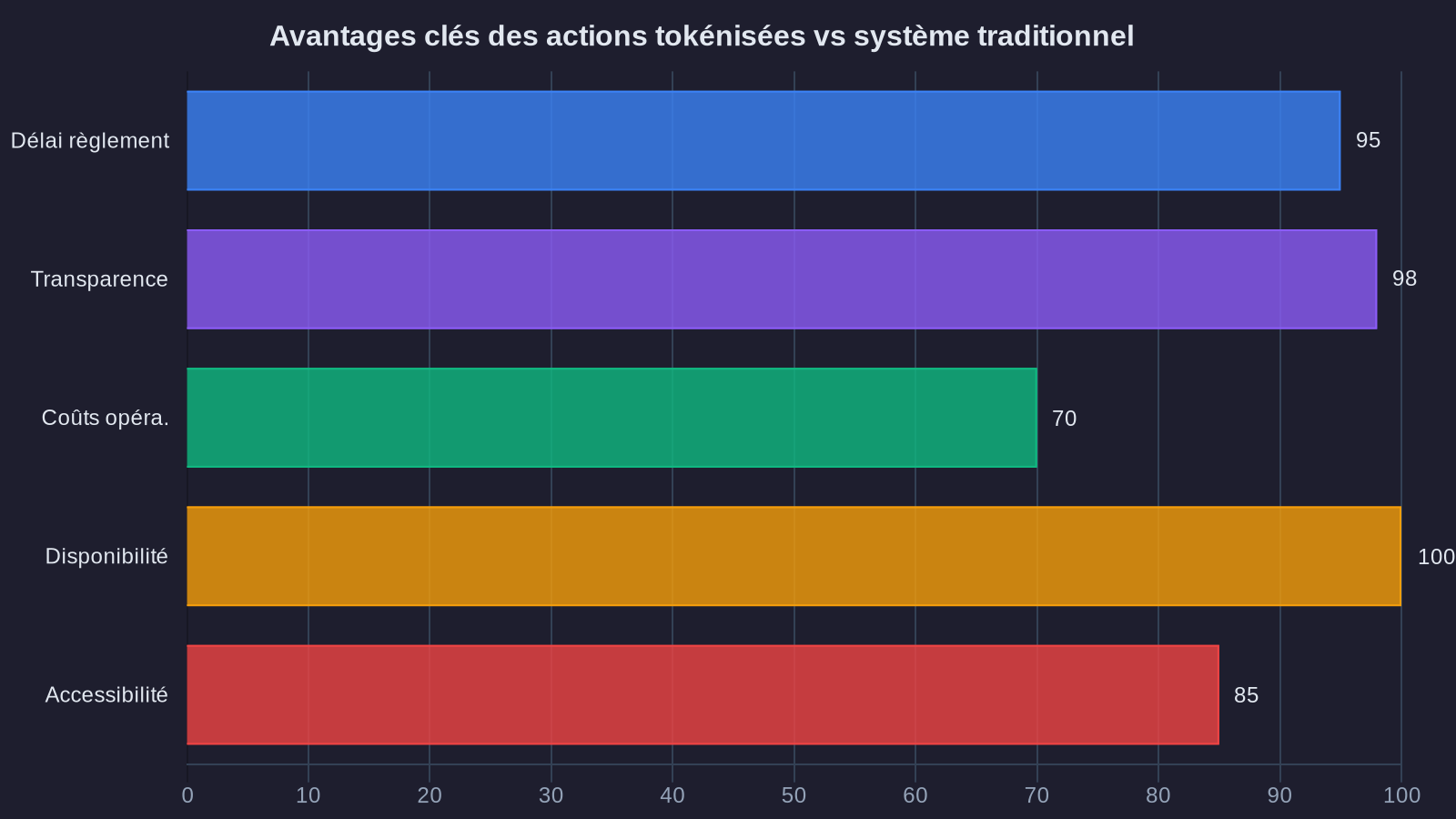
First, technological pressure. The current settlement system (T+1 as of 2024, previously T+2) remains archaic compared to blockchain's capabilities. While a stock still takes 24 hours to officially change hands, stablecoins settle billions of dollars in seconds. This inefficiency costs the market approximately $5.4 billion annually in collateral costs and counterparty risks, according to a DTCC study.
Second, international competition. Singapore launched its Guardian project in 2022, already enabling instant settlement of tokenized bonds. Switzerland incorporated the ability to maintain property registers on blockchain into its law as early as 2021. The European Union is finalizing its regulatory framework for digital securities. The United States risked seeing its market infrastructures lose their competitive edge.
Finally, technological maturity. Institutional-grade blockchains — we're talking about private or semi-private networks, not public Ethereum — have proven their ability to handle significant volumes with security guarantees acceptable to regulators. The approved pilot will likely use a permissioned blockchain where each participant is identified and the SEC retains supervisory capabilities.
What blockchain equity trading concretely changes for the stock market
Tokenizing equities isn't simply a digital version of a paper certificate. It's a complete overhaul of financial plumbing with major operational implications.
Instant settlement (T+0) finally becomes possible. Today, when you buy a stock, your broker immediately credits you in your interface, but the legal transfer of ownership doesn't occur until one business day later. This latency creates counterparty risks, imposes regulatory capital requirements, and locks up liquidity. With tokenized equities, settlement is atomic: either the transaction executes completely and instantly, or it fails. No more uncertainty period.
The transparency of the ownership chain improves dramatically. Each tokenized equity exists on a distributed ledger where the complete transaction history is traceable. This transparency greatly facilitates audits, detection of market manipulation, and anti-money laundering efforts. It also resolves thorny issues like "naked short selling" (short selling without actually borrowing the securities), since each token represents a verifiable asset on the blockchain.
Operational costs decrease significantly. The current system involves clearing houses, depositaries, transfer agents, each taking their commission. A tokenized infrastructure automates much of these functions through smart contracts. Preliminary estimates suggest potential savings of 40 to 60% in post-transaction costs.
Composability opens new use cases, notably blockchain fractional ownership. An equity token can be programmed to automatically distribute dividends, to be used as collateral in a decentralized loan, or to integrate into complex structured products without requiring multiple intermediaries. This technical flexibility enables product innovations impossible with current infrastructure.
The acceleration of institutional adoption of digital assets
The Nasdaq's approval has a legitimizing effect that extends far beyond the pilot itself. For years, traditional institutions have observed the crypto space with a mix of curiosity and suspicion. They saw blockchain technology as potentially transformative, but associated with too many regulatory and reputational risks.
This SEC decision fundamentally changes the calculus. When the world's most powerful regulator authorizes the world's second-largest stock exchange operator to use tokenization for assets as central as listed equities, it sends an unambiguous signal: blockchain technology is no longer a regulatory gray area, but a legitimate tool for financial markets.
Major banks, which had cautiously tested blockchain in internal projects for years, are now accelerating their investments. Goldman Sachs announced in February 2024 the deployment of its GS DAP platform for real asset tokenization, with a target of $2 billion in assets under management by end of 2025. JPMorgan is developing Onyx Digital Assets, which has already processed over $1 trillion in intraday tokenized repo transactions.
Traditional asset managers are following suit. BlackRock launched its tokenized money market fund BUIDL in March 2024, reaching $500 million in assets in less than two months. Fidelity already offers custody services for Bitcoin and Ethereum to its institutional clients. Franklin Templeton has managed an entirely on-chain bond fund since 2021, an approach similar to what Amundi is now adopting with its tokenization of €100 million on Ethereum.
This convergence creates a virtuous circle. The more established players adopt blockchain technology for traditional assets, the better the infrastructure becomes, the more regulators become familiar with the issues, and the easier it becomes for other institutions to take the leap. We're witnessing the emergence of a hybrid ecosystem where traditional finance and digital assets are no longer separate but interconnected.
The challenges that remain to overcome for SEC-approved pilots
The Nasdaq pilot's approval represents a major advance, but the path toward widespread adoption of tokenized equities remains fraught with technical, regulatory, and operational obstacles.
The question of interoperability remains central. If each stock exchange develops its own proprietary blockchain with specific standards, we risk creating new silos as problematic as current systems. Will an Apple equity token issued on the Nasdaq blockchain be transferable and recognized on the NYSE's? Regulators will need to quickly establish interoperability standards to avoid counterproductive market fragmentation.
The legal framework remains incomplete. What happens if there's a bug in a smart contract managing dividend distribution? Who's liable if a blockchain vulnerability allows equity tokens to be stolen? How do we handle situations where a court order requires the freezing or seizure of tokenized assets? These questions, which have no direct equivalent in the current system, require legislative and legal clarifications.
Technical scalability represents a major challenge. Nasdaq currently processes approximately 250 million orders per day during peak activity. The best-performing permissioned blockchains reach a few tens of thousands of transactions per second, which falls short of requirements to fully replace current infrastructure. Second-layer solutions or hybrid architectures will likely be necessary.
Governance raises unprecedented questions. In a decentralized system, who decides on protocol updates? How can we ensure that changes needed to comply with new regulatory obligations can be implemented quickly? The governance model must strike a delicate balance between decentralization (to benefit from blockchain's resilience and transparency) and rapid decision-making capability (to respond to operational and regulatory requirements).
What ForYield thinks about this
This SEC approval marks a fundamental maturation milestone for the entire digital asset ecosystem. It validates the thesis we've been defending for years: blockchain technology isn't limited to speculative cryptocurrencies, but constitutes superior market infrastructure for all financial assets.
For the investors we support, this evolution has several concrete implications. First, it strengthens the legitimacy of digital asset allocations in a diversified portfolio. The boundary between traditional and digital assets becomes increasingly blurred, and arguments for completely excluding this asset class lose relevance.
Second, it opens arbitrage and optimization opportunities. As certain assets exist in both traditional and tokenized forms, temporary price gaps will appear, creating possibilities for market-neutral strategies for investors capable of navigating between these two universes.
Finally, it accelerates our conviction that exposure to tokenized finance infrastructure — whether layer 1 blockchains, institutional DeFi protocols like Aave which now integrates traditional credit, or tokenization platforms — represents a strategically relevant positioning to capture the structural growth of this sector.
The market structure revolution has only just begun. Tokenized assets currently represent less than 0.1% of global market capitalization. In ten years, this figure could exceed 30%. Investors who understand this transition and position themselves early will have a significant competitive advantage.
This week's action item: Reassess your exposure to institutional-grade blockchain infrastructure. Protocols that facilitate real-world asset (RWA) tokenization will experience structural growth driven by this regulatory evolution. Particularly examine platforms developing institutional custody and regulatory compliance solutions for tokenized assets.