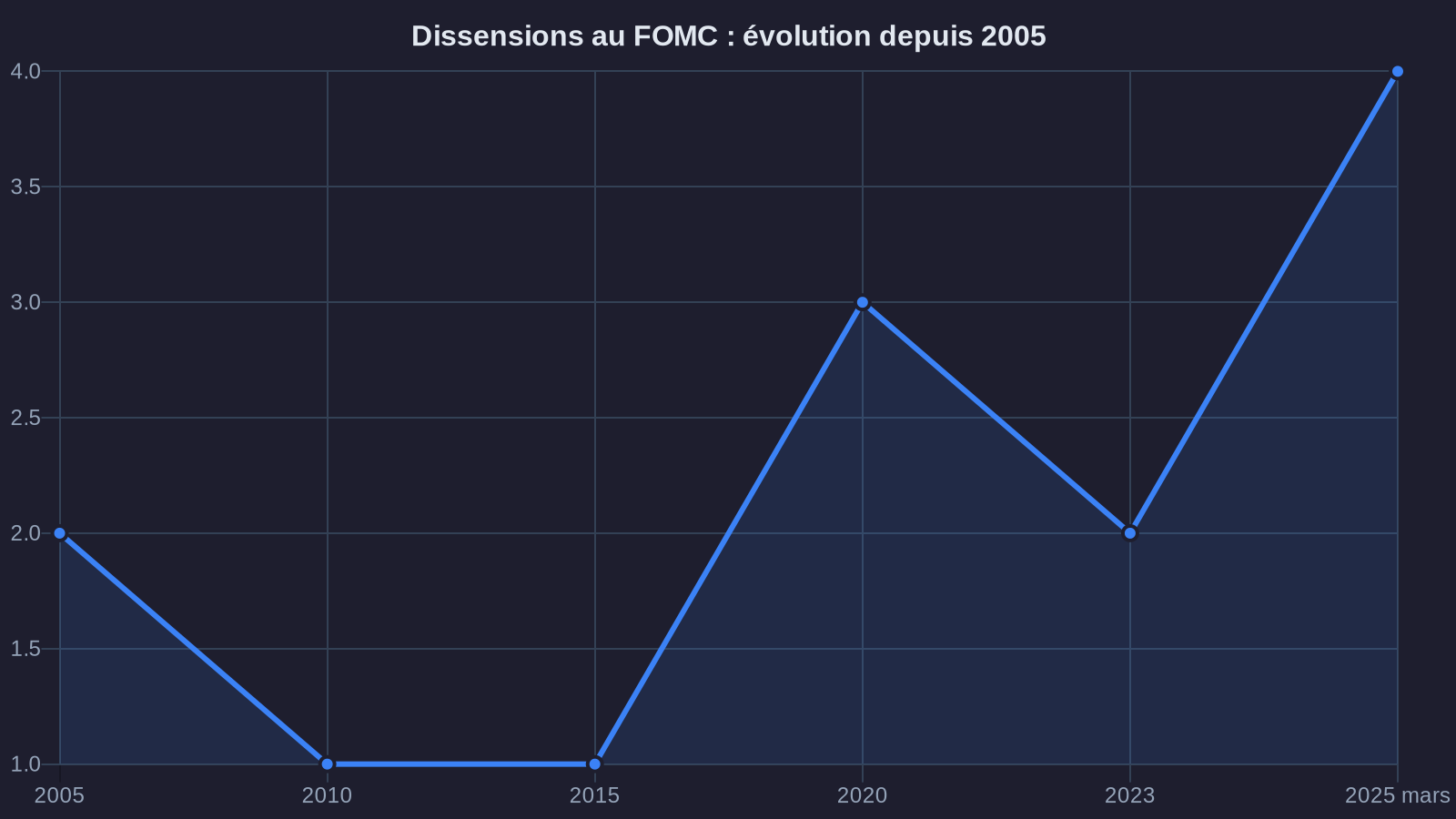
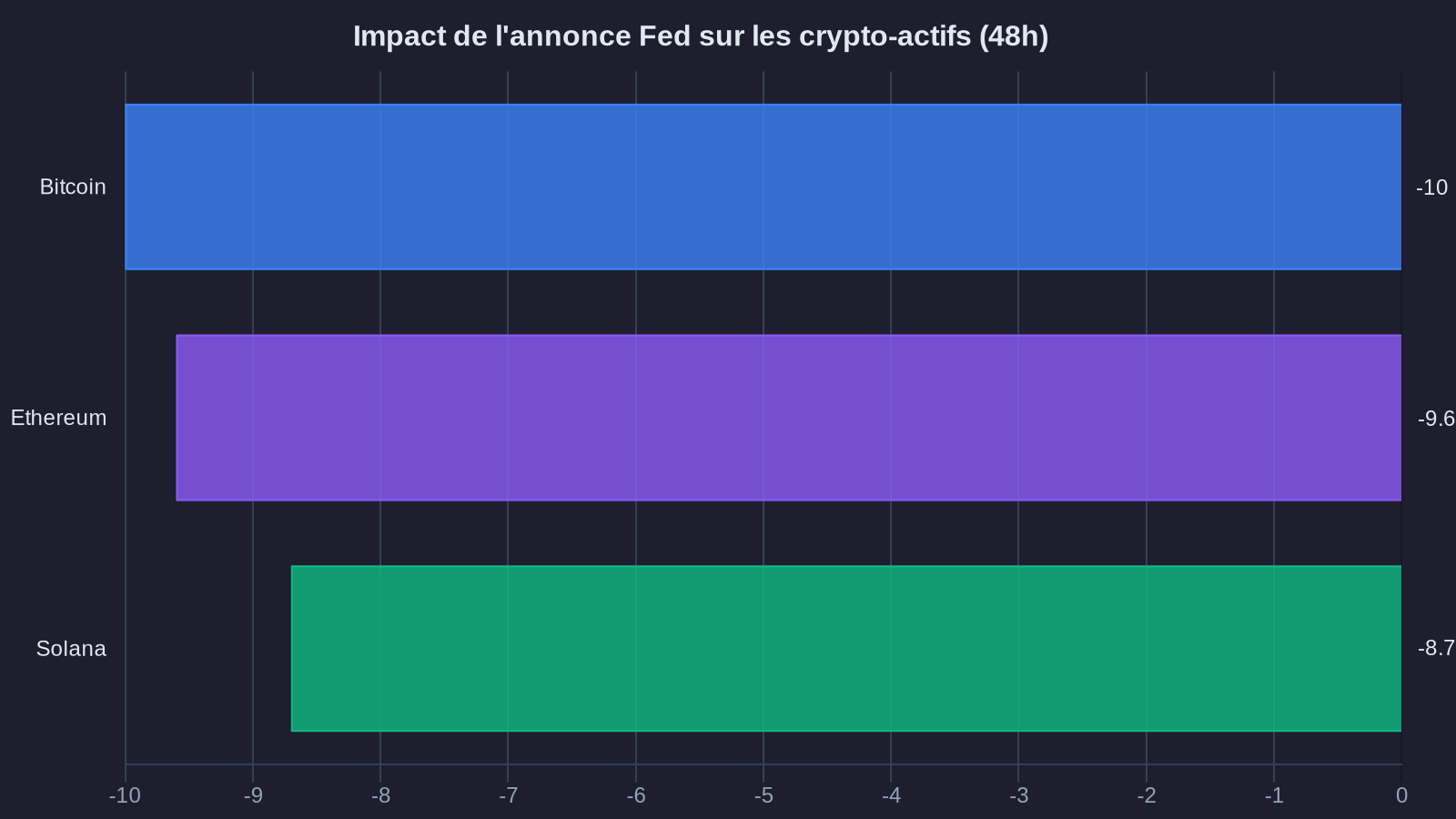
March 18, 2025. Jerome Powell announces the Fed keeps interest rates steady between 4.25% and 4.50%. Nothing extraordinary on the surface. Except that 4 committee members voted against — an unprecedented level of dissent since 2005. Within 48 hours, Bitcoin drops 10% and falls back to $75,000. Ethereum follows at $2,800, Solana at $115.
This synchronization is no accident. It reveals a mechanism many crypto investors underestimate: the direct link between Fed monetary policy and digital asset valuation. Understanding this mechanism allows you to anticipate movements and adjust your strategy accordingly.
Why Fed interest rates affect Bitcoin: the mechanism in 3 steps
The relationship between Fed rates and cryptocurrencies is anything but mysterious. It breaks down into three precise transmission channels.
First channel: opportunity cost. When the Fed keeps rates at 4.50%, US Treasury bonds offer a guaranteed 4.5% annual return with no capital loss risk. Facing this alternative, Bitcoin — which generates no passive income — becomes relatively less attractive. An institutional investor comparing the two options sees a widening risk/return gap. Result: arbitrage toward fixed-rate assets.
The numbers confirm it. In the 7 days preceding the announcement, spot Bitcoin ETFs in the US recorded net outflows of $1.2 billion. This movement accelerates after the FOMC decision: $340 million exits in a single day on March 19. Major holders adjust their allocations.
Second channel: available liquidity. Higher rates increase the cost of credit. Hedge funds using leverage to amplify their crypto positions see their financing costs rise. At 4.5%, borrowing to buy Bitcoin becomes less profitable. Marginal demand contracts, buying pressure declines.
Third channel: the dollar. Interest rates maintained at elevated levels support the dollar's value. The DXY (dollar index) gains 1.8% within 48 hours of Powell's announcement. Yet Bitcoin is historically negatively correlated with the dollar: when the greenback rises, BTC falls. Since January 2024, this negative correlation oscillates between -0.6 and -0.7 on rolling 90-day windows.
The 4 FOMC dissenters: what this unprecedented fracture reveals about monetary policy
Back to that vote. 8 in favor, 4 against. The last time such dissension occurred within the FOMC (Federal Open Market Committee) was in 2005. Back then, Alan Greenspan was chairman. Twenty years later, this internal division sends a signal to markets: the Fed no longer has clear consensus on its path forward.
The 4 dissenters called for an immediate 25 basis point cut. Their argument: inflation measured by PCE (Personal Consumption Expenditures) fell to 2.4% in February 2025, the lowest since March 2021. For them, maintaining rates at 4.50% while inflation converges toward the 2% target amounts to unnecessarily prolonging a restrictive policy that weighs on growth.
Powell, meanwhile, points to persistent tensions in the labor market. Unemployment remains stuck at 3.8% — a historically low level. Wages continue growing at 4.1% year-over-year. In this context, cutting rates risks reigniting inflation via demand. Hence the hold.
This divergence has a direct impact on crypto-assets. It introduces uncertainty. Markets hate uncertainty. Investors anticipating a cut by June 2025 (probability assessed at 62% by Fed Funds futures a week before the announcement) had to revise their models. This revision mechanically translates into profit-taking and defensive reallocations.
How to anticipate the Fed's next moves for your crypto investments
Three indicators allow you to read the Fed's intentions before it announces them officially.
FOMC minutes. Published 3 weeks after each meeting, they detail internal debates. The latest edition (published March 6) already revealed tensions over the timing of a cut. Hawkish members (favoring high rates) stressed risks of inflation resurgence. Dovish members (favoring a cut) warned against growth slowdown. This debate foreshadowed the 4 dissents on March 18.
Core inflation data. The Fed watches two metrics: the CPI (Consumer Price Index) and especially core PCE (excluding food and energy). Core PCE is its preferred gauge. Each monthly publication — the last Friday of the month — sets the tone. Core PCE dropping below 2.2% would open the door to a cut. Above 2.6%, Powell will justify the hold.
Fed Funds futures. These forward contracts allow you to read market expectations. As of March 20, 2025, they price in 38% probability of a cut in June, 71% in September. Tracking the evolution of these probabilities — available in real time on the CME Group website — gives you a head start.
What ForYield thinks
At ForYield, we've integrated monetary policy into our yield strategies from day one. Our approach: don't bet on rate direction, but build positions that generate returns in every scenario.
Concretely, in an environment of elevated rates, we favor DeFi protocols offering stable returns in stablecoins (USDC, USDT) backed by real assets. Currently, our allocations include positions on Aave V3 (net return of 5.2% on USDC as of 03/20/2025) and Compound (4.8%). These rates outpace Treasury bonds once accounting for instant liquidity access and no lock-up periods.
In parallel, we maintain Bitcoin exposure through progressive dollar-cost averaging (DCA) strategies on technical support levels. The drop to $75K represents an opportunity: it's 37% below January 2025's peak ($119,000), a correction level that historically precedes significant rebounds within 3 to 6 months.
The mistake would be reacting emotionally to Powell's announcements. Violent post-FOMC moves create noise but don't change crypto-assets' long-term fundamentals. Our conviction: Bitcoin remains a relevant diversification asset in a multi-class portfolio, provided you accept its volatility and adjust your allocation based on the monetary cycle.
For investors wanting to secure their crypto assets while maintaining exposure to digital assets, we recommend exploring yield-bearing stablecoins that offer an interesting alternative in a high interest rate environment.
If you hold crypto-assets without a clear strategy facing Fed decisions, ask yourself one simple question: is your current allocation designed to withstand prolonged high rates? If the answer is no, it's time to adapt.