
A CFO receives a call from their bank: "You have €800,000 in your current account. We could invest part of it." The question seems straightforward. Yet before answering, this finance director must ask themselves another question: of these €800,000, how much is needed to pay suppliers next week, how much serves as a safety cushion, and how much is genuinely idle with no foreseeable use?
This distinction between operational, precautionary, and surplus cash is far from purely academic. It underpins every trade-off between liquidity, security, and returns. A single euro misclassified means either a liquidity crunch at the wrong moment or years of lost gains. We regularly observe companies that lock up their safety reserve in illiquid investments, or conversely, let structural surplus languish in accounts earning 0.01%. Knowing how to formalize a treasury investment policy starts with this segmentation.
Operational cash: money in motion
Operational cash finances the daily business cycle. It covers foreseeable outflows: payroll, social contributions, suppliers, rent, tax payments. For an industrial SME, this cash typically represents 30 to 60 days of operating expenses. For a service company with low inventory and short payment cycles, this amount may drop to 15-20 days.
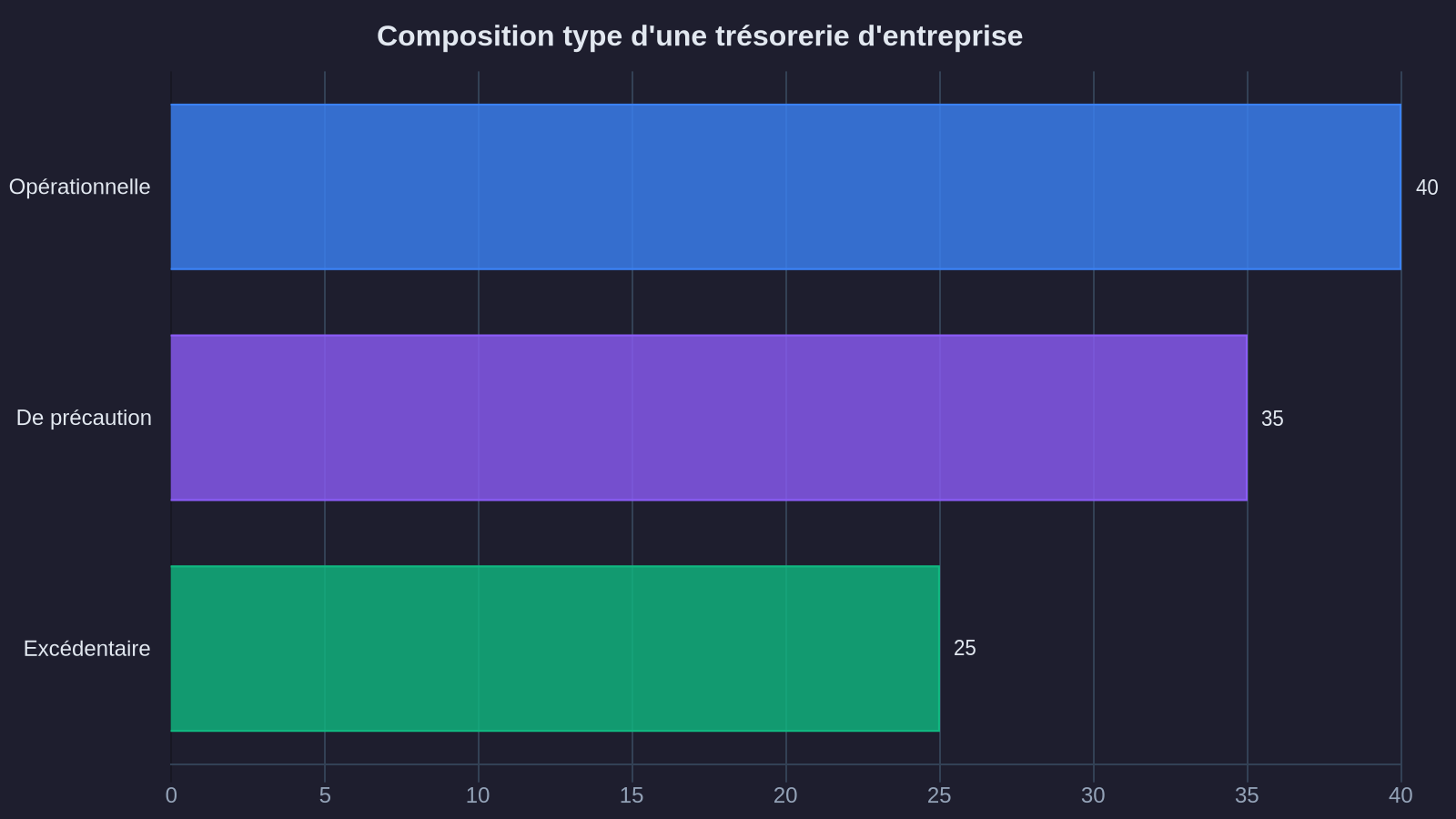
This cash must remain immediately available. We're talking about same-day liquidity (T+0), with no release delays and no risk of even minor depreciation. A standard bank current account meets this need. Some companies also use ultra-short term accounts (7-day term deposits) for amounts they know they won't need instantly, but this requires very precise cash flow forecasting.
The common mistake: underestimating this operational need to "put more money to work." A manager who invests 90% of available cash while overlooking a VAT payment due three weeks later may find themselves forced to unwind an investment urgently, sometimes at a penalty or discount. The rule here fits in one sentence: no return justifies a liquidity crisis.
Precautionary cash: the buffer against the unexpected
Beyond the predictable business cycle, every company must build a reserve to absorb shocks: a major customer payment delay, critical equipment failure, or sharper-than-expected seasonality. This precautionary cash acts as a shock absorber. It's not used every day, but when needed, it prevents costly recourse to overdrafts or emergency short-term credit.
The size of this reserve varies by sector, revenue volatility, and customer concentration. A common rule of thumb is to set aside two to three months of fixed costs. A company with €200,000 in monthly charges (excluding variable purchases) should thus keep between €400,000 and €600,000 in precautionary reserve. This amount may rise if the order book fluctuates significantly or customer payment terms structurally lengthen.
This cash can support a slightly longer investment horizon than operational cash, typically with liquidity available in T+2 to T+5, but it must remain free from capital loss risk. Standard money market investments (money market funds, short-term term deposits) are suitable. Some managers also use undrawn confirmed credit lines as a complement, freeing up some precautionary cash for slightly longer-term investment. Be careful, though: a confirmed credit line carries a cost (unused commitment fee), and it never fully replaces holding actual liquid funds.
The reverse pitfall of the previous one: oversizing the precautionary reserve out of excessive caution. We encounter companies holding six months of charges in reserve when their activity is stable and their customer base diversified. This excess buffer locks up funds that could find more productive use elsewhere, without any real gain in security.
Surplus cash: what remains after securing operations
Once operational cash and the precautionary reserve are established, the remaining balance constitutes surplus cash. This surplus comes from several sources: retained earnings, asset sales, undeployed capital increases, or simply positive cash generation over multiple periods without immediate industrial investment plans.
This surplus cash can support a longer investment horizon (from a few months to several years) and tolerate measured risk-taking, provided the manager has clearly identified that these funds won't be needed near-term. It's on this portion of cash that return/risk/liquidity trade-offs become truly relevant.
Take a concrete example. An SME has €1.2 million in available cash. After analysis, the CFO determines they need €150,000 in operational cash (one month of running charges) and €450,000 in precautionary reserve (three months of fixed costs). This leaves €600,000 in surplus. With these €600,000, the manager can consider investments with a 12-24 month horizon, or even longer if no major investment project is planned. Before committing, they should also ask the right questions.
Standard options for this surplus include term accounts, short-term bonds, certain diversified funds, or even—for companies comfortable with the capital loss risk inherent in crypto-assets—measured allocations in yield strategies via decentralized finance. In all cases, no profit promise should obscure the risk: an investment targeting higher returns than a standard savings account necessarily exposes the company to volatility or capital loss risk.
How to segment your cash in practice
This segmentation isn't a one-time exercise. It must be reviewed regularly, at least quarterly, based on business evolution, investment projects, and the company's risk profile.
First step: establish a rolling 12-month cash forecast. This forecast lists expected inflows and outflows month by month. It identifies the minimum cash level needed to operate without strain. This floor corresponds to operational cash.
Second step: assess risks specific to your business. A manager should ask themselves a few straightforward questions: what impact would default by my largest customer have? How much would major equipment failure cost? What breathing room do I need to seize unexpected commercial opportunity? The numerical answers determine precautionary reserve size.
Third step: identify medium-term investment projects. A company planning to acquire machine tooling in 18 months, hire aggressively next year, or acquire a competitor should keep cash necessary for these projects in an accessible pool, even if it can tolerate a several-month horizon. This cash isn't truly surplus: it already has a destination, even if deferred.
Once these three steps are complete, the remaining balance constitutes genuine surplus that the company can dedicate to an investment strategy with a longer horizon and, where appropriate, assumed risk-taking. This approach avoids two pitfalls: investing too much and creating liquidity pressure, or investing nothing and letting sums sleep that could improve return on equity.
Treasury management pitfalls to avoid
The first pitfall is mixing fund buckets. A manager investing €500,000 without first isolating operational and precautionary cash takes on liquidity risk. Some investments—particularly those promising above-average returns—impose lock-up periods or demanding early withdrawal conditions. If these funds are actually needed for operations, the company gets trapped.
The second pitfall: overestimating investment liquidity. A "liquid" fund may show redemption delays of a few days, but during market stress, delays can lengthen or redemption values fall. Theoretical liquidity only holds if market conditions stay normal. For precautionary cash, guaranteed liquidity under all circumstances is preferable, even if target returns are lower.
The third pitfall: confusing target returns with guaranteed returns. No investment outside regulated savings guarantees returns. Once a product shows rates above standard savings accounts, risk exists: interest rate risk, counterparty risk, liquidity risk, or capital loss risk. This risk must be understood, accepted, and proportionate to the cash nature being invested. You don't place precautionary reserve in capital loss-bearing products, even if target returns seem attractive.
Finally, some companies underestimate tax impact. Financial income received by a company is subject to corporate tax. A gross 4% return becomes a net 2.75% return after tax (at the reduced 15% rate up to €42,500 in profit, then 25% beyond). This tax drag must factor into real return calculations, especially when comparing investment options.
Toward active cash management
Cash segmentation isn't an administrative burden. It's the foundation of active cash management—that is, management that continuously arbitrates between security, liquidity, and returns based on business evolution. Active management allows capturing return opportunities without compromising financial solidity.
This approach requires disciplined review. Every quarter, the CFO or manager must reassess: has operational cash evolved with activity growth? Does the precautionary reserve remain calibrated to current risks? Has surplus increased or been consumed by investment?
This discipline avoids inertia. We regularly see companies that built surplus three years ago, invested it, then never reassessed the allocation despite activity doubling and operational cash needs exploding. The investment, now mismatched, creates liquidity risk that didn't exist initially.
For companies wanting to go beyond standard money market investments, decentralized finance solutions exist. They allow targeting higher returns in exchange for accepted capital loss risk and volatility. These solutions suit only the truly surplus portion of cash, once operational and precautionary needs are covered. They also require clear understanding of underlying mechanisms and formal board risk acceptance.
Decentralized finance doesn't replace standard investments. It complements a diversified allocation for managers seeking to optimize structural surplus returns, provided they respect one simple rule: never confuse money that truly sleeps with money you might need.
Before investing a single euro, a manager must therefore know what that euro is for. This knowledge avoids costly mistakes and opens the door to thoughtful cash management decisions, tailored to the company's real situation, and grounded in a clear understanding of target returns versus accepted risk.