
Imagine you own a safe with a reputation for being unbreakable. For years, it protects your most precious possessions. And then one day, someone invents a tool capable of opening it in minutes. That's exactly the scenario Ethereum is preparing for with post-quantum cryptography.
In January 2025, the Ethereum Foundation announced the creation of a team specialized in post-quantum cryptography. This decision marks a strategic turning point: the blockchain is no longer simply reacting to current threats, it's anticipating those of tomorrow. And this threat has a name: the quantum computer.
For ETH holders and asset owners on Ethereum, this announcement raises legitimate questions. Are your cryptocurrencies at risk? Should you take action now? Let's look at what's actually being prepared, and what it means for your portfolio in the long term. As we've already discussed in our analysis on Bitcoin's vulnerability to quantum computing, this question affects the entire crypto ecosystem.
The quantum computing threat: a revolution that changes blockchain security rules
To understand the urgency, let's go back to basics. Ethereum's entire security rests on cryptography. When you sign a transaction with your wallet, you use a private key – a string of characters that proves you're the rightful owner of your funds. This key is protected by mathematical algorithms so complex that a conventional computer would take billions of years to crack them.
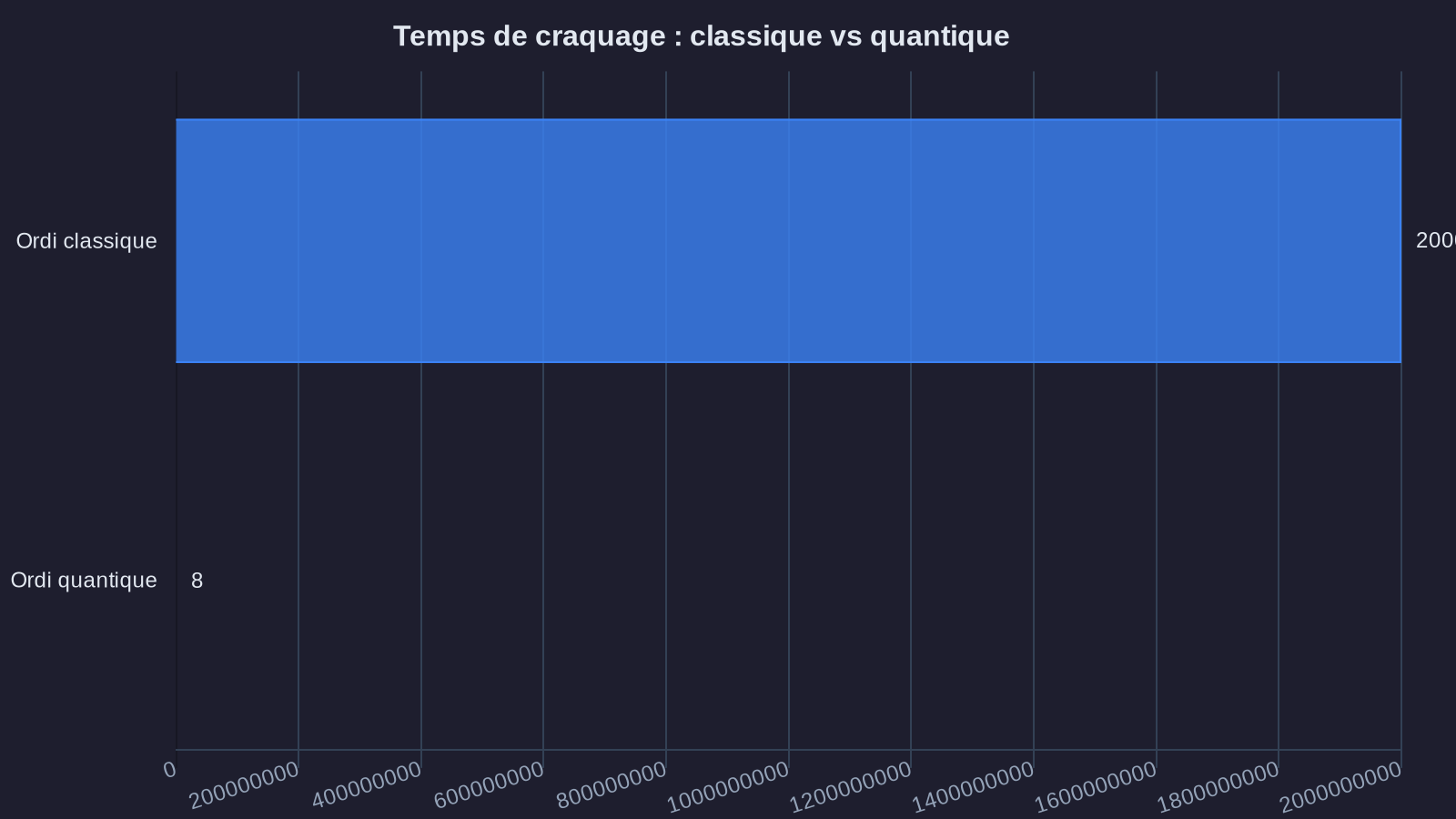
It's as if you had a lock whose combination consists of 1 million digits. Even trying every possibility, it would take so long that no one would bother attempting it.
Quantum computers change the game radically. Unlike traditional computers that process information bit by bit (0 or 1), quantum machines exploit the properties of quantum physics to simultaneously test millions of combinations. What took billions of years could be done in a few hours.
In 2019, Google demonstrated that one of its quantum processors could solve in 200 seconds a calculation that would have required 10,000 years on a classical supercomputer. Since then, IBM, Microsoft, and several Chinese players have been making rapid progress. Experts estimate that a quantum computer powerful enough to threaten current cryptography could emerge within 5 to 15 years.
For Ethereum, this means that the digital signature algorithms used today – particularly ECDSA (Elliptic Curve Digital Signature Algorithm) – would become vulnerable. An attacker could theoretically derive a private key from a public key and drain any wallet. The security of your assets therefore depends directly on this race against time, which is why best security practices starting today are so crucial.
The Ethereum protocol upgrades 2026: anticipate rather than react
Faced with this quantum computing threat, the Ethereum Foundation isn't starting from scratch. For several years now, the developer community has been monitoring quantum technology's evolution. But the creation of a dedicated post-quantum cryptography team marks a notable acceleration in blockchain security efforts.
This team is working on several fronts simultaneously. The first involves identifying the precise vulnerabilities in the current architecture. Not all components of Ethereum face the quantum threat equally. Transaction signatures are particularly exposed, while hash functions – which secure blockchain blocks – are much more resistant.
The second axis concerns integrating post-quantum algorithms and developing cryptographic resilience. These new cryptographic standards, developed by NIST (the American standards institute), are designed to resist quantum attacks. They rely on different mathematical problems that remain difficult even for quantum computers.
But integrating these algorithms into a blockchain is far from trivial. Ethereum processes millions of transactions daily. Changing signature mechanisms requires modifying the protocol deeply, without compromising either performance or compatibility with existing applications. It's a bit like renovating the foundations of a 50-story building while residents continue living inside.
The current timeline for Ethereum protocol upgrades unfolds in several phases. By 2026-2027, the first real-world tests should begin on testnets. The goal: validate that the new algorithms work without slowing the network or creating security gaps. Then comes a phase of gradual adoption, probably spread over 2 to 3 years, allowing the old and new standards to coexist before a final switchover.
What post-quantum cryptography concretely changes for your assets
If you hold ETH or tokens on Ethereum, the legitimate question is: should you worry now?
In the short term, the answer is no. The quantum computing threat is not imminent. Current quantum computers, while spectacular in the laboratory, don't yet have the power to attack Ethereum's cryptography. We're talking about a horizon of 5 to 15 years according to the most optimistic estimates.
During this transition period toward blockchain security 2026, your assets remain protected by current cryptography. As long as you follow best practices – never sharing your seed phrase, using a hardware wallet for significant amounts, enabling two-factor authentication on platforms – your funds are secure.
However, migration to post-quantum cryptography will involve practical changes. Your wallet will probably need to be updated to support the new signature algorithms. Private keys themselves could evolve – become longer, for example, since post-quantum algorithms typically require more data.
Smart contracts and DeFi applications will also need to adapt. A lending protocol, a decentralized exchange, or an NFT project all use signature mechanisms. Their developers will need to update their code to remain compatible with the new infrastructure.
For long-term investors, this transition represents both a risk and an opportunity. The risk would be that a competing blockchain successfully completes its post-quantum migration faster and more efficiently than Ethereum, thus gaining a competitive advantage. The opportunity is that Ethereum, by taking the lead, strengthens its position as the reference platform for critical applications requiring maximum security.
Cryptographic resilience: other blockchains facing the quantum challenge
Ethereum is not alone in facing this cryptographic resilience challenge. Bitcoin, given its more conservative architecture, is equally vulnerable – perhaps even more so, since its community prioritizes stability over innovation. Evolving the Bitcoin protocol typically takes longer and requires broader consensus.
Some recent projects, like Algorand or QAN, already integrate elements of quantum resistance into their initial design. But these blockchains lack Ethereum's ecosystem, liquidity, and adoption. Building a post-quantum infrastructure from the start is simpler, but doesn't guarantee success.
What really matters for blockchain security is the capacity to adapt. Ethereum has demonstrated in the past that it knows how to evolve – the transition to Proof of Stake in September 2022 is glaring proof. This migration, which reduced the network's energy consumption by 99%, was considered one of the most ambitious technical challenges in crypto history. It succeeded without service interruption.
The post-quantum transition represents a challenge of comparable scale in the Ethereum protocol upgrades, but Ethereum now has an experienced team and a proven roadmap. Lessons learned from The Merge – particularly the importance of exhaustive testing and transparent communication – will be invaluable.
How to prepare as an investor in the post-quantum cryptography era
Facing this evolution toward blockchain security 2026, the wisest approach is to stay informed without giving in to panic. The quantum computing threat is real, but it's anticipated. Ethereum has the time and resources to develop its cryptographic resilience.
In the months and years ahead, monitor official announcements from the Ethereum Foundation concerning Ethereum protocol upgrades. When the first updates arrive, make sure your wallets and applications are up to date. Recognized wallet providers – MetaMask, Ledger, Trezor – will communicate clearly about the steps to take.
If you use DeFi protocols, favor those displaying active governance and a responsive development team. Projects that will survive long term are those capable of adapting to major technical evolutions like the post-quantum transition.
Finally, keep a broader perspective. Cryptography has always evolved. What protected communications 30 years ago is obsolete today. What protects Ethereum today will evolve tomorrow. It's the natural cycle of cybersecurity.
The difference with Ethereum and its post-quantum cryptography is that this evolution is not endured: it is anticipated, planned, transparent. For a long-term investor, that's exactly what you expect from infrastructure designed to store value and execute critical applications over decades.
The quantum computer will arrive. But when it does, Ethereum will be ready. And so will your assets.