
Imagine living in a building constructed ten years ago. The foundations are solid, the residents are satisfied, but over time, problems emerge: the plumbing is aging, insulation no longer meets standards, the boiler consumes too much energy. You have two options: build a new building next door, or renovate the existing one from top to bottom, room by room, without requiring residents to move out.
This is exactly the challenge Ethereum is about to take on with the "Ethereum Lean" project, announced by Vitalik Buterin as a major overhaul comparable to the Merge of September 2022. This technical transformation, planned over three to four years according to Vitalik's roadmap, aims to radically simplify Ethereum's architecture while maintaining its day-to-day operations.
To understand the scope of this refactoring, let's first review what Ethereum has accomplished and why this next step is necessary.
The weight of history: why Ethereum needs to lighten its infrastructure
Since its launch in 2015, Ethereum has accumulated nearly ten years of development. Each improvement, each new feature added a layer of complexity. It's like keeping every version of your accounting software since its creation: it works, but it's cumbersome, difficult to maintain, and every update becomes a puzzle.
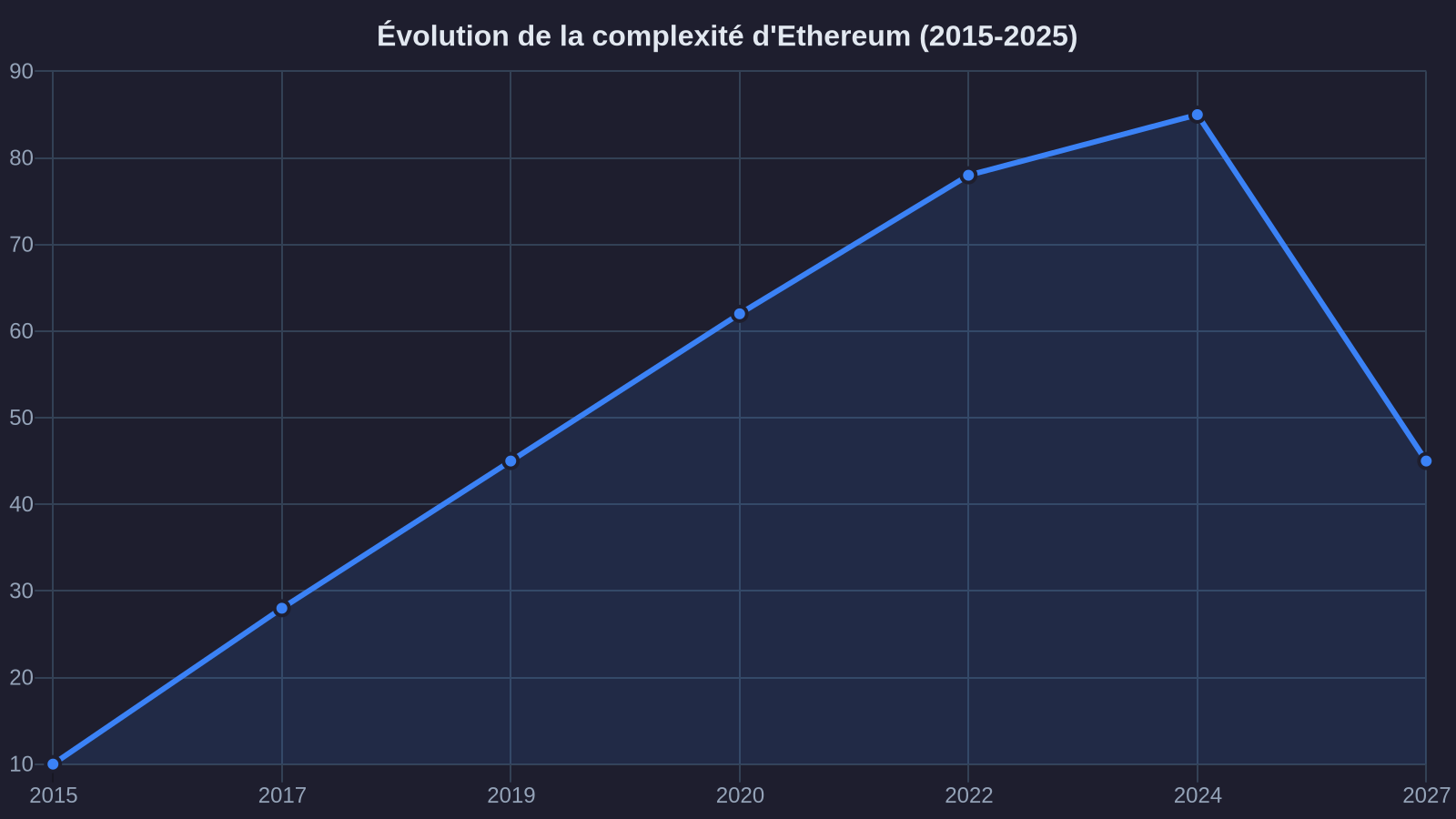
The Merge, that historic transition to proof-of-stake in September 2022, solved one major problem: energy consumption. Ethereum reduced its energy consumption by 99.95%, a remarkable technical achievement. But this transformation didn't simplify the protocol. On the contrary, it maintained parts of the old infrastructure to ensure a smooth transition.
Today, Ethereum operates with what developers call substantial "technical debt." Obsolete consensus mechanisms coexist with new systems. Pieces of code dating back to the proof-of-work era remain present in the protocol. The network carries the weight of its history, a challenge common to many blockchain infrastructures.
Vitalik Buterin is clear about it: "We need to clean up the protocol, remove what no longer serves a purpose, simplify what has become too complex."
Nora's analogy: the big cleanup
Imagine your garage after ten years without organizing it. You know where each tool is, you find what you need, but a newcomer would be completely lost. Ethereum Lean is the big cleanup: we keep what actually matters, we get rid of what takes up space, and we reorganize so everything is clearer and more efficient.
The three pillars of the Ethereum Lean upgrade
The announced overhaul revolves around three major axes, each with concrete consequences for the ecosystem.
Consensus simplification
Ethereum's consensus mechanism, the process that allows validators to agree on the network's state, has evolved through successive layers. Ethereum Lean plans to remove layers that have become unnecessary and streamline what remains.
In practical terms, this means less code for security teams to audit, fewer risks of bugs, and better overall system understanding. For validators, those who secure the network by staking their ether, the objective is to reduce the computing resources required. A validator should be able to operate on more modest hardware, making network participation more accessible.
Lightening historical data
Currently, running a full Ethereum node requires storing the entire network history since 2015. We're talking about hundreds of gigabytes of data. It's like having to keep all your bank statements since you opened your first savings account just to verify your current balance.
Ethereum Lean introduces a different approach: only recent data would be mandatory for validating current transactions. The older history would remain accessible through specialized nodes, but would no longer be a prerequisite for participating in the network. This evolution could reduce the disk space needed to run a node by half, or even by three-quarters.
Optimization of the virtual machine
The Ethereum virtual machine, the EVM, is the engine that executes smart contracts. Over the past ten years, it has accumulated functions, some heavily used, others almost never. Ethereum Lean proposes a spring cleaning: remove obsolete opcodes, optimize the most common ones, simplify the whole thing.
For smart contract developers, the impact will be gradual. Existing contracts will continue to function thanks to compatibility mechanisms, but new projects will benefit from a more coherent and performant environment.
A three to four year timeline: Vitalik's roadmap explained
Three to four years might seem like an eternity in the crypto universe, where projects are born and disappear within months. But modifying Ethereum is like repairing an airplane in mid-flight. We can't afford the slightest mistake.
The Ethereum network currently secures over 50 billion dollars in assets. Hundreds of thousands of decentralized applications run on its infrastructure. Millions of users depend on its stability. Every modification must be tested, retested, audited by independent experts, then deployed progressively.
The planned timeline draws directly from the experience of the Merge. This transition to proof-of-stake took nearly five years from initial research to final deployment. Five years of development, testing on testnets, simulations, security audits. And the result was a remarkable technical success, with no service interruption, no loss of funds.
Ethereum Lean will follow a similar methodology: phased deployment, validation at each step, community feedback, adjustments if necessary. The first phase, focused on cleaning up the oldest consensus mechanisms, could occur as early as late 2025. Subsequent phases will be staggered through 2028-2029.
Impact on the ecosystem: who will be affected by this improved scalability?
A refactoring of this scale will have cascading repercussions across the entire Ethereum ecosystem. Let's decode who will be affected and how.
Validators will be the first affected. Changes to the consensus mechanism could potentially alter technical requirements for running a validator node. The stated objective is simplification, but the transition period will require careful attention and regular software updates.
Application developers will need to follow the evolution of the EVM. Existing smart contracts won't stop functioning overnight, but certain optimizations or cleanups could affect applications using rare or obsolete features. Technical documentation and development tools will need to be updated accordingly.
Infrastructure providers, those offering node services or APIs to interact with Ethereum, will need to adapt their systems. The management of historical data, in particular, will evolve. Some players might choose to specialize in archiving the complete history, while others will focus on recent data.
End users, on the other hand, should notice no change in their day-to-day experience. Your tokens will remain accessible, your wallets will function normally, your transactions will go through as usual. That's precisely the objective: transform the engine without passengers noticing.
What you need to know
Ethereum Lean represents a major technical simplification of the protocol, comparable in scope to the Merge but with different objectives: reduce technical debt, ease maintenance, make network participation more accessible.
The planned timeline extends over three to four years according to Vitalik Buterin, with progressive phased deployment to guarantee network security and stability. The first phase could occur as early as 2025.
The impact will primarily affect technical ecosystem participants: validators, developers, infrastructure providers. End users should notice no change in their daily use of Ethereum.
Toward a new era for Ethereum infrastructure
Ethereum Lean is not just another technical update. It's a strong strategic choice: favoring simplicity and sustainability over feature stacking. In a crypto ecosystem often drawn to complexity and flashy innovations, this approach stands out.
The success of this refactoring will say much about Ethereum's maturity as an infrastructure. A mature protocol is one that knows how to question itself, clean up its code, simplify its architecture. It's a protocol that thinks long-term, beyond market cycles and passing trends, much like other regulatory developments such as the GENIUS Act for stablecoins.
The next three to four years will be decisive. If Ethereum succeeds in executing this transformation with the same success as the Merge, it will strengthen its position as the reference programmable blockchain. If difficulties arise, newer competitors that started from a simpler technical foundation could gain ground.
For now, one thing is certain: Ethereum continues to evolve, transform, and adapt. Exactly as it has done for the past ten years.