The yield farming market regularly promises double-digit returns on stablecoins. Yet most institutional investors and family offices we work with ask us the same question: where should I place my USDC to get predictable returns without taking on outsized risk?
The answer isn't in protocols advertising 50% APY on their homepage. It lies in a rigorous mapping of crypto yield farming strategies available, an honest assessment of the risks, and a methodical selection of protocols that have proven themselves.
The fundamentals: why USDC generates yield
Before discussing strategies, it's worth understanding where returns on a stablecoin actually come from. Unlike volatile cryptocurrencies, USDC doesn't generate gains through price appreciation. Yields come exclusively from the economic use of your capital within the DeFi ecosystem.
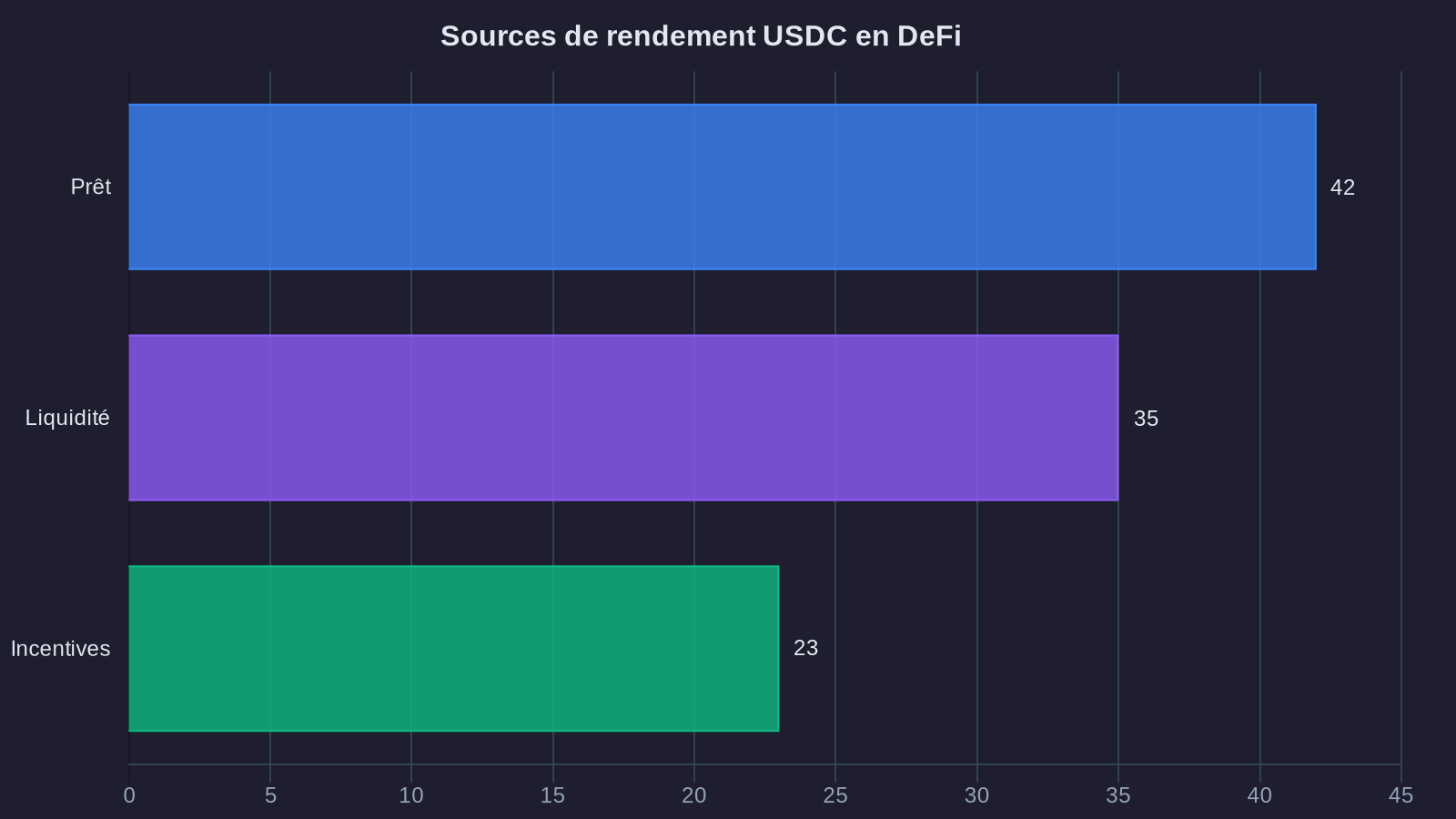
Three main sources feed these returns. First, lending protocols: borrowers pay interest to borrow your USDC, whether for leveraged trading, treasury needs, or arbitrage strategies. Second, liquidity provision: decentralized exchanges reward those who provide liquidity to their pools, enabling traders to swap assets. Third, protocol incentives: some projects distribute their native tokens to attract liquidity.
This last source explains the exceptionally high yields sometimes observed. A new protocol might offer 80% APY not because economic activity justifies it, but because it's distributing tokens heavily to bootstrap growth. It's a disguised subsidy, rarely sustainable long-term.
USDC yield farming strategies: from most conservative to most sophisticated
Approaches to generating USDC returns can be classified into four distinct categories, each with its own risk-return profile.
Simple lending: the foundation of stable stablecoin returns
Money market protocols like Aave, Compound, or Morpho let you lend USDC to borrowers. Returns typically range from 2% to 8% depending on market cycles and borrowing demand. It's the most straightforward strategy, comparable to other crypto wealth strategies but with zero volatility.
The main risk lies in smart contract security. Aave and Compound, audited multiple times and in production for several years, present relatively controlled technical risk. Morpho, newer but built on these proven foundations, often delivers slightly higher yields through its peer-to-peer optimization mechanism.
Liquidity remains excellent: you can withdraw your capital anytime, provided the pool has available liquidity. In practice, major protocols maintain utilization rates that guarantee this availability.
Liquidity provision: higher yields, increased complexity
Providing liquidity on a DEX like Uniswap or Curve means depositing USDC (often paired with another stablecoin or correlated asset) into a trading pool. In return, you earn a share of trading fees and, on some protocols, additional rewards.
Stablecoin-to-stablecoin pools (USDC-USDT, USDC-DAI) on Curve offer 3% to 12% returns with virtually no impermanent loss risk, since the assets move in correlation. It's a relatively safe setup for those who understand the mechanics.
Real sophistication begins with multi-protocol strategies. Convex Finance, for example, lets you deposit your Curve LP tokens to earn boosted returns. You then stack multiple layers: Curve trading fees, CRV rewards, and CVX incentives. Overall returns can hit 10% to 15%, but you also multiply technical risk points.
Automated vaults: delegating complexity
Protocols like Yearn Finance, Beefy, or Convex automatically aggregate multiple strategies. You deposit USDC, and a smart contract optimizes yield by reallocating capital based on market opportunities.
The appeal is twofold: time savings and gas fee economies, since reallocations are pooled across all depositors. Returns typically range from 5% to 15% depending on underlying strategies and market conditions.
The flip side of automation: you delegate allocation decisions to an algorithm. So you must understand the vault strategy, analyze cumulative risks from underlying protocols, and accept less control over your capital placement. The best vaults publish transparent documentation on their strategies and protocol selection criteria.
Advanced strategies: incentive farming and emerging ecosystem participation
Some investors chase the highest yields by participating in new protocol launches or aggressively farming incentive tokens. Displayed APY can exceed 50%, even 100% in the first days of a launch.
This approach is more venture capital than treasury placement. You're betting on future valuation of the reward token you receive, with considerable risk: token price collapse, bugs in unaudited smart contracts, or simply a protocol that can't find its market.
For institutional investors or significant allocations, this category typically remains out of scope. For tactical allocations of modest size with high risk tolerance, it can form a satellite pocket within a larger portfolio.
Selecting a protocol: the criteria that truly matter
Faced with abundant options, how do you tell reliable protocols from fragile constructs? Several criteria enable you to build an operational framework.
Protocol longevity is the first filter. A protocol in production for more than two years, having weathered multiple market cycles and survived stress situations (like the USDC depeg in March 2023 or November 2022 turbulence) demonstrates resilience that newcomers cannot claim.
TVL (Total Value Locked) indicates market confidence. A protocol managing several billion dollars naturally attracts more scrutiny from the community, security researchers, and white hats. Aave regularly exceeds $10 billion TVL, Curve maintains around $3-4 billion. These magnitudes don't guarantee anything, but signal significant adoption.
Security audits are a minimum standard. Multiple independent audits from recognized firms (Trail of Bits, OpenZeppelin, Consensys Diligence) signal credibility. Be cautious, though: an audit doesn't certify absence of vulnerabilities—it attests that at a specific moment, auditors found no critical flaws.
Protocol governance deserves examination too. A centralized protocol, controlled by a team that can change parameters at will, presents meaningful governance risk. Conversely, mature decentralized governance with established voting processes and an active community offers more predictability.
Finally, the source of returns must be explicit and sustainable. A 30% yield on USDC with no visible underlying economic activity is a red flag. Either the protocol artificially subsidizes via token issuance (unsustainable), or there's a risk dimension not disclosed.
Building a realistic allocation: yield versus safety
For an investor seeking to generate stablecoin returns with controlled risk, how you structure your allocation determines the outcome as much as choosing individual protocols.
A cautious approach might allocate 70% to established lending protocols (Aave, Compound) for 3-5% base yield, 25% to stablecoin liquidity provision via Curve or an optimized Yearn vault for 6-10%, and keep 5% for tactical higher-yield opportunities with limited duration.
This allocation targets 4-7% blended returns with risk concentrated on the most proven protocols. It's less flashy than the 50% promised by some emerging protocols, but it's a yield you can reasonably expect to sustain over several quarters.
For significant amounts (hundreds of thousands to millions), protocol diversification becomes critical. Even the most solid protocols can experience incidents. Spreading capital across 3 to 5 different protocols limits exposure to a single event—an approach similar to managing crypto wealth risks.
Regular allocation review is also essential. Yield conditions shift with market cycles. A protocol can become less attractive if yields drop significantly, or merit increased allocation if its risk-return profile improves.
Beyond yield: the overlooked parameters
Too often, yield farming discussions focus solely on displayed rates. Yet several factors determine the net yield you actually receive.
Gas fees on Ethereum can significantly erode returns for modest amounts. Depositing 5,000 USDC on Aave during network congestion might cost $50-$100. If gross annual yield is 5%, it takes months just to recover entry fees. Layer 2 solutions (Arbitrum, Optimism, Base) or some Layer 1 alternatives (Polygon) can drastically cut these costs.
Taxation is another frequent blind spot. In many jurisdictions, token rewards constitute taxable income when received, even if you haven't sold them. Receiving $1,000 in CRV tokens then watching their value drop 70% before selling creates complex tax situations. A strategy optimizing after-tax yield can differ significantly from one maximizing gross APY.
Effective liquidity deserves attention too. A pool might display attractive APY but have limited available liquidity. Attempting to withdraw a significant amount could impact price or face delays. On lending protocols, utilization rates above 90% signal risk of withdrawal difficulties.
We also observe that many investors overlook the opportunity cost of time spent. Actively managing multiple yield farming positions, tracking returns, regularly reallocating capital: this represents significant time investment. For some investors, delegating this management to an automated vault or professional service, even with 1-2% fees, frees time for higher-value activities.
Outlook: toward maturity in the crypto yield market
The crypto yield farming market is evolving toward greater maturity. The excessive yields of 2020-2021 are gradually normalizing. Surviving protocols are developing more sustainable business models. Investors are becoming more demanding on transparency and security.
This normalization isn't bad news. It means generating yield on USDC becomes a more predictable activity, with better-identified risks and more robust protocols. For investors seeking alternatives to traditional placements without pursuing pure speculation, it's precisely what they need.
The real challenge now is maintaining active oversight, regularly reassessing positions, and resisting the temptation of exceptional yields that almost always come with exceptional risks. Steady 4-8% net returns often outperform 50% yields that evaporate in weeks.
```