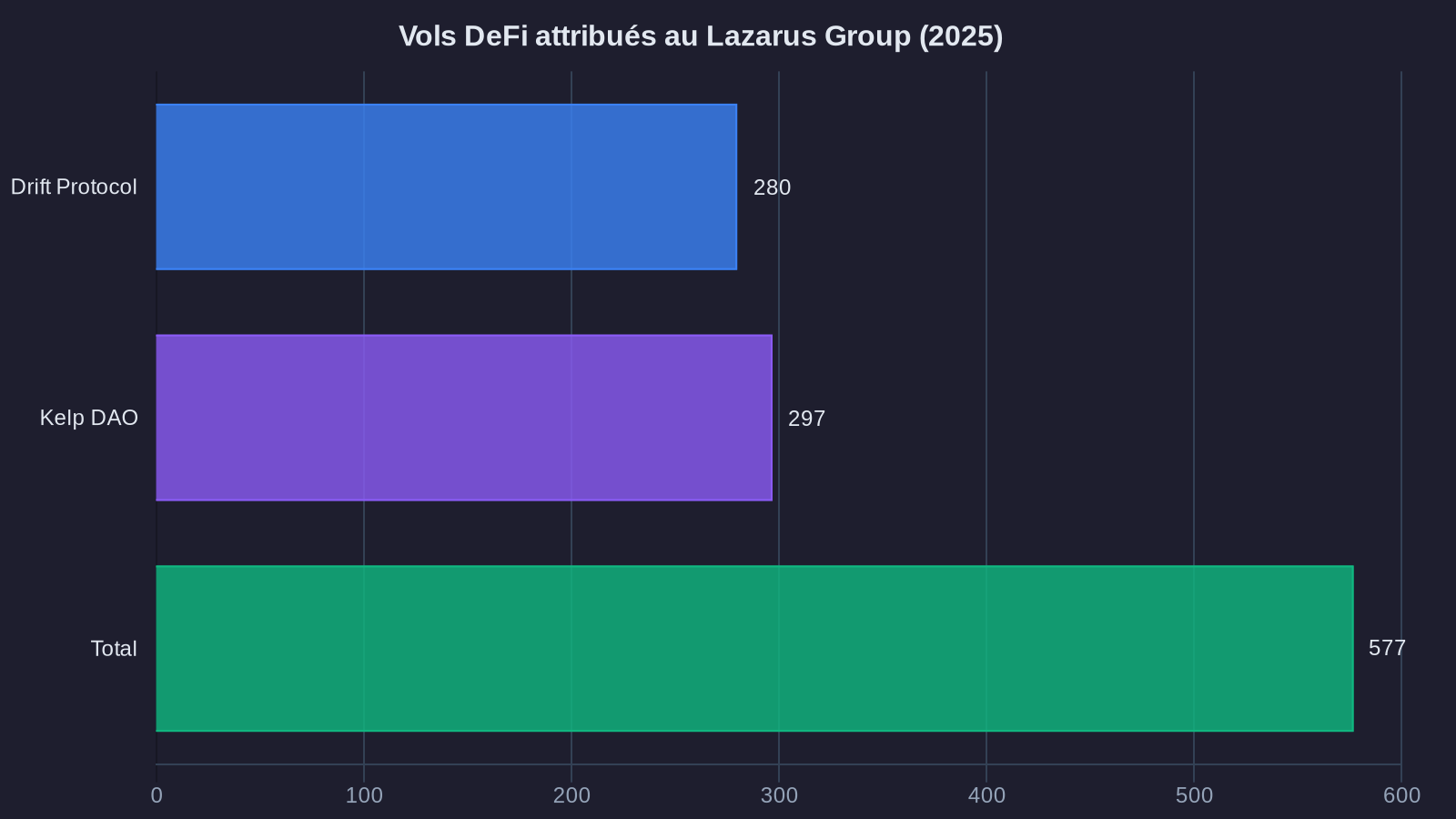
Between January and March 2025, two major DeFi protocols – Drift Protocol and Kelp DAO – were drained of their funds within hours. Combined toll: $577 million evaporated. Technical investigations conducted by Chainalysis and Elliptic point to the same actor: North Korea's General Bureau of Reconnaissance, commonly known as the Lazarus Group.
These are not opportunistic hackers seeking quick profits. This is a state-sponsored cyber infrastructure, funded and coordinated by Pyongyang, with an explicit objective: circumvent international sanctions and finance the regime's nuclear weapons program. The sums at stake now exceed some conventional military budgets.
This situation raises a question the crypto industry can no longer avoid: how can audited protocols, secured by millions of dollars in TVL (Total Value Locked), be plundered with such efficiency? And more importantly, what does this escalation reveal about the very nature of the threat hanging over decentralized finance?
Anatomy of an attack: when technical sophistication meets social engineering
Attacks conducted by North Korean hackers are distinguished by their hybrid methodology. They combine exploitation of zero-day vulnerabilities with long-term human infiltration. In the case of Drift Protocol ($280 million), the attack began six months before the final exfiltration.
The pattern is now well-documented: North Korean developers apply under false Western identities, armed with flawless CVs, active GitHub profiles and credible LinkedIn recommendations. They pass technical interviews, join development teams, gradually gain access to critical infrastructure. And wait.
This patience is their strength. Unlike conventional hackers hunting for immediately exploitable flaws, North Korean teams can afford to wait for the optimal moment: a smart contract update, a change in validation procedures, a period of high activity where unusual transactions go unnoticed.
Privileged attack vectors in cyber APT attacks
Forensic analysis of the Drift and Kelp exploits reveals three main vectors used in a coordinated manner. First vector: compromise of multisig private keys via privilege escalation. In the case of Kelp DAO ($297 million), attackers managed to obtain enough signatures to validate malicious transactions. How? Likely through privileged access to key management systems, made possible by prolonged internal presence.
Second vector: exploitation of vulnerabilities in cross-chain bridges, a critical multi-chain security concern. Protocols enabling asset transfers across different blockchains (Ethereum, Binance Smart Chain, Polygon) present a considerable attack surface. Each bridge represents a mandatory passage point where security validations can be bypassed if one sufficiently masters the underlying architecture.
Third vector, less visible but equally critical: manipulation of price oracles. Some DeFi protocols rely on external data sources to determine the value of collateralized assets. By injecting false data at the right moment, it becomes possible to create under-collateralized positions that enable extracting more value than what was deposited. A similar technique was mentioned during the Vercel breach incident, where exposure of sensitive keys revealed the structural vulnerabilities of certain architectures.
The business model of a rogue state: from cryptocurrency to ballistic missiles
The $577 million from Drift and Kelp attacks doesn't end up in a discreet offshore account. It transits through a network of mixers and privacy protocols (Tornado Cash before its closure, now lesser-known alternatives), then is progressively converted into usable currencies.
According to estimates from the U.S. Treasury Department, North Korea has stolen between $2 and $3 billion in cryptocurrencies since 2017. These funds represent between 30% and 40% of the budget dedicated to the intercontinental ballistic missile program. Concretely, each DeFi attack directly finances the development of weapons of mass destruction.
The cost-benefit ratio is unparalleled in the history of cybercrime. Training and maintaining an elite hacker team costs Pyongyang only a few million dollars per year. The return on investment runs into the hundreds of millions per successful operation. No other illicit activity – drug trafficking, counterfeiting, traditional money laundering – offers such a return-to-risk ratio.
The domino effect and sanctions evasion
This situation creates a dangerous precedent. Other sanctioned states – Iran, Venezuela, Myanmar – are closely watching the North Korean model. If an isolated regime can generate hundreds of millions of dollars by targeting DeFi protocols, why wouldn't others attempt to replicate the scheme? The FATF has already sounded the alarm over the use of stablecoins to circumvent international sanctions.
The implications extend far beyond cybersecurity. They touch on international financial regulation, weapons export controls, and nuclear deterrence. When the United Nations imposes sanctions on a state, the implicit assumption is that state will no longer access global financial flows. DeFi, by design, renders this assumption obsolete.
The red flags you must spot before it's too late
If you're a security officer, developer, or active user of DeFi protocols, certain signals should trigger immediate alerts. They don't guarantee an attack is underway, but their combined presence warrants heightened vigilance.
First signal: employee profiles that are difficult to verify. A developer who consistently refuses video calls, uses only encrypted messaging, or whose professional history can't be confirmed by actual colleagues should raise questions. North Korean hackers excel at creating credible online personas but struggle to maintain consistency in real physical or real-time video interactions.
Second signal: code modifications just before critical periods. If a developer pushes major commits to smart contracts hours before a liquidity migration or governance change, and that code hasn't been reviewed by multiple experienced sets of eyes, it's legitimate cause for concern.
Third signal: unusual access requests for privilege escalation. A team member who suddenly seeks permissions on systems outside their normal scope, or who seeks to understand in detail the architecture of multisig keys when that's not their role, deserves particular attention.
Fourth signal: unexplained test transactions. Before a major attack, hackers often execute low-value transactions to validate their exploitation chain. Unusual fund movements, even minimal ones, on governance contracts or bridges should be traced and explained.
Strengthening DeFi security against state-level threats: what must change
Classical security recommendations – code audits, bug bounties, privilege separation – remain necessary but no longer suffice against an adversary with state resources and strategic patience. DeFi security must now be conceived as a defense against APT-level actors (Advanced Persistent Threats), comparable to defending critical government infrastructure.
Reinforced KYC processes for developers. This may seem contradictory to the decentralized spirit, but employing people with access to systems managing hundreds of millions of dollars imposes proportional responsibility. Strengthened identity verification, mandatory video interviews, independent professional background checks: these steps must become standard practice.
Mandatory delays between proposal and execution. Governance systems should enforce an uncompressible timelock between the moment a smart contract modification is proposed and its actual deployment. This delay allows the community and security researchers to analyze the code in depth. Attackers rely on rapid execution; slowing the system reduces their window of opportunity.
Privilege segmentation and mandatory hardware wallets. No private key controlling more than $50 million should be stored on an Internet-connected device. Critical signatures must originate from hardware wallets kept in physically secure environments, with multi-person validation procedures.
Algorithmic behavioral monitoring. AI tools can now detect unusual behavior patterns in code contributions or system interactions. A developer who suddenly begins working at atypical hours (compatible with North Korean time zones), or whose coding style abruptly changes, can trigger an alert for manual investigation.
A critical watchpoint on multi-chain security
If you use DeFi protocols with significant amounts, verify that the development team is publicly identifiable, that smart contracts have undergone multiple audits by recognized firms, and that the governance system enforces sufficient delays between proposal and execution. No yield, however attractive, justifies exposing your funds to protocols that don't meet these minimum standards. When in doubt, prefer regulated platforms or established protocols whose resilience has been proven. In case of uncertainty, prefer regulated platforms or established protocols whose resilience has been tested.
What these attacks reveal about the future of decentralized finance
The irony is cruel: DeFi was designed to bypass financial intermediaries and their supposedly excessive procedures. It now finds itself forced to reinvent those same control mechanisms, not under regulator pressure, but facing the concrete threat of hostile states exploiting its structural weaknesses.
The $577 million lost in the Drift and Kelp attacks doesn't represent an isolated cost for two unlucky protocols. It constitutes an alarm signal for the entire ecosystem. As long as security is treated as an optional cost rather than an existential prerequisite, attacks will continue to multiply in scale and sophistication.
The question is no longer whether other protocols will be targeted, but which ones and when. North Korean hackers have demonstrated their capacity to penetrate the defenses of the most audited projects. The answer cannot be purely technical. It must be systemic, involving developers, investors, regulators, and users in a profound overhaul of security standards.
For teams building DeFi protocols today, the message is clear: security must be considered from design, not added afterward. And for users: caution isn't paranoia when your adversary actually possesses state resources and geopolitical motivation. Verify, question, demand transparency. Your capital, and indirectly the credibility of the entire ecosystem, depends on it.
```