
Imagine depositing money into a savings account, only to have the bank let part of your funds sit idle without paying you any interest. That's precisely what's happening today on Aave, the largest decentralized lending protocol: $6 billion in liquidity remains inactive, generating no returns for its owners.
Aave Labs just announced the deployment of an automatic reinvestment module on Aave V4. The goal? Transform these dormant billions into a new revenue stream for protocol users. An evolution that could redefine the standards of yield in decentralized finance.
Why are $6 billion sitting idle on Aave?
To understand this anomaly, let's go back to Aave fundamentals. When you deposit USDC or ETH on the protocol, you feed a shared pool. Other users borrow from this pool, and the interest they pay is redistributed to depositors. Simple, effective.
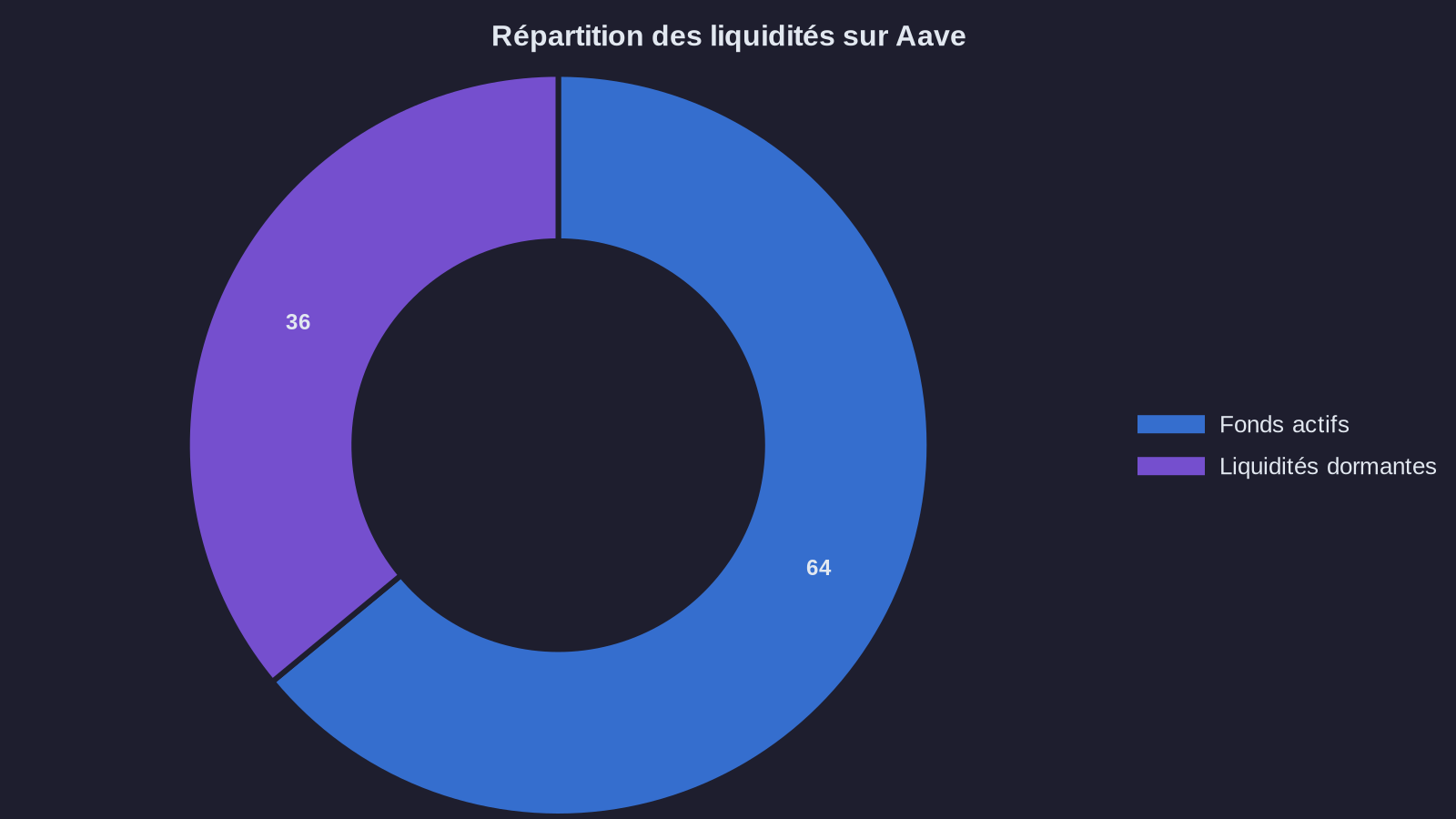
The catch? Not all deposited funds are continuously borrowed. Aave intentionally maintains a DeFi liquidity buffer to ensure depositors can always withdraw their funds instantly. It's as if your bank always kept a portion of customer money in the vault, just in case multiple people wanted to withdraw at the same time.
On Aave, this buffer currently represents $6 billion that isn't working for anyone. These liquidity reserves are neither lent out nor invested. They simply wait, dormant, for a borrower to appear or a depositor to request a withdrawal.
That's precisely what the new reinvestment module is going to change.
The Aave V4 Reinvestment Module: Making dormant money work
The principle is elegant. Rather than letting these $6 billion sit idle, Aave V4 will automatically deploy them in other yield-generating strategies, while preserving the liquidity needed for withdrawals.
Picture a public library. Some books are borrowed every day, others sit on shelves for months. Aave's reinvestment module is like the library deciding to temporarily lend its less-requested books to partner libraries, generating additional revenue in the process, while ensuring they'll be available if someone asks for them.
In practice, excess liquidity can be deployed to:
- Liquid staking protocols like Lido or Rocket Pool for ETH
- Tokenized Treasury bonds for stablecoins
- Other DeFi protocols selected based on strict security criteria
The entire process will be automated and transparent. You won't have to do anything: your deposits will continue working exactly as before, but will generate more yield thanks to this optimization.
An additional revenue source for depositors
The impact for Aave users could be significant. Currently, if you deposit USDC on Aave, you receive interest paid by borrowers. With the reinvestment module, you'll also receive a share of the revenues generated by deploying excess liquidity.
Let's work through a concrete example. Suppose Aave holds $1 billion in USDC, with only $600 million actually borrowed. The remaining $400 million currently generates no return. If the reinvestment module deploys this $400 million in tokenized Treasury bonds offering 4.5% annually, that represents $18 million in additional revenue to distribute to depositors.
This mechanism is nothing revolutionary in traditional finance. It's precisely what your bank does with money you deposit in your checking account. The difference? On Aave, everything is transparent, auditable on the blockchain, and you maintain full control of your funds.
Risks to watch for Aave governance
This innovation raises legitimate questions around risk management. Deploying liquidity to other protocols, even temporarily, introduces new vulnerabilities.
What if the partner protocol gets hacked? If tokenized Treasury bonds lose their peg? If a withdrawal run happens when funds are deployed elsewhere?
Aave Labs anticipated these concerns. The reinvestment module includes several safeguards:
Strict selection criteria: only protocols with proven security track records can receive liquidity from Aave. No deploying funds to recent or unaudited protocols.
Amount limitations: the protocol will deploy only a controlled portion of excess liquidity, never the entirety. A safety cushion will always remain available for withdrawals.
Real-time monitoring: oracles will continuously monitor the state of partner protocols. At the first warning sign, funds can be automatically repatriated.
Still, zero risk doesn't exist in DeFi. Each new layer of complexity introduces new potential attack surfaces. Users will need to weigh the additional yield against these extra risks.
What this changes for the DeFi ecosystem
Beyond the direct impact on Aave, this innovation could redefine industry standards. If the reinvestment module works as intended, other lending protocols will likely follow suit. Compound, Morpho, Spark could develop their own similar mechanisms.
We'd then see a general optimization of capital across DeFi. Currently, tens of billions sit unnecessarily dormant in the reserves of various protocols. Intelligently reinvesting these liquidity pools could significantly increase average yields for all users.
This evolution also brings DeFi closer to traditional finance practices, while retaining its distinctive advantages: complete transparency, no intermediaries, and user control. That's exactly what decentralized finance should do: draw inspiration from proven mechanisms in classical finance, improve them through blockchain, and make them accessible to everyone.
Nora's analogy: It's as if your savings account transformed into an intelligent manager. Rather than leaving your money completely static, it temporarily moves it toward safe investments when you don't need it, while ensuring it's instantly available if you want to withdraw.
Key takeaways
Aave V4's reinvestment module will transform $6 billion in dormant liquidity into an additional revenue source. Excess funds that aren't borrowed will be automatically deployed into revenue-generating strategies, while preserving the liquidity needed for withdrawals.
Depositors will benefit from higher yields without changing how they use Aave. The process will be entirely automated and transparent, with safeguards to limit risks associated with deploying liquidity to other protocols.
This innovation could become the norm in DeFi, pushing other lending protocols to optimize their own liquidity reserves. An evolution that brings decentralized finance closer to the efficiency standards of traditional finance, while keeping its unique advantages.
The question is no longer whether this approach will take hold, but how quickly the rest of the DeFi ecosystem will follow. Now that you understand automatic reinvestment, discover how liquidity pools work to generate yields in DeFi.