
In early 2025, Coinbase announced the progressive rollout of its agent wallets, an infrastructure that enables autonomous agents to handle specific crypto asset management operations. For CFOs allocating a portion of their treasury to crypto assets, this evolution is a game-changer: it shifts from time-consuming manual management to selective automated portfolio management of yield strategies. But what does this architecture truly deliver, and how can it be integrated into a treasury diversification approach without introducing uncontrolled operational risk?
This article examines the technical foundations of Coinbase agent wallets, their concrete use cases for optimizing yield strategies, and the essential safeguards to consider before integrating them into a corporate treasury management system.
Agent wallets: what exactly are we talking about?
An agent wallet is not a simple custodial wallet. It's a system combining three layers: a standard wallet (on-chain address, cryptographic keys), an automated execution interface (smart contracts or off-chain scripts), and a programmable decision layer. Coinbase offers here an infrastructure where the company retains control of its keys but delegates the execution of certain operations to an agent configured according to strict rules.
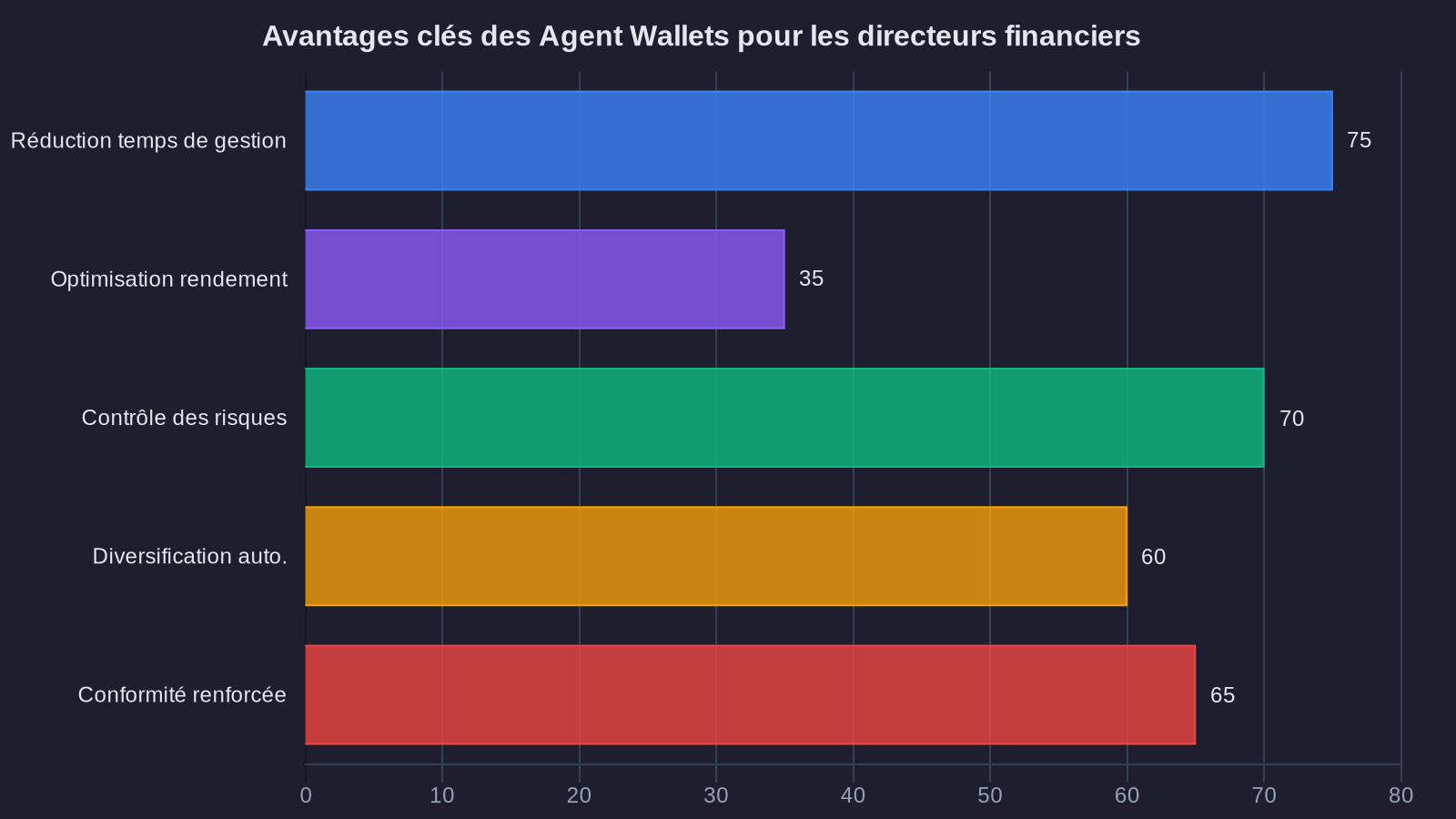
Concretely, a Coinbase agent wallet can monitor yield farming opportunities across multiple DeFi protocols, compare risk-adjusted returns, and automatically redeploy positions when predefined thresholds are breached. For example, if a company allocates €200,000 in USDC stablecoins to a lending protocol, the agent can detect that another protocol offers a rate 1.5 points higher, verify available liquidity, and switch the position without human intervention.
This architecture differs from standard automated management solutions (like trading bots) through its control granularity. The company defines management policies (minimum return thresholds, authorized protocols, concentration limits), and the agent operates within this framework without ability to exceed the set parameters. This reduces execution risk while enabling responsiveness impossible to achieve with manual management.
Use case: optimizing returns on a corporate stablecoin portfolio
Consider an industrial SME with €500,000 in cash reserves, deciding to allocate 10% (€50,000) to stablecoin investments to diversify yield sources. The goal: achieve a net return exceeding that of a standard money market fund (currently around 3% net), while maintaining liquidity available within three months maximum.
Without an agent wallet, the CFO must manually monitor rates offered by different protocols (Aave, Compound, Maker), compare smart contract risks, and decide when to reallocate positions. This operational burden is unavoidable: minimum weekly monitoring is necessary, consuming management time for a relatively modest amount.
With a Coinbase agent wallet portfolio configured, the logic changes. The CFO defines a clear policy: invest only on Aave and Compound (audited protocols with proven track records), maintain 100% USDC exposure, and automatically reallocate whenever a rate differential exceeding 0.5 points persists over a seven-day rolling period. The agent continuously monitors rates, triggers arbitrage opportunities, and the CFO receives consolidated monthly reporting.
Over a year, this DeFi automation can generate a return improvement of 0.8 to 1.2 points compared to static management, or €400 to €600 net on €50,000 invested. The financial gain is modest in absolute terms, but the real benefit lies in reduced operational burden and disciplined execution. The agent has no emotional bias, doesn't defer decisions, and strictly applies the defined policy.
Building a Coinbase agent wallet: architecture and integration
The technical implementation of a Coinbase agent wallet relies on several building blocks. First step: open a Coinbase Prime account (enterprise offering), which provides access to advanced APIs and institutional custody features. Coinbase Prime offers fund segregation and distributed key infrastructure (multi-signature), which reduces compromise risk compared to a standard self-hosted wallet.
Second step: configure the agent wallet via Coinbase interface or API. The company defines management rules (authorized protocols, return thresholds, concentration limits, exit rules in case of liquidity deterioration), and deploys the agent on a limited scope. It's recommended to start with a test amount (€10,000 to €20,000) to validate agent behavior before scaling up.
Third step: integrate reporting into the company's treasury management system. Coinbase provides reporting APIs that enable extraction of position data, realized returns, and executed transactions. This data must be consolidated into the monthly treasury dashboard, with separate tracking of crypto positions and daily mark-to-market valuation.
Point of caution: automated portfolio management doesn't eliminate the need for internal controls. The CFO must implement an alert system for unusual operations (amounts exceeding a threshold, unauthorized protocols, abnormal return spreads). Coinbase offers configurable notifications, but it's prudent to complement this with a monthly manual review of positions and movements.
Risks and limitations: what automation doesn't resolve
The crypto trading agent improves operational efficiency, but it doesn't eliminate the intrinsic risks of crypto assets. Three risk categories remain fully intact.
First risk: smart contract risk. Even by limiting exposure to audited protocols like Aave or Compound, there's always a non-zero probability of critical bugs or exploits. The agent can't assess this risk in real-time: it mechanically applies defined rules. If a protocol suffers an attack and the agent deployed funds the previous day, losses are incurred. DeFi security incidents regularly remind us of this reality. The only mitigation is to diversify protocols and limit per-platform exposure (for example, no more than 30% of crypto allocation on a single protocol).
Second risk: liquidity risk. During market stress periods, DeFi protocols can experience bank runs where withdrawals become impossible or extremely costly (high gas fees, significant slippage). The agent can detect these situations and suspend reallocations, but it can't guarantee immediate exit. For a company, this means part of the treasury allocated to stablecoins could become temporarily illiquid. Therefore, this allocation must be sized according to actual need horizons: no DeFi placement for funds needed within less than three months.
Third risk: regulatory and tax risk. The MiCA framework is progressively applying in Europe, and crypto transaction traceability rules are tightening. Each operation executed by the agent generates a tax event (realized or latent gains/losses, interest received). The company remains responsible for tax reporting of these operations, and Coinbase provides necessary data, but it's up to the accountant to integrate them into financial statements. An agent wallet that frequently reallocates positions can generate significant transaction volume, complicating accounting oversight. It's therefore prudent to limit reallocation frequency (for example, maximum once per month) to simplify administrative management.
Recommendation: start with a limited scope and measure results
For a CFO considering Coinbase agent wallets, the prudent approach is to launch a pilot on a modest allocation (5 to 10% of excess treasury allocated to crypto assets), with strict management rules and detailed monthly reporting. This pilot's objective isn't to maximize immediate returns, but to validate the agent's operational robustness and measure the real time management savings.
After three to six months of operation, it's possible to evaluate whether automation delivers tangible value: net return gain (after Coinbase fees and gas costs), reduced operational burden, absence of technical incidents. If the assessment is positive, the allocation can be gradually increased, always respecting a concentration limit (no more than 10 to 15% of total company treasury in crypto assets).
Automated portfolio management via agent wallet doesn't replace a thoughtful treasury management strategy. It's an execution tool that enables efficiency gains once strategic choices (target allocation, authorized protocols, return thresholds) have been validated. To complement this approach, AI agents can also optimize asset allocation more broadly. For companies with structural cash surplus seeking to diversify yield sources, this technology deserves pragmatic evaluation, without excessive expectations or blanket rejection.