
Imagine this for a moment: an artificial intelligence manages part of your cryptocurrency investments. It analyzes markets 24/7, identifies yield opportunities, moves your funds between different DeFi protocols. And it does all this autonomously, while you sleep or work.
This vision is no longer science fiction. The first autonomous AI agents capable of managing crypto portfolios are already operational. Except there's a major problem: how do you stay in control of an agent that, by definition, acts independently? How do you verify and approve its transactions without losing the benefits of automation?
This is where an innovation comes in that could reshape our relationship with decentralized finance: the combination of AI agents on blockchain and mobile approvals via technologies like WalletConnect. A combination that could very well shape new AI-native fintech models by 2026.
Autonomous AI agents in crypto: much more than simple bots
Let's start by clarifying what an autonomous AI agent really is in the context of crypto assets. We're not talking about a simple trading bot programmed to buy and sell according to fixed rules.
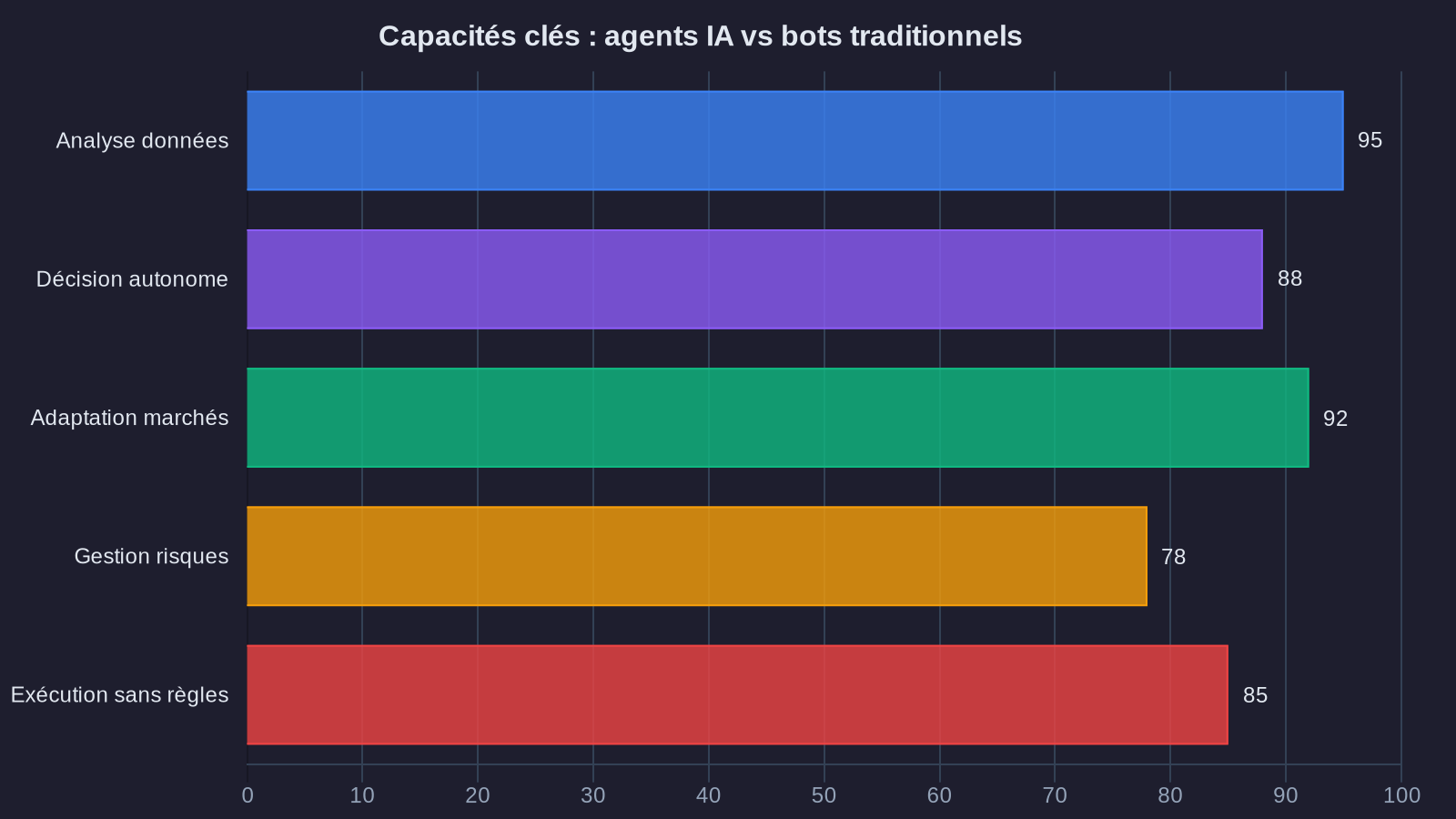
An autonomous AI agent is a program capable of analyzing complex data, making strategic decisions, and executing blockchain transactions, all without continuous human intervention. Think of it as a digital financial assistant that has its own crypto wallet and can interact directly with DeFi protocols — an approach that requires careful consideration of automated asset allocation.
In practice, these agents can perform several types of operations today: moving liquidity between different platforms to optimize returns, participating in liquidity pools, reacting to real-time market movements, or even arbitraging between different blockchains to profit from temporary price discrepancies.
The fundamental difference from traditional tools? These agents have their own wallet, their own on-chain identity. They don't just execute your orders: they act as semi-independent entities to which you delegate certain financial responsibilities.
A crypto AI agent is like a wealth manager who has his own bank account. You entrust him with a certain sum, he makes it grow according to an agreed strategy, but he's the one who signs the checks. The question then becomes: how do you keep an eye on what he's doing?
The control challenge: when autonomy meets blockchain security
The emergence of these autonomous agents raises a thorny question that strikes at the heart of crypto philosophy: how do you reconcile autonomy and security?
In the traditional world of blockchain, you sign every transaction with your private key. This cryptographic signature proves that it's really you authorizing the movement of funds. This is the basic principle of self-custody: you, and you alone, control your assets — a matter of absolutely critical security.
But with an autonomous AI agent, the model changes dramatically. If the agent has to ask you for permission for each action, it loses its main advantage: automation. Conversely, if you give it full and unlimited access to your funds, you're taking considerable risk. What if the agent gets hacked? If it makes a calculation error? If its algorithms malfunction?
This is what's called the "delegation dilemma" in crypto: how do you give enough freedom to an autonomous system while maintaining effective safeguards. Several approaches exist to solve this puzzle.
Some projects use smart contracts with preprogrammed limits: the agent can spend a maximum of X dollars per day, or can only interact with an approved list of protocols. Others opt for "multisig" systems where the agent proposes transactions that you must then manually validate.
But none of these solutions is perfect. Fixed limits lack flexibility. Systematic manual validations kill automation. A middle ground was needed.
WalletConnect and mobile signatures: the missing link
This is where WalletConnect enters the scene with an elegant proposition. For those unfamiliar with it, WalletConnect is an open-source protocol that allows you to connect your crypto wallet (typically a mobile application like MetaMask or Trust Wallet) to decentralized applications.
It works simply: you scan a QR code with your phone, and presto, your mobile wallet can interact with the web application. Each transaction requires your approval on your phone. It's convenient, secure, and above all: it's already widely adopted.
Now, imagine applying this same principle to AI agents on blockchain. The AI agent has its own wallet and can prepare transactions autonomously. But to execute them, it needs your validation through blockchain mobile approvals.
You receive a notification: "Your agent wants to move 500 USDC to the Aave protocol to benefit from a 4.2% rate instead of 3.8%". You review the details in seconds. If everything looks right to you, you approve with a gesture. If something seems off, you decline and the agent adjusts its strategy.
This hybrid approach combines the best of both worlds: the agent retains its ability to analyze and react quickly, but you keep final control over significant fund movements. You could call this "supervised autonomy".
The innovation goes even further with conditional validation systems. You can configure your mobile wallet to automatically approve certain types of transactions (for example: any transaction under 100 dollars on pre-approved protocols) while requiring your manual validation for larger or unusual operations.
It's like having a butler who manages your household. He can do routine shopping and pay regular bills without bothering you. But if someone rings the doorbell or an unusual expense comes up, he sends you a message and waits for your approval.
AI-native decentralized finance: toward new fintech models by 2026
This convergence between autonomous AI agents and blockchain mobile approvals paves the way for what you might call "AI-native DeFi". Financial protocols designed from the outset to be used jointly by humans and artificial intelligences.
We're already seeing platforms emerging that offer "agent strategies" out of the box. You choose an objective (maximize stable returns, optimize taxes, maintain balanced exposure), you define your risk tolerance, and the AI agent handles the rest. Your role is limited to approving major transactions from your phone.
This evolution could profoundly transform the AI-native fintech landscape by 2026. Neobanks and traditional financial services are starting to integrate crypto capabilities, but the real breakthrough may come from these new players building financial services designed for the age of AI.
Several trends are already emerging. First, extreme personalization: unlike traditional investment funds where all clients follow the same strategy, each AI agent can adapt its management to its user's specific profile. Next, 24/7 responsiveness: crypto markets never sleep, and neither does an AI agent. It can seize opportunities at 3am on a Sunday without you having to wake up.
We're also seeing the emergence of new compensation models. Some AI agents operate on a performance basis: they only charge fees if they actually generate returns above a benchmark index. Others offer fixed subscriptions, making active management accessible that was previously reserved for large portfolios.
The challenges remain numerous, of course. Regulation of these new players isn't yet clear in most jurisdictions. Questions of liability in case of error are complex: who's responsible if an AI agent loses money due to an algorithmic bug? Cybersecurity issues are also considerable: a hacked AI agent can cause far greater damage than a simple compromised wallet.
What you need to understand for tomorrow
The combination of autonomous AI agents and blockchain mobile approvals represents much more than a mere technical innovation. It's a new paradigm in our relationship with money and financial automation.
For the first time, we have tools that allow us to truly delegate day-to-day management of certain assets to automated systems, while maintaining a reasonable level of control and oversight. It's neither completely manual management (too time-consuming) nor blind delegation (too risky), but something in between.
The coming years will likely see these technologies mature. Interfaces will improve, the algorithms of AI agents on blockchain will become more sophisticated, security frameworks will strengthen. By 2026, it wouldn't be surprising if the majority of active crypto users use, in some form, AI agents to optimize their exposure to DeFi protocols.
The real question may not be whether this evolution will happen, but how we collectively define the rules of the game. What minimum guarantees should we require from these systems? What level of transparency should we impose on algorithms? How do we protect less tech-savvy users while preserving innovation?
One thing is certain: the world of decentralized finance continues to evolve at a rapid pace. And those who understand the mechanics of these new technologies now will have an edge navigating the financial ecosystem of tomorrow.
- Autonomous AI agents can now manage crypto portfolios independently, but present control and security challenges
- Mobile approvals via protocols like WalletConnect offer a middle ground between automation and human oversight
- This convergence opens the door to AI-native fintech that could transform the decentralized financial landscape by 2026