
You may have heard about these new AI assistants that "trade for you." Binance just launched AI Pro. Trust Wallet is integrating smart agents. We're hearing about algorithms that "optimize your positions" while you sleep.
Before you get carried away or dismiss the idea outright, let's take time to understand what's behind this new wave of AI agents and crypto trading automation. Because unlike the trading robots of the 2010s — often rudimentary and predictable — today's AI trading bots work differently. They learn. They adapt. They make decisions that even their creator couldn't always anticipate.
That changes a lot of things. Including for you, who may have never imagined delegating your investment decisions to a machine.
What an AI agent actually does (and what it doesn't)
Let's start with a simple example. Imagine you wanted to buy Bitcoin when it drops below $60,000, but only if trading volume is high and the long-term trend remains bullish. You could spend your day watching charts. Or you could entrust that task to an AI agent.
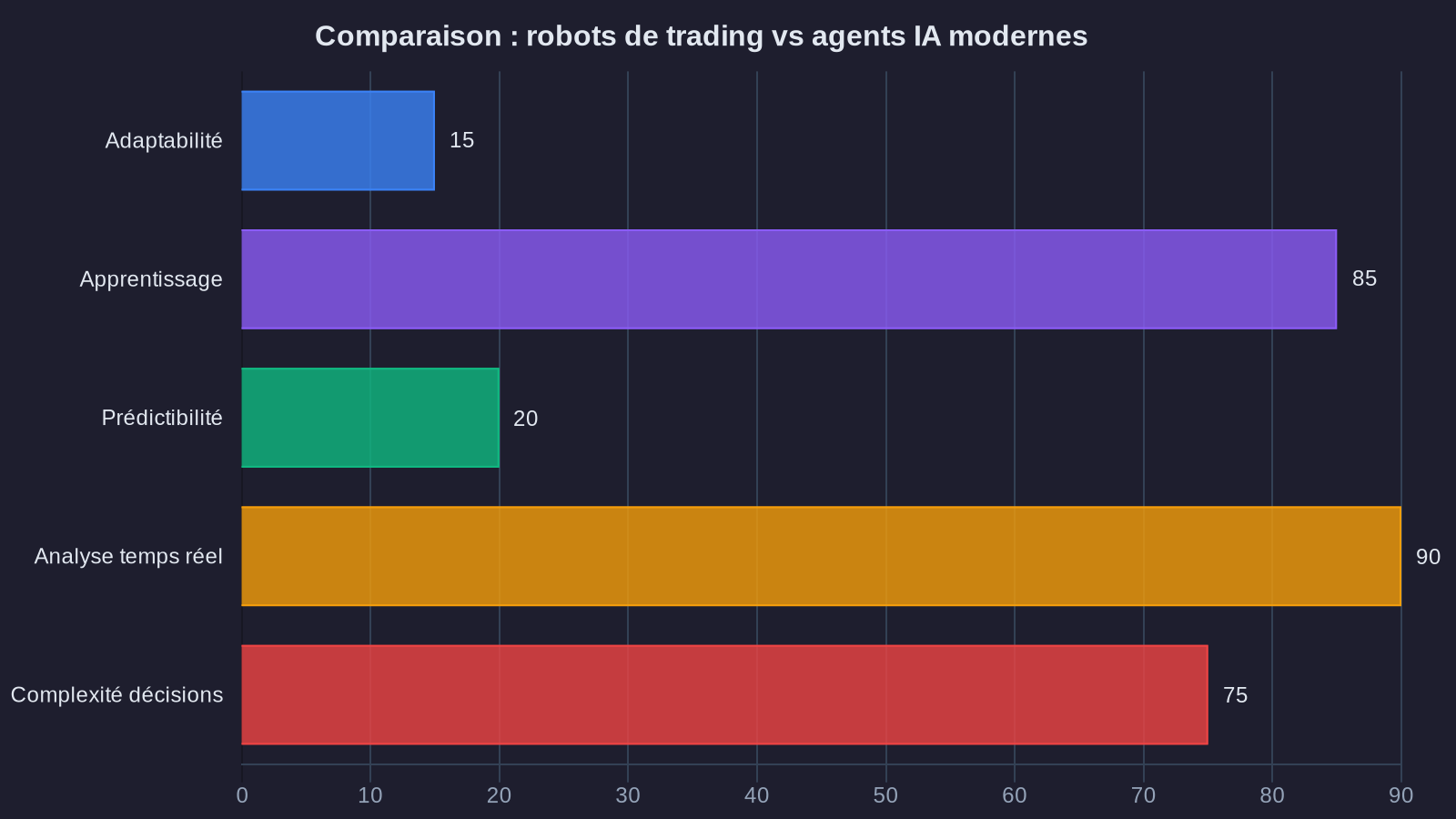
An AI agent isn't just a bot that executes pre-programmed orders. It's a system that:
- Analyzes thousands of data points in real time (prices, volumes, trends, market sentiment)
- Detects opportunities based on criteria you've given it
- Executes transactions autonomously, without you having to click a button
- Learns from its past actions to refine strategies through machine learning
The difference from a standard robot? The robot follows a rigid script. The AI agent adapts. If the market changes behavior, it adjusts its approach. If a strategy stops working, it modifies it. That's the whole power of modern automated crypto strategies.
But be careful: an AI agent doesn't "guess" the future. It doesn't beat the market by magic. It applies strategies you've entrusted to it, with a speed and rigor that no human could maintain 24 hours a day.
The concrete example of Binance AI Pro
Binance AI Pro, launched in early 2025, illustrates this shift in crypto trading automation nicely. Concretely, you connect your Binance account to this assistant. You tell it your goals: would you prefer returns or safety? You set limits: never invest more than X% of your portfolio in a single asset.
Then the agent goes to work. It spots arbitrage opportunities (buying a token on one platform where it's cheaper, reselling it elsewhere). It rebalances your portfolio when an asset becomes too concentrated. It exits a position if indicators show a reversal.
All without you having to open the app. You simply get notifications: "I sold 15% of your ETH because volatility exceeded your comfort threshold."
It's fascinating. It's also a bit unsettling. Because you're delegating part of the control — a reality that even the biggest asset managers must now integrate into their strategies.
Trust Wallet and conversational AI: chatting with your wallet
While Binance is betting on trade automation, Trust Wallet is exploring another path: conversational AI. Imagine being able to ask questions to your wallet as if you were talking to a financial advisor.
"Which tokens in my wallet have grown the most this month?"
"Show me liquidity pools with over 8% yield and moderate risk."
"What's the best strategy to diversify my stablecoins?"
Trust Wallet's AI agent analyzes your portfolio, consults market data, and responds in natural language. Better yet: it can execute actions directly. "Swap 100 USDT for BNB at the best available rate."
It's like having a personal assistant who knows your financial situation, tracks crypto markets constantly, and helps you make informed decisions.
Why it's different from a simple chatbot
The distinction matters. A standard chatbot gives you generic answers pulled from a database. Trust Wallet's intelligent crypto agent analyzes your specific situation. It knows what you hold. It knows your past transactions. It can tell you: "You tend to sell too early when an asset drops 10%. Would you like to set a rule to avoid emotional decisions?"
That completely changes the relationship you have with your portfolio. It's no longer just a digital safe. It's a tool that actively guides you in your decisions.
The risks you absolutely need to understand
Now, let's be clear: delegating financial decisions to an AI isn't trivial. There are risks you need to know about before diving in.
First risk: the black box. You don't always know exactly why the agent made a particular decision. It tells you it sold your SOL "due to deteriorating technical indicators." But which indicators? With what weighting? With what margin of error? This opacity can create frustration, even distrust.
Second risk: over-optimization. An AI agent learns by analyzing past data. If you let it train only on the last six months — a bull market period — it will develop strategies that work well... in a bull market. The moment the market crashes like during Fed announcements, its performance collapses. That's called overfitting: the agent becomes too specialized for a particular context.
Third risk: dependency. Entrusting your portfolio management to an agent is convenient. But it can also disconnect you from your investments. You stop following markets. You no longer understand why a position was taken. The day the agent makes a big mistake — and it will — you won't have the reflexes to react.
Questions to ask yourself before getting started
Before entrusting part of your capital to an AI trading bot, ask yourself these questions:
- Do I understand the broad strokes of the strategy being used?
- Have I set clear limits (maximum amount, acceptable risk level)?
- Do I keep a regular eye on what the agent is doing, or am I letting it run on complete autopilot?
- What happens if the agent crashes, the platform goes down, or the exchange's API is compromised?
These questions aren't there to discourage you. They're there to protect you. Because a well-configured and well-supervised AI agent can really improve your results. But a poorly set agent or one left without oversight can destroy your capital in a few hours.
AI agents don't replace your judgment
Here's what you need to take away: AI agents and crypto trading automation aren't omniscient financial advisors. They're powerful, fast, tireless tools. But they remain tools.
An AI agent excels at disciplined execution of a strategy. It will never panic. It won't sell out of emotion. It will apply your rules to the letter, even at 3 a.m. on a Sunday.
But it will never replace your ability to step back. To ask yourself if that strategy still makes sense in the current context. To decide it's better to exit the market entirely for three months because the macroeconomic situation is becoming too uncertain.
AI frees you from repetitive tasks. It lets you focus on overall strategy. But it doesn't relieve you of the need to think.
How to use an AI agent well in 2025
If you decide to test these automated crypto strategy tools, here are some concrete recommendations:
Start small. Don't entrust 50% of your portfolio to an agent on day one. Test with 5 or 10%. Watch how it behaves. Understand its logic.
Set strict guardrails. Limit the maximum amount per trade. Set a daily loss threshold beyond which the agent stops. Forbid it from touching certain assets you want to hold long term.
Review reports regularly. Most agents generate daily or weekly reports. Take 10 minutes to read them. You'll quickly spot if something's not right.
Never completely shut off your brain. The AI agent works well in a stable environment. But if a major event occurs — sudden regulation, a massive hack, widespread panic — it's up to you to decide to pause the agent.
AI agents and crypto trading automation on Binance and other platforms are redefining how we invest in crypto. They bring discipline, responsiveness, and analytical capacity that few individual investors can match. But they're not infallible. They're not magical. They remain what you make of them: remarkably efficient assistants, provided you keep control of the overall strategy.
The question is no longer whether to use AI in your crypto investments. It's how to use it intelligently, without losing sight of the fact that it's your capital, your objectives, and therefore your responsibility.