
A business executive who decides to allocate a portion of their treasury to crypto-assets finds themselves facing a paradoxical ecosystem. On one hand, the Solana blockchain offers opportunities for exposure to innovative protocols with robust technical infrastructure. On the other, there's a proliferation of fraudulent tokens designed to disappear within hours of launch, taking investors' funds with them. These "rug pulls" represent a considerable asset risk that no serious company can ignore.
The question isn't whether to abandon all exposure to emerging tokens, but how to build a rigorous, automated audit process that protects invested capital. AI agents for detecting rug pull tokens on Solana have become an essential governance tool for any professional crypto strategy.
The rug pull on Solana: anatomy of a real asset risk
Let's consider a concrete case. A small business decides to allocate 50,000 euros to a diversified portfolio including promising Solana tokens identified by their advisor. Without a structured audit process, they can end up exposed to a token whose creator holds 90% of the total supply, with contract modification rights that allow them to block sales at any time. The classic scenario: artificial price appreciation through coordinated purchases, followed by massive liquidation of the creator's position, leaving other holders with worthless, illiquid tokens.
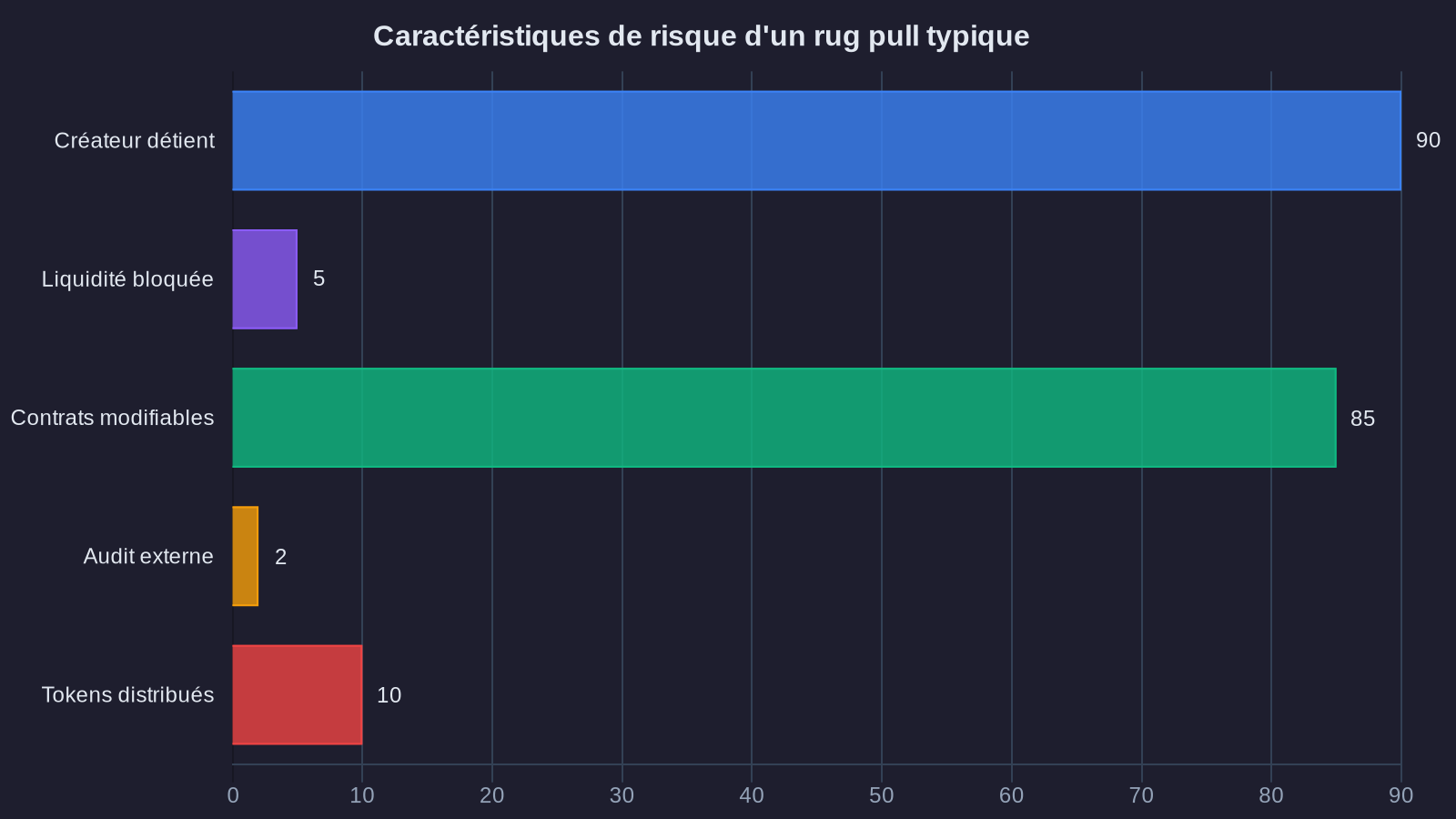
There are thousands of these fraudulent operations recorded each year on Solana. The average loss per victim varies considerably, but companies that diversify without due diligence expose themselves to losses that can represent the entirety of their allocation to a given token. This isn't normal volatility: it's an outright loss resulting from deliberate fraud. As illustrated by the average cost of a DeFi security breach, these risks represent major financial stakes for organizations.
The MiCA regulation, while strengthening obligations for crypto-asset issuers in Europe, doesn't cover all tokens launched on public blockchains like Solana. Verification responsibility therefore falls entirely on the investor. For a company, this means putting in place technical safeguards before any capital allocation.
The technical indicators an AI agent should prioritize analyzing
A serious audit of a Solana token relies on systematic smart contract token analysis and examination of several on-chain parameters. These verifications, impossible to perform manually at scale, can be automated via AI agents configured to query the blockchain and analyze data in a structured manner.
Supply distribution constitutes the first warning signal. A token where a single wallet holds more than 50% of circulating supply presents an obvious manipulation risk. The agent must identify not only the largest holders, but also suspicious distribution patterns: recent token creation, extreme concentration on a few addresses, lack of real liquidity on decentralized exchanges.
Analysis of the smart contract itself reveals essential information. Some contracts integrate unlimited "mint" functions allowing the creator to issue new tokens at will, instantly diluting the value for existing holders. Others include freeze mechanisms allowing the creator to block sales for certain wallets while authorizing them to liquidate their own position. A competent AI agent must scan for these functions and flag their presence immediately.
Real liquidity available on decentralized pools constitutes another critical indicator of Solana ecosystem risk. We regularly observe tokens displaying a theoretical market cap of several million euros, while total available liquidity for selling doesn't exceed a few thousand euros. A high-performing agent must calculate the liquidity-to-capitalization ratio and alert if this falls below pre-defined safety thresholds.
The transaction history of the creator also deserves particular attention. If the address that deployed the contract has already launched several tokens followed by massive liquidity withdrawal, the probability of another rug pull is statistically elevated. The AI must cross-reference historical data and establish a risk profile for the creator.
Building or using an AI audit agent: practical considerations for businesses
A company has two options: develop a custom audit agent in-house or leverage existing solutions. The choice depends primarily on the volume of planned allocations and available technical resources.
For a small business that occasionally diversifies its crypto treasury without a dedicated technical team, automated crypto screening tools like RugCheck, BubbleMaps, or Solscan Pro offer accessible automated analysis features. These platforms aggregate on-chain data and generate risk scores based on predefined criteria. The advantage: immediate implementation, user-friendly interface, reasonable cost (often a few hundred euros per month for professional access). The disadvantage: dependence on a third party and inability to fully customize audit criteria.
For an organization managing a significant crypto portfolio or integrating these verifications into a recurring investment process, developing a custom agent can be justified. Technically, this involves connecting the agent to Solana APIs (Solana RPC, Helius, QuickNode), implementing smart contract parsers, and building scoring rules adapted to the company's risk policy. Initial investment runs into tens of thousands of euros depending on desired complexity, but offers total autonomy and precise alignment with the organization's asset management criteria.
In both cases, one must never view the AI agent as infallible. An automated audit detects known patterns and obvious technical indicators, but doesn't replace fundamental analysis of the project, its team, and strategic positioning. AI constitutes a first line of defense that eliminates crude fraud. The final allocation decision remains a human judgment call that incorporates broader asset considerations, particularly evaluation of potential drawdown.
Integrating automated audit into rigorous asset governance
Automated audit by AI agent shouldn't be viewed as a technological gimmick, but as a structural component of crypto-asset governance in the company. This requires formalizing a clear decision-making process.
In practice, every allocation to a Solana token must first pass through automated verification generating a technical risk report. This report must be archived and integrated into the investment decision file, just like a standard financial analysis. If the risk score exceeds a threshold defined by management policy, the allocation is automatically rejected, regardless of the project's apparent attractiveness.
This approach offers several advantages for the executive. First, it transforms a subjective decision ("this token looks interesting to me") into an objectifiable and auditable process. Second, it protects against behavioral biases that lead to underestimating technical risks in light of high expected returns. Finally, it constitutes evidence of due diligence in case of tax audits or disputes with partners or investors.
From a French tax perspective, losses from rug pulls remain taxable losses-on-investment just like gains. A company that falls victim to proven fraud can certainly file a complaint, but recovering funds proves impossible in nearly all cases. Prevention through automated audit therefore constitutes the only truly effective protection.
In practice, rigorous governance also requires limiting exposure to unaudited tokens. A simple rule might be: no more than 5% of total crypto allocation on emerging Solana tokens, and zero allocation to any token where the AI agent flags critical red flags (extreme concentration, freeze functions, doubtful creator history). This discipline protects company assets against occasional misjudgments.
Toward a prudential approach to crypto diversification
Automating token audit via AI agents for detecting rug pull tokens on Solana represents a major advance in securing crypto-asset exposure within companies. It doesn't eliminate the inherent risk of these assets, but it removes a significant portion of pure fraud risk that has no economic justification.
For an executive or CFO, the question is no longer whether to implement these verifications, but how to integrate them into a coherent governance process. Investment in an AI audit agent, whether through subscription to an existing platform or development of an in-house solution, should be viewed as an asset compliance cost, just like accounting audits or internal controls. This approach fits into a broader strategy of automating asset management.
Crypto diversification remains a treasury management decision that requires accepting significant capital loss risk. But this risk must be an assumed economic and technical risk, not an avoidable fraud risk. Automating audit now constitutes the minimum standard for any company integrating crypto-assets into its asset strategy.
```