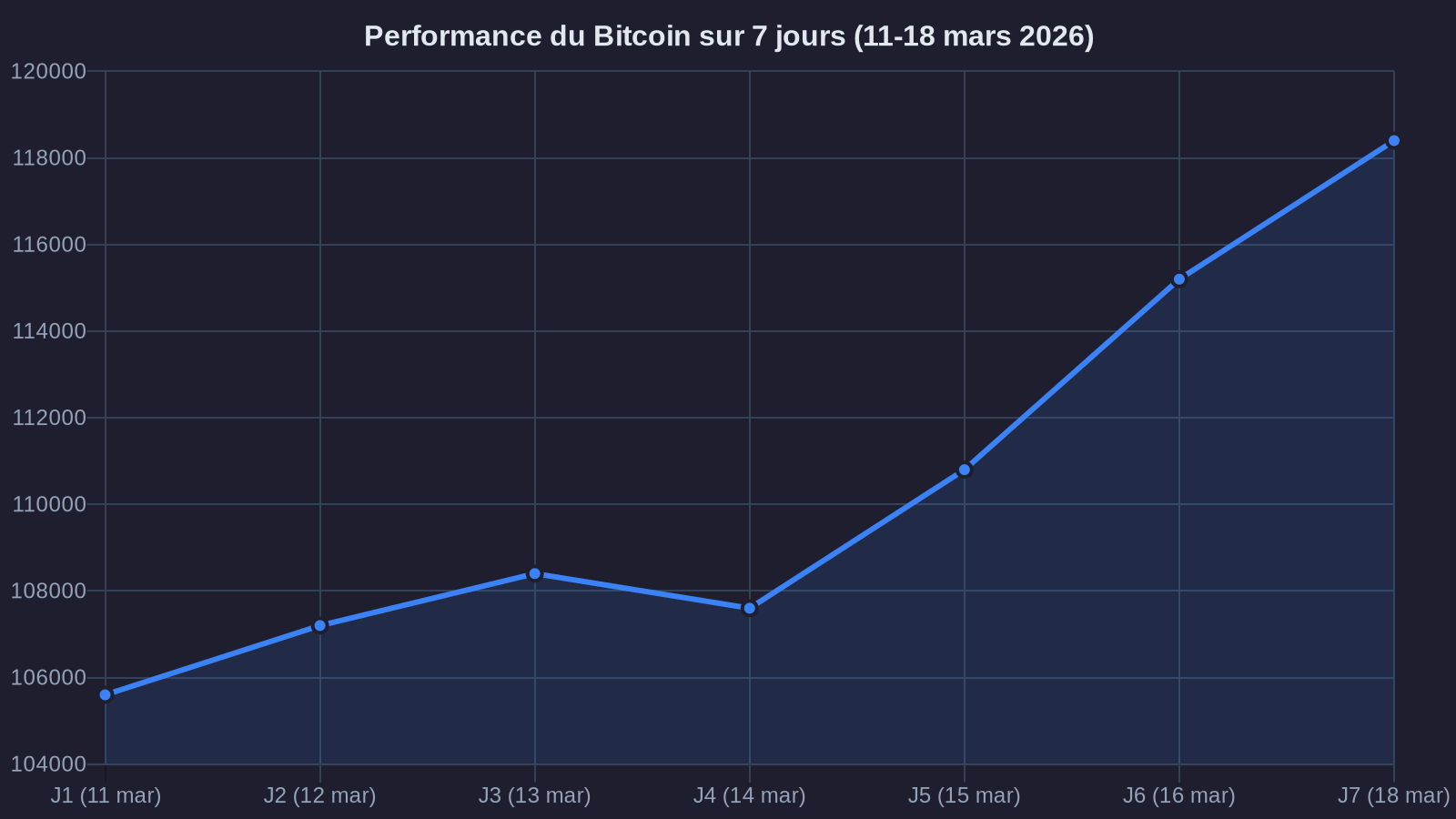
Bitcoin is trading at $118,400 on March 18, 2026, up 12% over 7 days. A level that might seem disconnected from current geopolitical reality. While tensions between Iran and Israel reach their most critical point since 2024, crypto markets are displaying unexpected resilience against Bitcoin geopolitical risk. This situation marks a turning point in how Bitcoin is perceived as a safe-haven asset.
Three events are converging this week: military escalation in the Middle East, the return of US bond yields to 4.5%—a level that's restoring appeal to traditional investments—and the first week of consecutive net outflows from XRP ETFs since their launch. These three macro factors crypto are drawing a new map of capital flows. Understanding how they interact has become essential for properly positioning a crypto portfolio.
Bitcoin facing the Iranian crisis: a selective safe-haven asset
Israeli airstrikes on Iranian nuclear facilities on March 14 triggered an immediate reaction in traditional markets. Gold surged 3.2% in 24 hours to hit $2,890 per ounce. Brent crude broke through the $94 per barrel mark. US equity indices fell 2.1% in the aftermath.
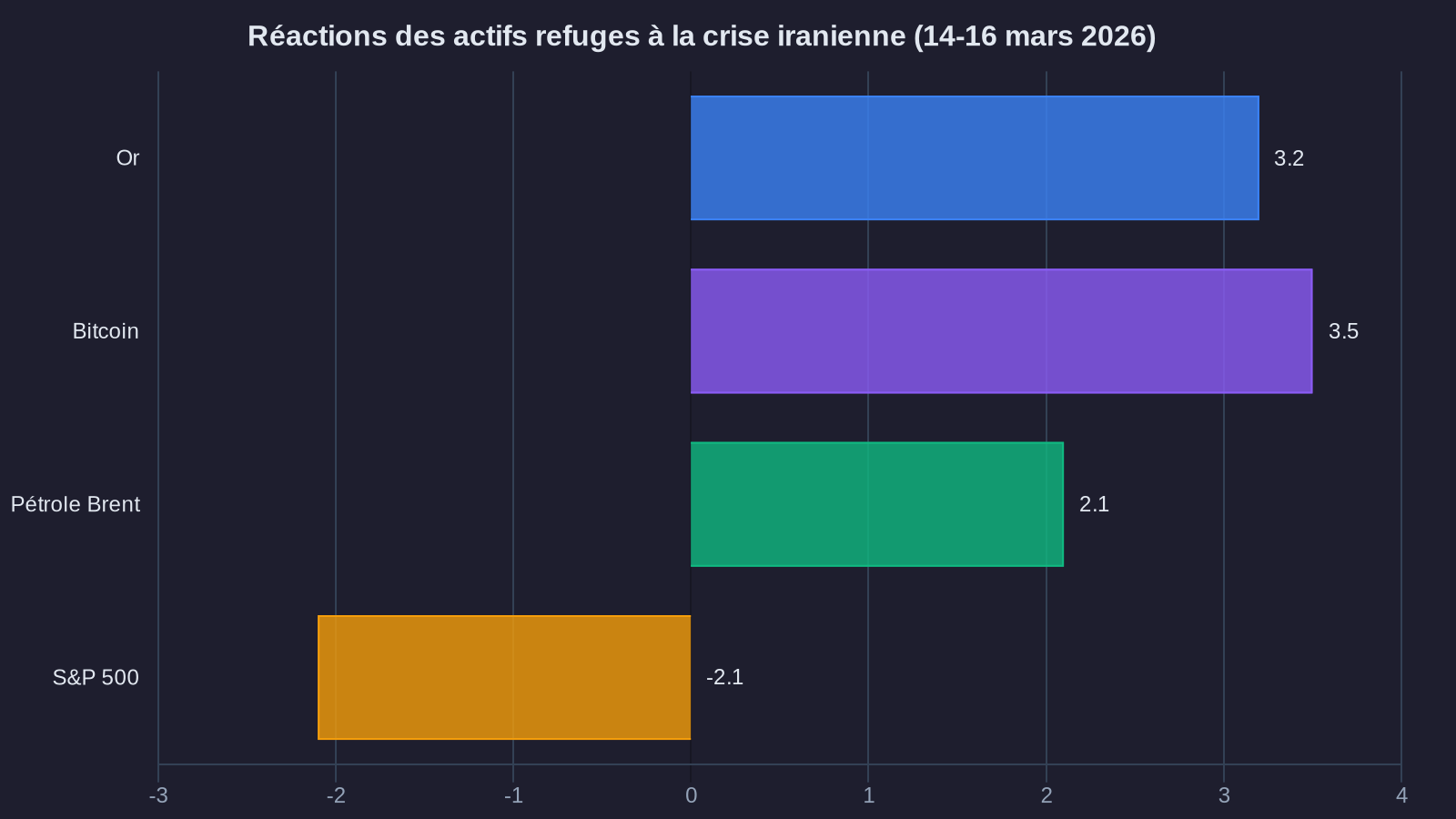
Bitcoin, on the other hand, only fell 0.8% on announcement day, before recovering 4.3% over the following 48 hours. This behavior contrasts sharply with March 2020, when a simple lockdown announcement caused BTC to plunge 50% in three days. It also contrasts with February 2022, during the Ukraine invasion, when Bitcoin lost 17% in a week.
Two explanations emerge from this resilience. First: growing maturity in the institutional market. US spot Bitcoin ETFs recorded $2.3 billion in net inflows during the March 10-14 week—a record since July 2025. These flows predominantly come from family offices and pension funds that are maintaining their strategic allocation despite turbulence.
The second explanation lies in volume geography. On-chain data analysis shows that 68% of spot volumes now come from regions outside the US and Europe: Southeast Asia, Middle East (excluding Iran and sanctioned countries), Latin America. These regions view Bitcoin as a hedge against their local currency instability, regardless of global geopolitical tensions. For a Lebanese or Turkish investor, an Iran-Israel conflict doesn't fundamentally change the equation pushing them toward crypto-assets.
Bond yields at 4.5%: the return of competition for stablecoins
The 10-year US Treasury yield crossed the 4.5% threshold on March 16. It's the highest level since November 2023. This Treasury yields impact shifts the dynamics for a significant portion of crypto capital: stablecoin holders.
The numbers speak volumes. As of March 18, 2026, total stablecoin outstanding reaches $198 billion. USDT represents $121 billion, USDC $58 billion. These amounts remain massively deployed across DeFi protocols offering yields of 3% to 8% depending on risk tolerance. But risk perception shifts when a risk-free Treasury yields 4.5%.
A migration is already underway. Stablecoin outstanding declined by $3.2 billion over the last 7 days—the first weekly decline in 11 weeks. In the same timeframe, tokenized money market funds (representing Treasuries on blockchain) grew by $1.8 billion. Protocols like Ondo Finance and Franklin Templeton OnChain US Government Money Fund are recording inflows at record levels.
This dynamic remains marginal at the total market scale for now. But it illustrates a reality: when rates rise, crypto yield strategies must offer a clear risk premium. A lending protocol offering 5% on USDC becomes less attractive against a 4.5% Treasury with no smart contract risk, no depeg risk, no regulatory risk.
For crypto portfolio managers, this requires a recalibration. Passive stablecoin allocations across mid-range yield protocols (4-6%) no longer make the same sense. You either need to increase risk exposure to capture truly differentiated yields (10%+), or accept temporarily exiting crypto yield strategies to reposition on the shorter end of the bond curve.
XRP ETFs: the first week of net outflows since launch
XRP ETFs have faced their first real test. After a triumphant launch in January 2026 with $4.2 billion in cumulative inflows over the first six weeks, investment vehicles backed by Ripple's token recorded $287 million in ETF outflows between March 11 and 18.
This flow reversal occurs in a specific context. XRP has lost 18% since its February 28 peak of $3.42, settling at $2.81 on March 18. This correction is part of a broader sector rotation within crypto-assets. Large-cap altcoins (ETH, SOL, XRP, ADA) collectively underperformed Bitcoin by 14 percentage points over March.
Two factors explain this reversal in XRP ETFs. The first is technical: natural profit-taking after a 340% surge between November 2025 and February 2026. Institutional investors who entered early on the ETFs are locking in gains. This is standard behavior, also observed with Ethereum ETFs between August and October 2025.
The second factor is more structural. XRP ETFs attracted a different investor profile than Bitcoin ETFs: less institutional, more retail through mainstream brokerage platforms. This investor segment reacts more quickly to price movements and sentiment cycles. When momentum reverses, outflows can be sharp.
Flow analysis by issuer confirms this hypothesis. ETFs offered by Grayscale and Bitwise—whose clientele is more institutional—show stable or slightly positive flows. Outflows are concentrated in vehicles distributed through Robinhood and online brokers, where rotation is structurally higher.
This first week of outflows doesn't signal the end of XRP ETFs. It simply normalizes their trajectory. After launch euphoria, flows stabilize around a base of conviction investors. This is exactly what Bitcoin ETFs experienced between April and July 2024.
What ForYield thinks
The convergence of these three events—Bitcoin's resilience amid Iran-Israel tensions, rising bond yields, the first correction in XRP ETFs—is drawing a new phase of maturity for crypto markets. Investors are no longer reacting solely on sentiment or speculation. They're comparing, arbitraging, rationalizing their allocations.
At ForYield, this evolution reinforces our active management approach for yield strategies. In an environment where risk-free rates are rising and geopolitical volatility persists, passive crypto allocations are losing their relevance. You now need to build portfolios that capture specific risk premiums: optimized DeFi yields, selective exposure to altcoins with solid fundamentals, tactical hedging in case of market stress.
We continue to favor Bitcoin as a portfolio anchor—its resilience to external shocks is proven. But we're progressively reducing passive stablecoin exposure in favor of active yield strategies on senior lending protocols or liquidity pools with low impermanent loss. On altcoins, selectivity becomes imperative. The sharp rotation seen in XRP reminds us that an ETF doesn't transform a speculative asset into a stable investment.
Bitcoin at $118,400 doesn't live in a bubble disconnected from the world. It evolves in a financial ecosystem where every asset competes. Iran-Israel tensions remind us that geopolitical stability is never guaranteed. Yields at 4.5% remind us that capital has an opportunity cost. Outflows from XRP ETFs remind us that flows can reverse quickly. In this context, only rigorous active management allows you to sustainably preserve and grow crypto capital.