
Ethereum is worth approximately 250 billion dollars in market capitalization today. The Ethereum Foundation holds an estimated treasury of over one billion dollars. Yet the developers maintaining the core protocol — those ensuring the network's security and evolution — struggle to secure stable funding. This paradox reveals a major structural vulnerability for the world's second-largest blockchain, an Ethereum development funding crisis that threatens the network's long-term viability.
On March 12, 2026, during a public address, Tim Beiko, coordinator of Ethereum's core developers, confirmed that several essential protocol contributors had left their positions due to inadequate compensation. The announcement sent shockwaves through the community. It raises a fundamental question: how can a network securing hundreds of billions of dollars afford to neglect those ensuring its technical continuity?
An outdated core developer funding model
From its inception, Ethereum has relied on a hybrid development financing model. The Ethereum Foundation funds part of the teams, but the bulk of core work is carried out by developers employed by third-party companies (Consensys, Chainlink Labs, Protocol Labs) or non-profit organizations like EF Research. This system, effective in the early years, is now showing its limits.
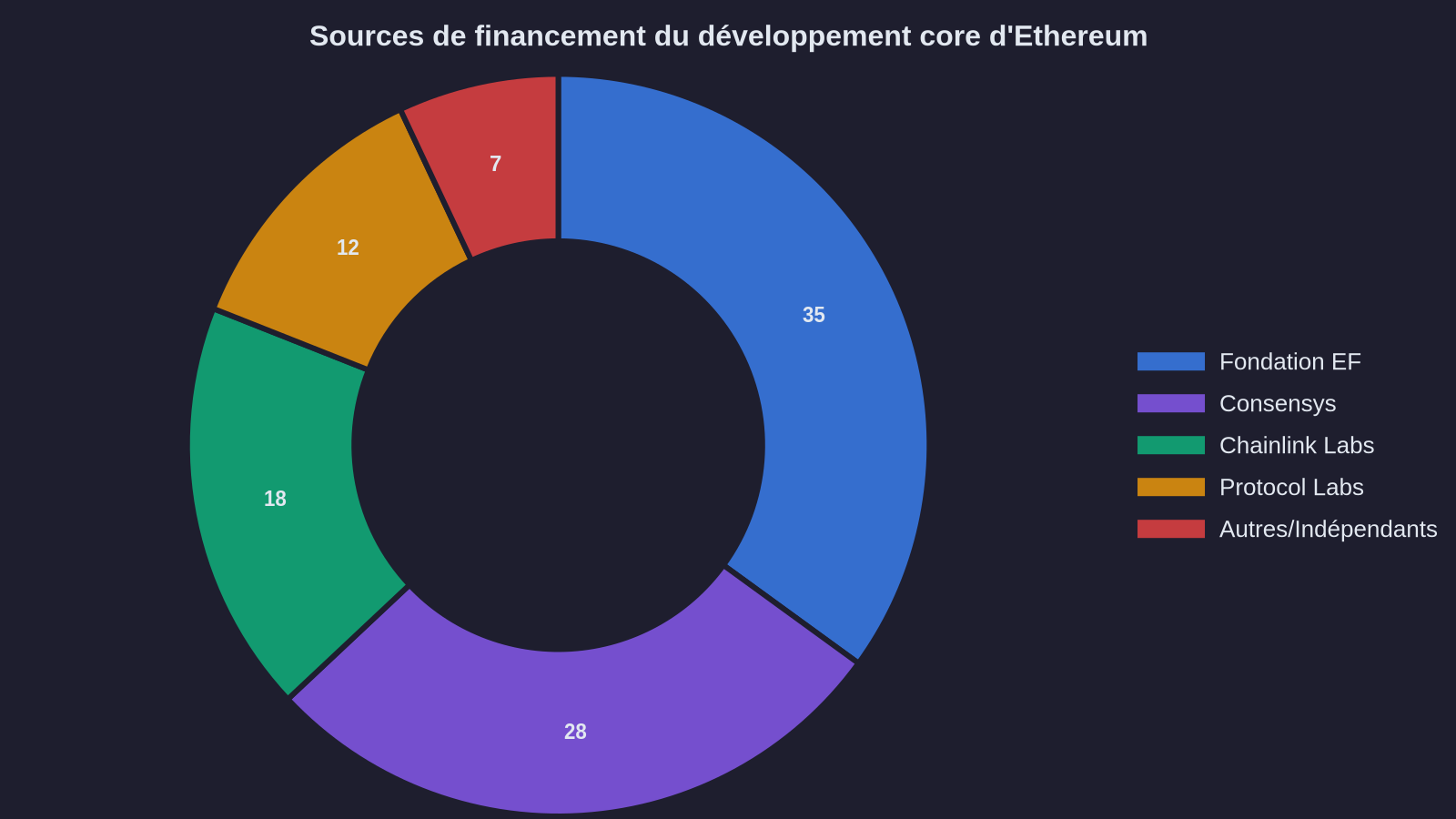
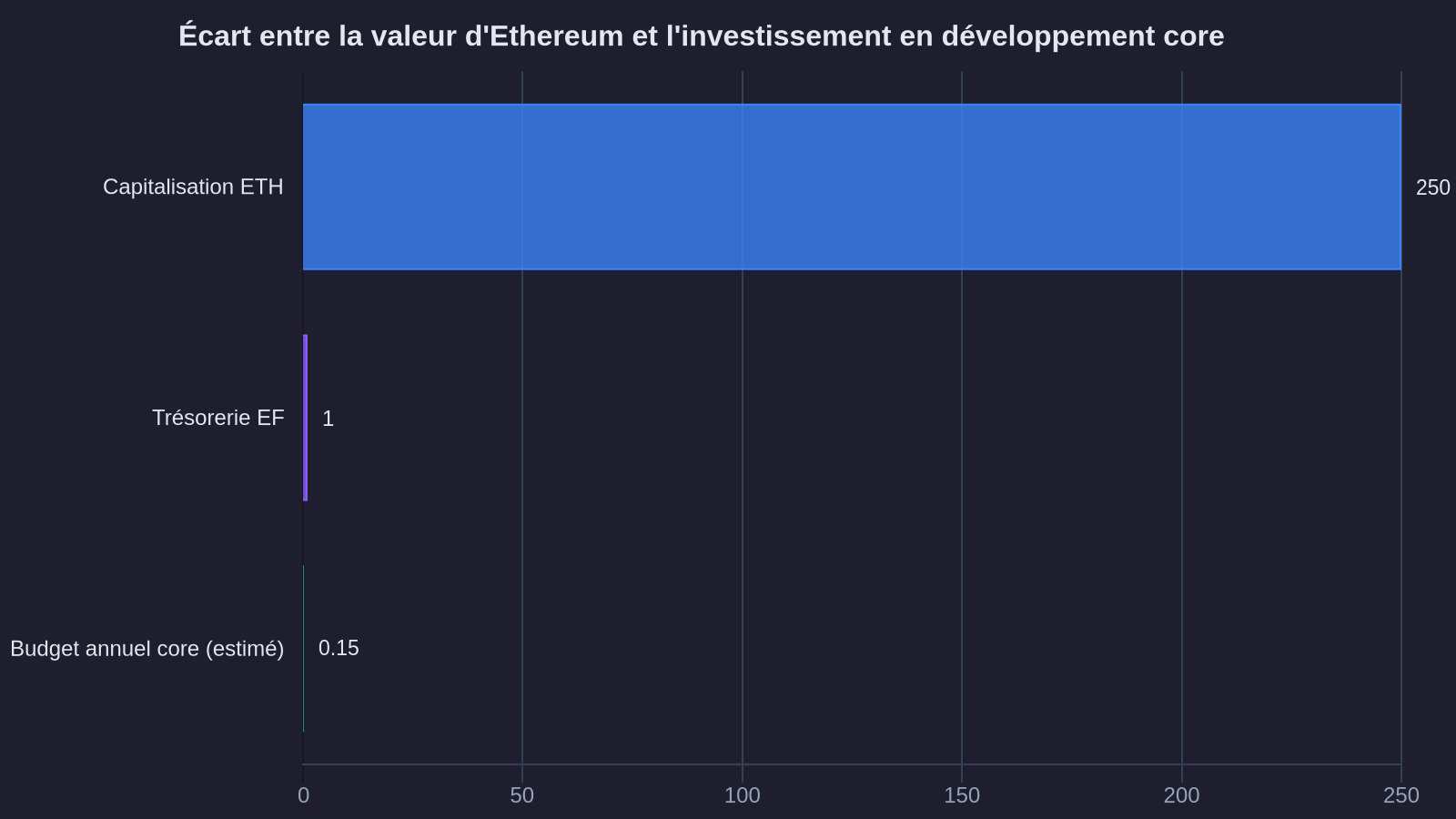
First challenge: dependence on market cycles. When ETH was at $4,800 at the end of 2021, funding a developer team seemed natural for a crypto company. With ETH fluctuating between $1,500 and $2,500 between 2022 and 2024, many sponsors slashed their R&D budgets. Core developers, however, cannot interrupt their work with price swings. Network security demands absolute technical continuity—a challenge that the exodus of developers toward AI only exacerbates.
Second problem: compensation asymmetry. A competent Solidity developer can easily command $200,000 to $400,000 annually working on a DeFi application or Layer 2 project. A core developer working on the Geth client or consensus specifications often earns two to three times less. We're talking about salaries between $80,000 and $150,000 for ultra-specialized profiles. Result: top talent migrates to better-funded projects, leaving the base protocol understaffed.
Recent figures confirm this. In 2023, the team working on the Prysm client (one of the most widely used consensus clients) had 12 full-time developers. By March 2026, they number just 7. The same story for Lighthouse, another critical client: the team dropped from 9 to 5 people in 18 months. This staff erosion comes precisely when Ethereum is preparing critical upgrades (Verkle Trees, improved PBS, partial statelessness).
Direct consequences for Ethereum network security
A blockchain network doesn't maintain itself. Every line of protocol code must be audited, tested, and optimized. Critical bugs must be fixed quickly. Potential attacks must be anticipated. All of this requires qualified, available, and stable human resources.
On February 7, 2026, a flaw in blob handling (introduced with EIP-4844) was discovered by an independent researcher. The fix took 11 days to deploy across all clients, versus the typical 48 hours for this type of vulnerability. Teams cited the reason: lack of bandwidth to coordinate dispersed teams. No malicious exploitation occurred, but the incident revealed degraded network responsiveness to threats—a genuine Ethereum technical risk that underscores the importance of protocol maintenance, just as much as quantum threats to Ethereum security.
We're also seeing a slowdown in the pace of improvements. Ethereum's roadmap initially planned Verkle Trees deployment for mid-2026. This upgrade, essential for improving node efficiency and lowering entry barriers, has been postponed to no earlier than late 2027. Official reason: insufficient development resources to finalize specifications and testing.
This creates a vicious cycle. Fewer core developers means fewer innovations, so less appeal for new projects, so less revenue to fund development. Meanwhile, competitors like Solana or Avalanche, backed by well-endowed foundations and aggressive VC structures, are accelerating their development cycles.
What ForYield thinks
At ForYield, we've been monitoring this issue closely for several quarters. Ethereum's technical soundness has always been a pillar of our ETH allocations for clients. A less well-maintained network means increased security risk, and therefore a higher risk premium to incorporate into our valuation models.
Concretely, we've adjusted our ETH return projections for 2026-2027. We now integrate an operational risk factor into our internal scoring. This doesn't mean we're selling our ETH positions—far from it. Ethereum remains the most decentralized and mature blockchain for large-scale financial applications. But we're modulating our exposure based on how this funding issue evolves.
We're also closely following ongoing discussions within the Ethereum community. Several proposals are circulating: creation of an endowment fund dedicated to core developer funding, implementation of an automatic redistribution mechanism for a fraction of transaction fees, or introduction of a recurring grant system funded by major DeFi protocols built on Ethereum. No solution has yet emerged as consensus, but the debate is open.
Solutions to watch regarding Ethereum protocol funding
The Ethereum community is not passive in facing this problem. Several initiatives are under evaluation, each with its own advantages and limitations.
The first option, championed notably by Vitalik Buterin himself, involves formalizing a protocol funding mechanism. This would involve collecting a fraction of transaction fees (for example, 0.5% to 1%) to feed a dedicated core developer fund. This system would guarantee a stable revenue source, indexed to network activity. The main obstacle: it requires a protocol change, hence community consensus that's difficult to achieve. Many see it as a form of taxation contradicting crypto ethos.
Second avenue: creation of a financing consortium bringing together major beneficiaries of the Ethereum ecosystem. Uniswap, Aave, Lido, MakerDAO, and other major DeFi protocols would generate a common fund to finance core teams. The idea was formally proposed in January 2026 by Aave Governance. The amount discussed: 50 million dollars annually, distributed among different development teams. This approach has the advantage of not touching the protocol, but it raises governance questions: who decides fund allocation?
Third path: issuance of a specific governance token to fund development. This model, inspired by what Polkadot does with DOT, would allow fundraising while giving contributors long-term interest alignment. But it complicates Ethereum's economic architecture and potentially dilutes ETH value.
None of these solutions is perfect. All raise questions about Ethereum governance, potential centralization, and community acceptability. But the urgency is becoming inescapable. The coming months will be critical in seeing a viable model emerge.
Implications for long-term ETH investors
For an investor holding ETH over a multi-year horizon, this funding crisis is far from trivial. It touches on the network's credibility as a trust infrastructure.
First point of attention: Ethereum's ability to deliver on its technical roadmap. Updates like sharding, improved PBS (Proposer-Builder Separation), or scalability optimization directly depend on available development resources. A structural slowdown in innovation pace could see Ethereum lose ground to more agile competitors.
Second element: governance risk. If core developers become too dependent on a few major sponsors (Consensys, a16z, Coinbase), that poses a decentralization problem. Ethereum could become de facto controlled by an economic oligarchy, contradicting its founding principles. For an investor concerned with long-term resilience, that's a red flag to watch.
Third consideration: valuation impact. ETH valuation models rest largely on the assumption of a continuously improving network capable of absorbing a growing share of global financial activity. If this improvement dynamic slows, value projections for 5-10 years should be revised downward. We've integrated this factor into our own models, with an 8 to 12% discount on our optimistic scenarios depending on how the situation develops in the second half of 2026.
That said, Ethereum retains considerable assets. The network still benefits from the industry's most powerful network effect, with more than 4,000 active decentralized applications and unparalleled on-chain liquidity. The transition to proof-of-stake also significantly reduced the network's environmental footprint, a compelling argument for institutional investors subject to ESG constraints. But these achievements aren't enough if technical infrastructure degrades for lack of resources.
An opportunity to rethink decentralized digital public good funding
Beyond Ethereum's specific case, this crisis raises a broader question: how do we sustainably fund decentralized digital infrastructure? The traditional open-source model, based on volunteerism and a few sponsors, clearly doesn't work at the scale of a network securing hundreds of billions of dollars.
Other blockchain ecosystems have adopted different models. Polkadot directly integrates a treasury mechanism into its protocol that funds development via an on-chain voting system. Solana has a richly-endowed foundation that directly employs a large portion of core developers. Cosmos built a model of interconnected zones where each chain can fund its own developers while contributing to the common protocol.
Ethereum could draw inspiration from these models while preserving its decentralized architecture. The community has the maturity and resources to find a solution. But it must act fast. Each month passing without a structural answer erodes the network's human capital a bit more—a risk that even the best risk detection tools cannot completely eliminate.
For investors, the message is clear: closely follow the next EIPs (Ethereum Improvement Proposals) and governance discussions. Adoption of a sustainable funding mechanism would be a major bullish signal, validating Ethereum's ability to adapt to structural challenges. Conversely, prolonged decision paralysis would justify a reassessment of long-term positions.
At ForYield, we maintain our ETH exposure in diversified portfolios, but with heightened vigilance on this operational health indicator. Current staking yield (3.2% annualized as of March 18, 2026) remains attractive, and ETH market liquidity allows quick adjustments if the situation deteriorates. But our long-term conviction on Ethereum remains conditioned on resolving this funding issue within the next 12 to 18 months.