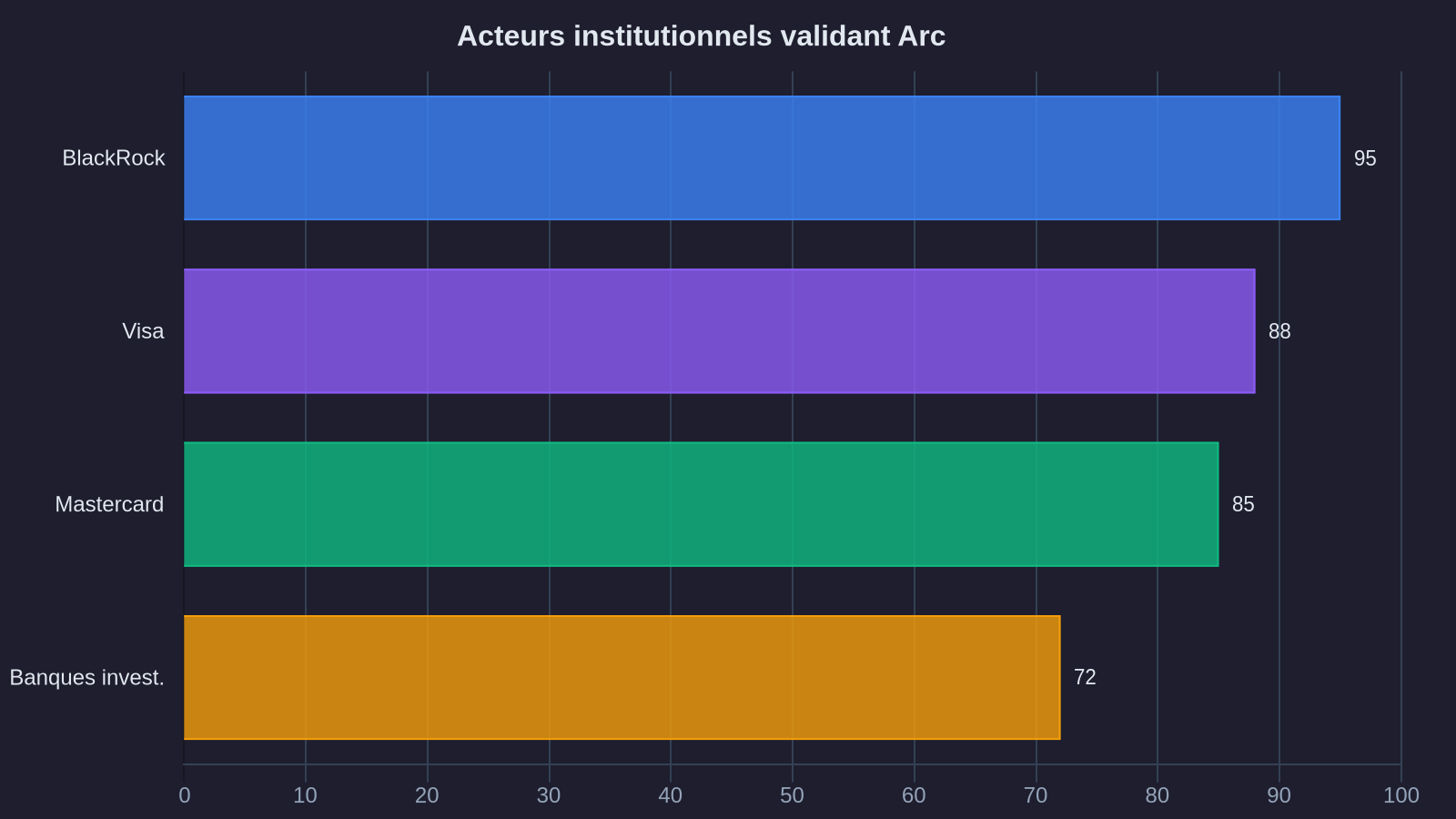
Circle has just announced the launch of Arc, its production-ready public blockchain. The news might seem like just another blockchain initiative, except for one detail that changes everything: BlackRock, Visa, Mastercard, and several major investment banks operate the network's validator nodes. In other words, the institutions that long viewed blockchain with skepticism are now its direct gatekeepers.
To grasp the scale of this shift, recall that these same players recently dismissed crypto-assets as speculative instruments for adventurous retail investors. Today, they're putting their infrastructure and reputation on the line to secure a public blockchain. This pivot isn't ideological—it's strategic: tokenization of traditional financial assets is becoming a competitive imperative, and Circle has just created the first truly operational institutional rail with its Arc mainnet and institutional validators.
Arc is not just another blockchain—it's an industrial pivot
Circle already owns USDC, a dollar-backed stablecoin representing over $40 billion in market capitalization. The company could have simply deployed its token on existing blockchains like Ethereum or Solana. Instead, it chose a different path: building its own infrastructure to control the entire value chain, from stablecoin to settlement layer.
Arc is built on an architecture prioritizing regulatory compliance and transaction cost predictability—two imperatives that standard public blockchains struggle to guarantee. The network uses a proof-of-stake consensus mechanism, but with closed governance: only validators approved by Circle can participate in network security. This hybrid approach between public blockchain and private consortium responds to a real constraint faced by finance departments: you can't build a treasury or settlement strategy on infrastructure whose costs and governance you don't control.
The choice of validators confirms this logic. BlackRock isn't operating a node out of technological philanthropy. The asset manager oversees nearly $10 trillion in assets and is actively exploring tokenization of money market and bond fund shares. Visa and Mastercard, meanwhile, are extending their dominant position in payments into programmable on-chain settlement. For these players, validating Arc transactions means securing the infrastructure they plan to deploy their own tokenized products on.
Tokenization: from experimentation to production
Tokenization of financial assets is no longer exploratory. Several investment banks have already issued tokenized bonds on public blockchain, with amounts remaining modest but testing the operational viability of the process. The real bottleneck isn't technology—it's settlement rail fragmentation: issuing a tokenized security on Ethereum means managing network congestion risks, transaction fee volatility, and the lack of contractual guarantees with validators.
Arc solves this equation by offering an environment where institutional issuers know exactly who validates their transactions, at what cost, and within what legal framework. Circle has also structured Arc to enable interoperability with other blockchains through bridge protocols, allowing USDC and other tokens to flow between networks while keeping Arc as the regulatory anchor point.
Concretely, a company wanting to issue tokenized money market fund shares can now do so on Arc knowing that BlackRock, as a validator, has direct incentive in the network's stability and compliance. This implicit guarantee shifts how finance departments and investment committees perceive operational risk.
Implications for companies: tokenized treasury becomes accessible
For an SME or mid-market company with structural cash surplus, the question of diversification arises in a context of negative real yields on traditional money market placements. Euro money market funds offer roughly 3% gross returns before corporate tax, leaving little margin after taxation. Bond funds present duration risk that few treasurers accept for operational liquidity.
Tokenized finance opens a third path: money market or bond fund shares issued as tokens, tradeable 24/7 on regulated platforms, with near-instantaneous settlement and controlled transaction costs. Arc positions Circle to become the infrastructure provider for these products, with USDC as the settlement currency.
Take a concrete example. A company with €2 million in cash surplus could tomorrow allocate part of these funds to a tokenized money market fund issued by BlackRock on Arc, denominated in USDC. Settlement would be instant, liquidity recoverable within an hour, and valuations visible in real-time. The benefit isn't necessarily higher gross yield, but operational flexibility and reduced fund mobilization delays.
This does require changes to treasury management procedures: you must manage institutional wallets, track on-chain valuations, and integrate these flows into traditional accounting systems. Most ERPs aren't yet equipped to natively handle tokenized assets, creating technical friction that finance departments will need to resolve before significant allocation.
Regulatory framework: MiCA changes the game in Europe
The timing of Arc's launch is no accident. The European regulation MiCA (Markets in Crypto-Assets) is progressively entering into application, with a key deadline in June 2024 for stablecoins and end of 2024 for all crypto-assets. MiCA imposes strict capital, asset segregation, and governance requirements for stablecoin issuers and trading platforms.
Circle has obtained a MiFID license in France through its acquisition of the Hashnote platform, allowing it to operate in Europe with full regulatory passport. Arc fits into this compliance strategy: by controlling the underlying infrastructure and selecting institutional validators, Circle builds an environment designed to meet MiCA requirements.
For European companies, this changes the nature of risk. Buying USDC on a MiCA-regulated platform and using it on Arc to access tokenized products issued by supervised actors (BlackRock holds AMF approvals, Visa and Mastercard are regulated by monetary authorities) significantly reduces regulatory and counterparty risk. You move from the unregulated crypto platform framework into an ecosystem where each link in the chain is supervised.
The tax question remains. In France, capital gains realized by a company on crypto-assets are taxed at the standard corporate income tax rate (25% to 26.5% depending on company size). Income generated by tokenized funds follows the same logic as traditional investment income. Complexity lies in accounting tracking: each on-chain transaction must be recorded, valued, and reconciled with traditional bank flows. Accounting firms are beginning to structure around this topic, but tool maturity remains uneven.
What changes for corporate treasurers
Arc's arrival reshapes institutional treasury management in several ways. First, it validates the idea that tokenized assets are no longer reserved for specialized investment funds or tech-savvy family offices. Accessible, liquid, compliant treasury products become technically available.
Second, it reduces infrastructure risk. Until now, a finance director considering allocating part of treasury to stablecoins or tokenized funds had to accept uncertainty about platform longevity, transaction fee stability, and public blockchain governance. With Arc, these questions get contractual answers: validators are identified, costs are predictable, and regulatory compliance is assured by design.
This obviously doesn't eliminate capital loss risk inherent to crypto-assets or valuation fluctuations of underlying assets. A tokenized money market fund remains a money market fund, with its credit risk and interest rate exposure. USDC remains a stablecoin backed by dollar reserves, thus exposed to currency risk for a company whose functional currency is the euro.
The recommendation for a finance director remains caution and gradualism. An initial allocation limited to 5% or 10% of cash surplus allows testing operational processes, training teams, and measuring actual responsiveness of tokenized products in case of urgent liquidity needs. It's not about migrating all treasury to blockchain rails, but progressively integrating these tools into a diversified management palette.
Finally, it's worth noting that tokenization doesn't mechanically generate additional yield. A tokenized money market fund on Arc will show returns similar to its non-tokenized equivalent, minus management fees and blockchain transaction costs. The interest lies in flexibility, valuation transparency, and the possibility of building programmable treasury strategies (for example, automatic reallocation rules between liquidity and short-term placements based on predefined thresholds).
Outlook: toward hybrid financial infrastructure
Circle's launch of Arc with institutional validators like BlackRock, Visa, and Mastercard marks a milestone in normalizing blockchain infrastructure for institutional finance. We're shifting from a model where traditional players cautiously test the technology to one where they become direct operators.
This evolution doesn't signal the disappearance of traditional settlement systems or legacy banking infrastructure. Rather, it signals the emergence of a hybrid ecosystem where certain financial flows (programmable payments, tokenized securities settlement, automated treasury management) progressively migrate to supervised blockchain rails, while other operations remain on existing circuits.
For finance departments, this requires active monitoring and progressive capability building. It's no longer about betting on whether tokenization will scale, but determining at what pace and with which operational partners to pursue this transition. Arc offers a credible institutional entry point, but each company must evaluate whether its treasury profile, risk tolerance, and operational maturity justify even a modest allocation to these new instruments.
The question is no longer whether to bet on blockchain technology, but when to integrate tokenized products into a balanced, diversified treasury strategy that complies with current European regulatory frameworks.
```