A wallet displays +347% over the month. Another accumulates winning trades, with a success rate touching 80%. On Pump.fun, these profiles naturally attract attention. Copy-trading promises an appealing solution: automatically replicate the positions of these "whales" to capture a share of their gains, without personal analysis or technical expertise.
The problem? These displayed gains mislead users by showing only one side of the story. Behind the impressive performance figures hide presentation biases, well-oiled manipulation mechanics, and an economic reality that platforms have no incentive to highlight. For anyone engaging in copy-trading without understanding these mechanisms, the risk of capital loss is very real, and can even lead to total loss of invested capital.
How Pump.fun presents performance: the survivor bias trap
Pump.fun, like most token launch platforms on Solana, publicly displays the performance of the most active wallets. You see impressive gain percentages, capital multiplications in a matter of days, sometimes hours. These figures are technically accurate. They do correspond to transactions recorded on the blockchain.
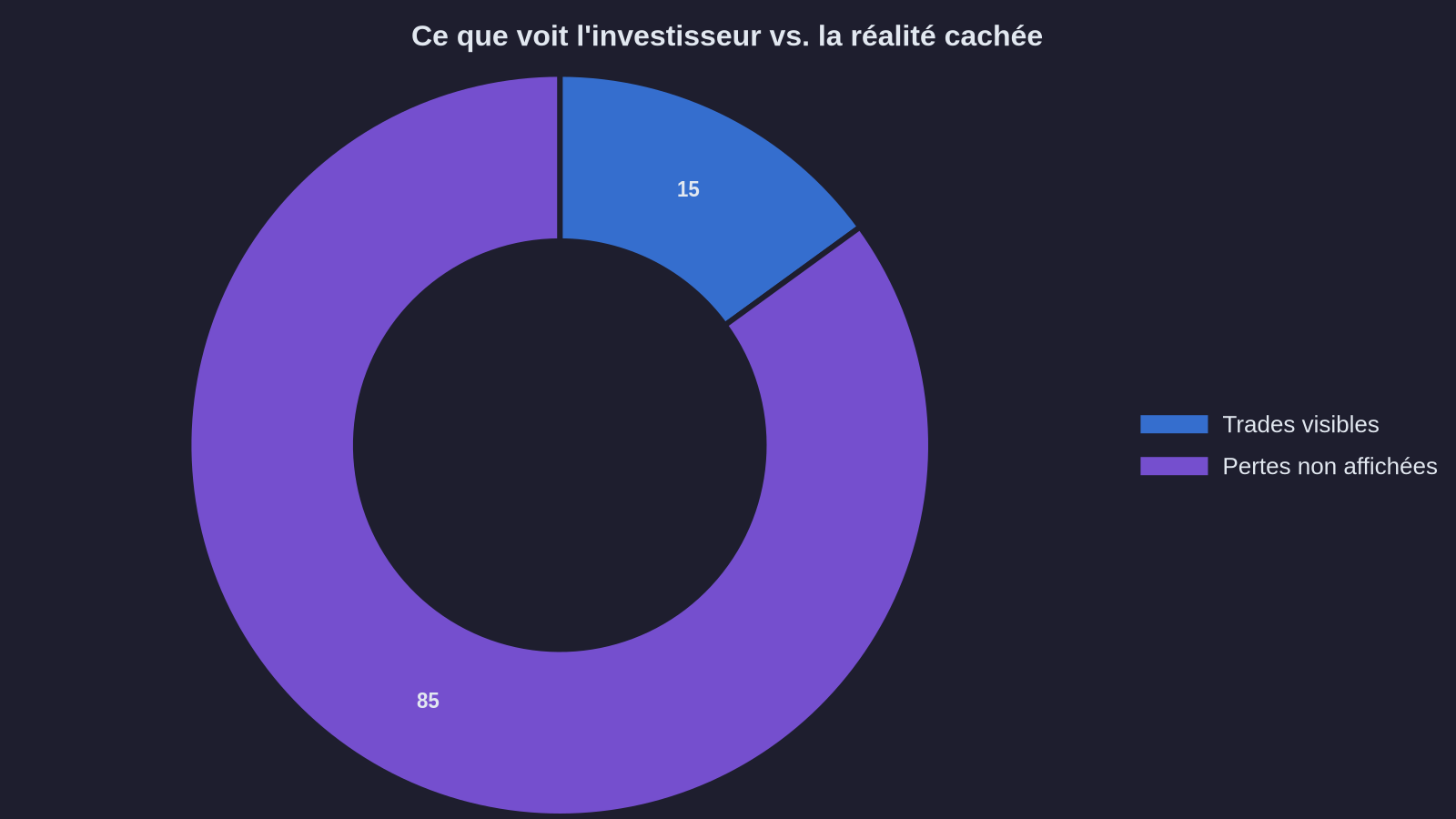
But they don't tell the whole story. What you see is the result of trades that succeeded. What you don't see is the mass of losing positions that preceded these gains, nor the launched tokens that never took off, nor the liquidity that evaporated in minutes. A wallet can display +500% on a specific token while having lost 80% of its overall value across all its positions.
This phenomenon has a name in statistics: survivor bias. You only look at what survived the selection filter, ignoring everything that disappeared. On Pump.fun, traders who succeed become visible. Those who fail disappear from the rankings, their wallets fade into oblivion. The result: an impression of ease that doesn't match ground reality.
Concretely, a trader may have made 50 transactions on newly launched tokens. Three of them generated spectacular gains. The other 47 lost between 50% and 100% of their value. On the platform, only the three winning positions appear prominently. The actual success rate will be 6%, but what the user sees is "+500% on TOKEN_XYZ".
Active manipulation in Pump.fun copy-trading: wash trading and fake volumes
Beyond presentation biases, some actors deliberately manipulate indicators to attract copy-traders. Two mechanisms are particularly widespread on Pump.fun: wash trading and fake volume creation.
Wash trading involves buying and selling the same token to oneself, using multiple wallets controlled by the same person. The objective: create the illusion of sustained activity, artificially drive up the price, and attract investors who interpret these movements as a confidence signal. On the blockchain, these transactions appear legitimate. Nothing formally distinguishes a wash trade from a real exchange between two independent parties.
Fake volumes operate on a similar principle. A manipulator uses multiple addresses to multiply transactions on an illiquid token, creating the impression of massive enthusiasm. Copy-trading platforms, which aggregate this data without thorough verification, then display this token as "trending" or "surging". Users who copy these positions enter an asset whose price has been artificially inflated. When the manipulator sells their tokens, the price collapses. Copy-traders end up with a net loss.
A concrete example: in November 2024, the AMF flagged several manipulation schemes on tokens launched via Pump.fun. In one of these cases, a coordinated group had generated over 2,000 transactions on a token in less than 48 hours, using 15 different wallets. The displayed volume gave the impression of a successful launch. In reality, 90% of transactions came from the same operator. When the price reached an artificial peak, the wallets sold simultaneously, leaving external buyers with a token whose value crashed 95% in minutes.
Warning signs to identify before copying a trader
Faced with these mechanisms, there are indicators to watch before deciding to copy a wallet. None of these signals constitute absolute proof of manipulation, but their accumulation should prompt caution.
Concentration of positions on low-liquidity tokens. A wallet that displays spectacular gains only on rarely traded tokens, with volumes concentrated over a few hours, presents a risk profile. A token's liquidity determines the ability to enter and exit a position without impacting the price. On an illiquid asset, a single large order can cause a 30% or greater variation. If a trader multiplies gains on this type of asset, they likely benefit from an information advantage (early access to launch, coordination with other wallets) or are directly manipulating the market.
Absence of visible losing positions. No trader, however experienced, wins on 100% of their positions. A wallet that only displays winning trades is probably hiding its losses. On Pump.fun, this can be done by transferring losing tokens to other addresses before they're counted in public statistics. A credible profile shows a mix of gains, losses, and neutral positions.
Transactions grouped with other wallets. If a wallet systematically buys and sells at the same time as several other addresses, it may be wash trading or coordination. On-chain analysis tools allow you to trace these links. Platforms like Nansen or Arkham Intelligence offer clustering features that identify wallets potentially controlled by the same entity.
Success rates that are too high over short periods. An 85% success rate on 200 trades in a month on tokens launched via Pump.fun is a statistical anomaly. By comparison, the best-performing quantitative funds on traditional markets display success rates around 55-60% over the long term. An excessively high figure can indicate biased selection of displayed data.
What the numbers don't say: the question of timing and position size
Even assuming a trader displays real performance without manipulation, another problem arises for those copying their positions: time lag and size effects.
On Pump.fun, tokens can see their price skyrocket within minutes of launch. The first buyers, those entering in the first 30 seconds, capture most of the surge. A trader with an automated bot or participating in the launch as an insider enters well before the position becomes public. When the copy-trader replicates this position, seconds or minutes have passed. In such a volatile market, this delay is enough for the price to have already jumped 50% or more. The copy-trader therefore buys much more expensive than the initial trader, mechanically reducing their gain potential.
The size effect exacerbates this phenomenon. A trader may enter a token with $500, without significantly impacting the price. If 50 copy-traders replicate this position with similar amounts, they collectively inject $25,000 into a low-liquidity asset. This buying pressure artificially drives up the price. The initial trader can exit their position at the best time, selling to copy-traders entering late. Result: the strategy leader realizes a gain, the followers suffer a loss.
This mechanism is not theoretical. In January 2025, analysis published by Chainalysis on Solana token launch platforms showed that copy-traders displayed average performance 40% lower than the wallets they were copying, precisely due to this time lag and size effect.
The social validation trap: the illusion of consensus
One last bias amplifies copy-trading appeal on Pump.fun: social validation. When dozens, even hundreds of users copy the same wallet, it creates an impression of legitimacy. "If so many people follow this trader, they must be reliable." This reasoning, intuitive as it may be, rests on a logical fallacy.
A wallet's popularity says nothing about the quality of its future performance. It simply testifies to the effectiveness of its communication, its visibility on forums and social networks, or its ability to display attractive figures. In some cases, this popularity is itself the product of manipulation: operators create fake accounts, multiply laudatory messages on Discord and Telegram, and artificially generate a crowd effect.
A striking example: in December 2024, a wallet presented as "the Pump.fun whale" had gathered over 2,000 copy-traders in days. The displayed gains were spectacular, enthusiastic testimonials multiplied on community channels. Two weeks later, an on-chain investigation revealed this wallet belonged to a coordinated group using these funds to manipulate prices of several tokens. Copy-traders lost an average of 70% of their capital. The lead wallet had already transferred its gains to mixing platforms, making any traceability impossible.
This dynamic echoes other documented crypto market manipulation cases uncovered by independent investigators, where displayed gains mask coordinated manipulation schemes.
What to do if you're considering copy-trading on Pump.fun
Copy-trading is not a scam in itself. It's a tool that, when used properly, can provide exposure to complex strategies without requiring technical expertise. But on a platform like Pump.fun, where tokens are launched without audit, without guaranteed liquidity and without regulatory framework, the risks of capital loss are high.
If you consider this approach, start by verifying the complete history of the wallet you wish to copy, not just the highlighted trades. Use on-chain analysis tools to trace transactions, identify losing positions, spot any connections with other wallets. A credible profile shows gains, but also losses, and consistency in position sizing.
Then ask yourself the timing question. If the trader you're copying systematically enters in the first seconds of a launch, you won't have access to the same entry conditions. Your performance will be mechanically inferior, or even negative. Also verify the liquidity of tokens the wallet positions on. If trading volumes are low, your ability to exit a position without suffering significant slippage will be limited.
As with any exposure to digital assets, understanding the underlying mechanisms remains your best vigilance tool. Your wallet security and transaction traceability must remain absolute priorities.
Never consider copy-trading as an automated and risk-free solution. You remain responsible for your decisions. The gains displayed by a wallet tell you nothing about its future performance. And on a market as volatile as that of Pump.fun tokens, the risk of total loss of invested capital is a reality you must factor in before any decision.
Before committing significant sums, consult a wealth management advisor or accountant familiar with digital assets. Copy-trading on unregulated tokens is not investment, but extremely high-risk speculation. If you decide to proceed anyway, limit your exposure to a portion of your capital you're prepared to lose entirely, and document each transaction for your reporting obligations.