"We are approved by the Financial Markets Authority. You can invest with confidence." This phrase appears on dozens of fraudulent websites every month. AMF approval has become scammers' ultimate selling point: reassuring, official, difficult for a busy individual to verify.
The mechanism is simple: scammers know that the mention "AMF approved" is enough to overcome final hesitations. They're banking on you not taking the time to verify. Yet checking whether a platform isn't a fake AMF-approved platform takes less than five minutes and could save you from losing several thousand euros.
Here's how to do it, step by step, with no special technical skills required.
The REGAFI whitelist: your first verification reflex
The AMF maintains an official register of all entities it has actually authorized to operate in France. This register, called "REGAFI" (Register of Financial Agents), is freely accessible on the AMF website.
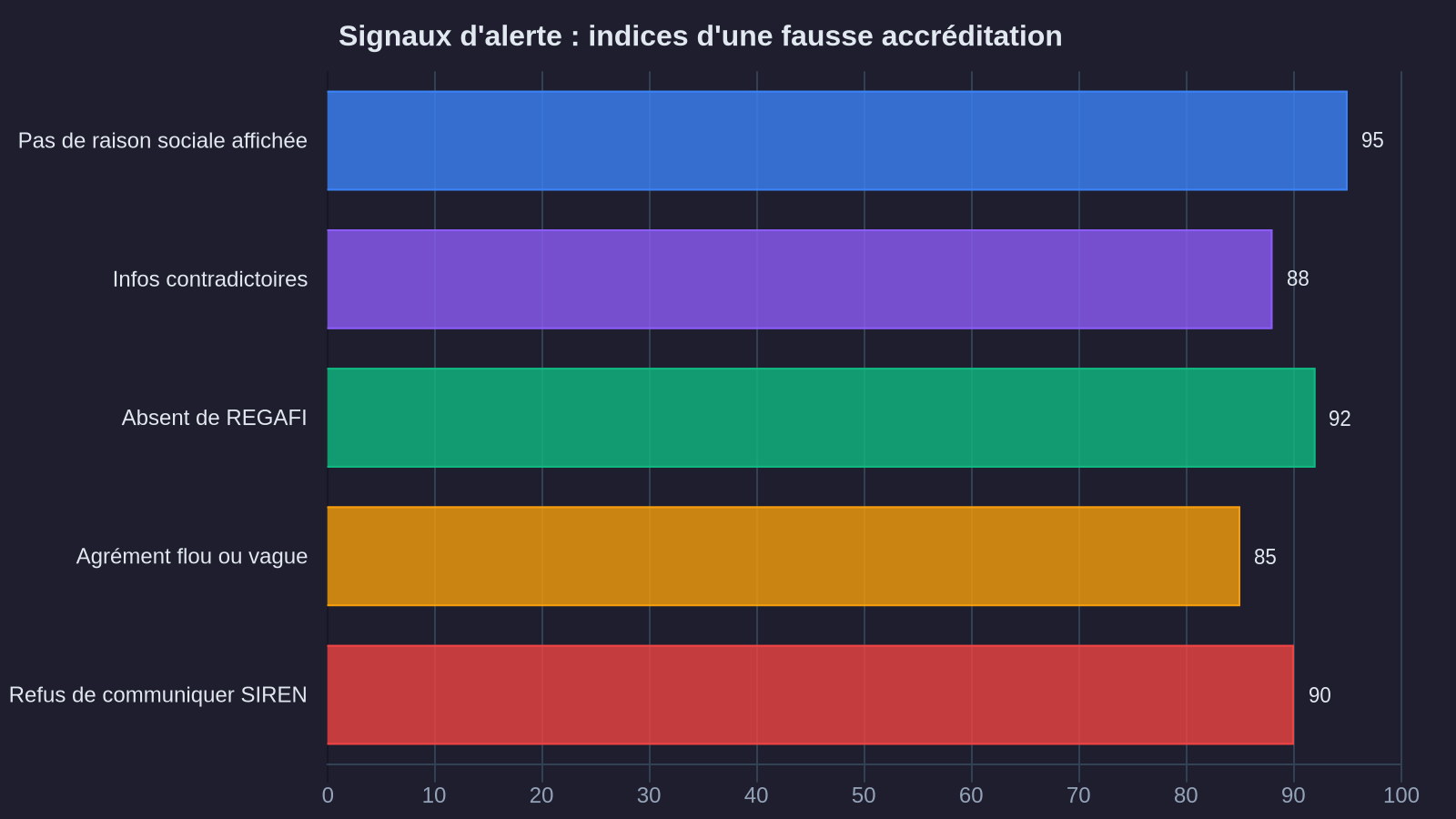
Search for the exact company name requesting your business. Not its trade name or URL, but its legal name—the one that normally appears in the website's legal notices. If the platform refuses to provide its exact legal name or doesn't display it anywhere, that's already a major red flag.
An approved company appears in REGAFI with its SIREN number, its registered office address, the exact nature of its approval (Payment Institution, investment advisor, etc.) and the approval date. If you find nothing, or if the information doesn't match, you're likely dealing with fraud.
Caution: some scammers cite the name of a real approved company but redirect you to a fake site or use a made-up email address. This is why verifying contact details is equally important. This identity theft technique is becoming increasingly common, as illustrated by the Revolut case, which shows how even established platforms can be targeted.
The AMF blacklists: verify that the platform isn't already flagged
The AMF also publishes two blacklists: one for unauthorized sites and entities offering investments in France, and another for sites impersonating regulated entities. These lists are updated several times a week.
You'll find hundreds of names there: fake trading platforms, companies offering cryptocurrency investments without approval, sites cloning the appearance of well-known brokers. If the site or company name appears on either list, there's no doubt left.
The problem is that these lists are never exhaustive. A platform can be fraudulent without yet appearing on them, simply because it was just created or no victim has reported it yet. A name's absence from the blacklist guarantees nothing. This is why checking REGAFI remains essential.
The trap of financial identity theft
Some scammers go further: they use the name, logo, and sometimes even the approval number of a real regulated company, but create a fake site or use false contact details. You check REGAFI, you find the company just fine, and you think everything's okay. Except you're not dealing with the real company.
This is where verifying contact details becomes critical.
Verifying official contact details: phone, address, email
Once you've identified the company in REGAFI, carefully compare its official contact details with those you've used or been given.
The registered office address must match exactly. The phone number must be the one listed on the company's official website, not the one a salesperson texted you. The email address must use the company's exact domain name (if the real company is called example-invest.fr, be wary of example-invests.fr or example-invest.co).
When in doubt, call the company using the number listed in REGAFI or on its verified official website. Ask for confirmation that the person who contacted you actually works there. A real regulated company will fully understand this cautious approach.
If you were contacted by phone, systematically ask for your contact's full name, the company name, its SIREN number, and its AMF approval. A genuine professional will provide this information without hesitation. A scammer will make excuses or pressure you to invest quickly "before the offer ends."
Alert signals that should immediately concern you
Beyond formal verification in REGAFI and on the AMF blacklists, certain behaviors systematically reveal a fake platform:
- You're contacted out of the blue (phone, SMS, social media) with an investment offer. Approved companies almost never solicit this way.
- You're promised high guaranteed returns (8%, 10%, 15% annually "risk-free"). No financial investment can guarantee high returns without risk of capital loss.
- You're pressured to decide quickly: "the offer ends tonight," "only three spots left," "you'll miss a unique opportunity." Time pressure is the scammer's basic tool.
- You're asked to transfer money to an offshore account, or through hard-to-trace payment methods (cryptocurrencies, prepaid cards, Western Union).
- The website doesn't display complete legal notices (legal name, SIREN, exact registered office address) or displays inconsistent notices (supposedly French company with a non-existent SIREN).
If you spot even one of these signals, don't invest. And if you've already transferred money, report the fraud immediately. Extra vigilance is needed in the crypto space, where scam techniques are becoming increasingly sophisticated.
The key point of caution
AMF approval is not a guarantee of returns, nor insurance against capital loss. It simply attests that the company complies with strict regulatory framework: minimum capital, management competence, separation of client assets, regular audits. An approved company can offer perfectly legal risky investments. Approval protects you against fraud, not against market risk.
Conversely, a company can be perfectly legitimate without AMF approval if its activities don't legally require it. This is the case, for example, with certain insurance brokers or platforms offering only standard banking products. But if a company claims to be AMF approved when it isn't, that's clear fraud.
For crypto platforms, verification doesn't stop at approval: understanding how to verify actual solvency through proof of reserves provides an additional layer of protection.
What to do if you're affected
If you've invested on a platform claiming AMF approval and your checks reveal fraud, take three immediate actions:
- Stop all further payments. Don't "add more money to unlock your gains," even if you're strongly encouraged. This is a classic technique to extract more from you.
- Report the fraud to the AMF through its online form, and file a complaint with the police or gendarmerie. Even if your chances of recovering your money are slim, your report helps fuel ongoing investigations and protect other potential victims.
- Contact your bank immediately if you've shared your banking details or made a recent transfer. In some cases, a transfer can be blocked or canceled if you react quickly enough. Also request a block on your payment card if you used it.
Keep all evidence: website screenshots, emails, SMS messages, transfer statements, call recordings if you have them. These will be useful for your complaint and for potential claims with your insurance or guarantee funds if you have legal protection coverage.
Vigilance as a reflex
Scammers constantly adapt their techniques. Today, they clone regulated sites with impressive precision, buy ads on social media, create fake customer reviews. Tomorrow, they'll use artificial intelligence to simulate even more credible phone calls.
Faced with this growing sophistication, the best protection remains methodology: never invest under pressure, always verify approval in REGAFI, compare official contact details, watch for alert signals. These few verification minutes are well worth the hassle of filing a complaint afterward and losing capital permanently.
The AMF updates its lists and tools regularly. Consult them before any financial commitment, regardless of how trustworthy your contact appears. Fraud is no longer recognizable by spelling mistakes or poorly designed sites. It's unmasked through method.