Imagine lending your bike to a friend to keep in their garage. While it's there, this friend rents it out to other people, pockets the rental money, and occasionally gives you a small thank-you payment for lending it to them. Would you think that's fair?
Yet that's exactly what happens with your money at the bank. Except nobody really explains it to you. And that's where the story of financial disintermediation begins.
What your bank actually does with your money
When you deposit 10,000 euros into your checking account or savings account, you might imagine that money sitting safely in a vault with your name on it. In reality, your bank immediately lends a large portion of those 10,000 euros to other customers: a mortgage at 3.5%, a consumer loan at 6%, an authorized overdraft at 15%.
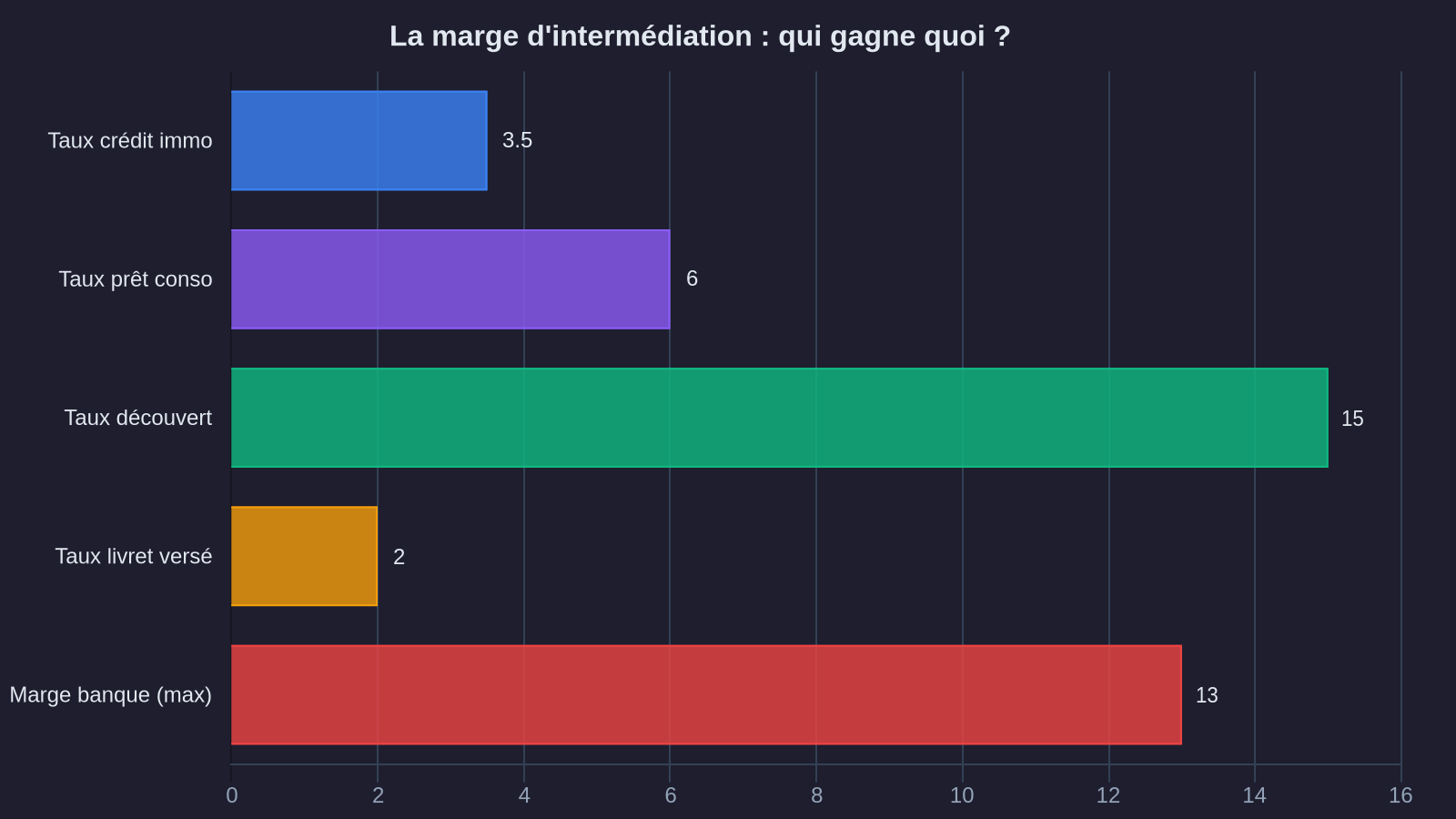
The result: your bank earns between 3% and 15% on your money. You? If you're lucky, you get 2% on a standard savings account. The difference is what we call the intermediation margin. A technical term for "the gap between what the bank earns with your money and what it pays back to you."
That's the traditional banking model: it positions itself between those who have money (you) and those who need it (borrowers). It takes a cut along the way. A substantial cut.
Financial disintermediation: removing the middleman
Financial disintermediation is the idea of bypassing that intermediary. Creating a system where you could lend your euros directly, or put them to work without an institution inserting itself and capturing most of the returns.
Let's use another analogy. Imagine selling handmade items. You can go through a shop that takes 40% commission on every sale. Or you can set up your own stall at a market and keep 100% of the sale price. Disintermediation is just that: eliminating the middleman.
In finance, this model was impossible for ordinary people for a long time. Why? Because you needed a network of contacts, guarantees, infrastructure to manage loans, verify repayments, handle defaults. Basically: you needed a bank.
But with the arrival of disintermediated finance (also called DeFi for Decentralized Finance), new infrastructure emerged. Infrastructure built on public blockchains, where rules are automated through computer code rather than dictated by a central institution.
How a disintermediated system actually works
In a disintermediated financial system, there's no bank in the middle. Instead, you have protocols: computer programs that organize exchanges between those bringing money and those needing it.
Imagine a shared pool. Several people deposit their euros into it. Others can borrow from this pool by putting up collateral (another digital asset). When they repay, they pay interest. That interest is automatically distributed among everyone who contributed to the pool, proportional to their contribution.
No bank employees, no corporate headquarters, no board deciding the margin. Just code. Everything is transparent: you see how much money is in the pool, how much is borrowed, what the interest rate is in real time.
This is called a liquidity pool. It's just one example among many, but one of the most common mechanisms in disintermediated finance. Like any digital infrastructure, the security of protocols remains a central concern — even a disconnected wallet can remain vulnerable if you don't understand the technical risks.
What disintermediation doesn't always tell you
You might be thinking: "If I can earn more by removing the middleman, why doesn't everyone do it?" Good question. Because removing the bank also means removing everything it provides: deposit protection, customer service, fraud protection, recourse if something goes wrong.
In a disintermediated system, nobody guarantees your capital. If the protocol experiences a software bug, if a hacker exploits a code vulnerability, if the collateral posted by a borrower loses value, you could lose part or all of your investment. There's no insurance, no guarantee fund, no number to call.
Take a concrete example. You deposit the equivalent of 5,000 euros in stablecoins (crypto assets pegged to the euro or dollar) into a liquidity pool. The protocol shows a target yield of 8% per year. But a week later, the protocol is hacked. The attacker drains the pool. Your euros vanish. You have no legal recourse against the protocol, because it has no legal entity behind it, no headquarters, no contractual guarantee. You took the risk, you absorb the loss.
That's the trade-off of financial disintermediation: you gain autonomy, but you assume responsibility for risks that the intermediary used to bear. You no longer have a bank inserting itself and capturing a margin, but you no longer have a safety net either. Moreover, verifying that a platform is genuinely licensed becomes an essential step before any commitment.
Why this model attracts anyway
So why do millions of people use these protocols? For three main reasons.
First, transparency. At a bank, you don't really know what's being done with your euros. In a disintermediated protocol, everything is public. You see how much money is circulating, who's borrowing, at what rate. You see the code managing the operations. This transparency doesn't eliminate risk, but it lets you understand it.
Next, access. You don't need to justify your income, provide bank details, or go through an interview. You just need an internet connection and a digital wallet. For someone without access to traditional banking, or wanting to circumvent local restrictions, that's a door wide open.
Finally, the target yield. Without the bank's margin, a larger share of what your euros earn can come back to you. But beware: that yield never comes without capital loss risk. The higher it is, the greater the underlying risk. A protocol showing 15% per year is necessarily taking more risk than a 2% savings account. And you're taking those risks with it.
Disintermediation doesn't replace everything
It's tempting to see disintermediated finance as a system that will sweep away banks. That would be a mistake. The two models address different needs.
If you're looking for security, simplicity, and the guarantee of getting your capital back if something goes wrong, the traditional banking system remains your best bet. Your deposits are protected up to 100,000 euros per institution. You have an advisor, an app, an emergency number. You pay for this security with lower returns on your savings, but it's an informed choice.
If you want to better understand how your euros work, if you're willing to take calculated risks, if you accept there's no safety net, then disintermediation might interest you. But it requires vigilance, technical understanding, and the ability to evaluate risks that nobody will explain to you over the phone.
The real question isn't choosing one or the other. It's understanding what each brings, and most importantly, what each takes away.
Key takeaways on financial disintermediation
Your bank is already lending your euros. It earns between 3% and 15% with them, and returns a small portion to you. That's its business model: position itself in the middle and take a margin. In exchange, it offers you a guarantee, a service, protection.
Financial disintermediation removes that intermediary. You can put your euros to work directly, through automated protocols. You keep a larger share of the returns. But you also assume all the risks: software bugs, hacks, value collapses. Nobody reimburses you if things go wrong.
It's not a binary choice. The two systems coexist. One prioritizes security and simplicity. The other prioritizes autonomy and transparency. Each has a price. Each has its limits.
Before diving into disintermediated finance, ask yourself this: are you ready to bear the risks that your bank was bearing until now? If the answer is no, that's not a problem. That's an informed decision. And that's exactly what you should do: decide with full knowledge of the facts, not chasing a promise.