A quiet yet significant trend has been sweeping through the tech ecosystem since 2024: seasoned Bitcoin and Ethereum developers are gradually leaving blockchain to join artificial intelligence projects. This shift where developers are abandoning Bitcoin and Ethereum for AI is far from anecdotal. It raises strategic questions for companies that have integrated crypto into their financial or operational planning.
What does this pivot reveal about the real maturity of the crypto sector? What concrete impacts for ongoing blockchain projects? And most importantly, how should we interpret this talent migration when considering investments in this ecosystem?
A talent movement accelerating since late 2023
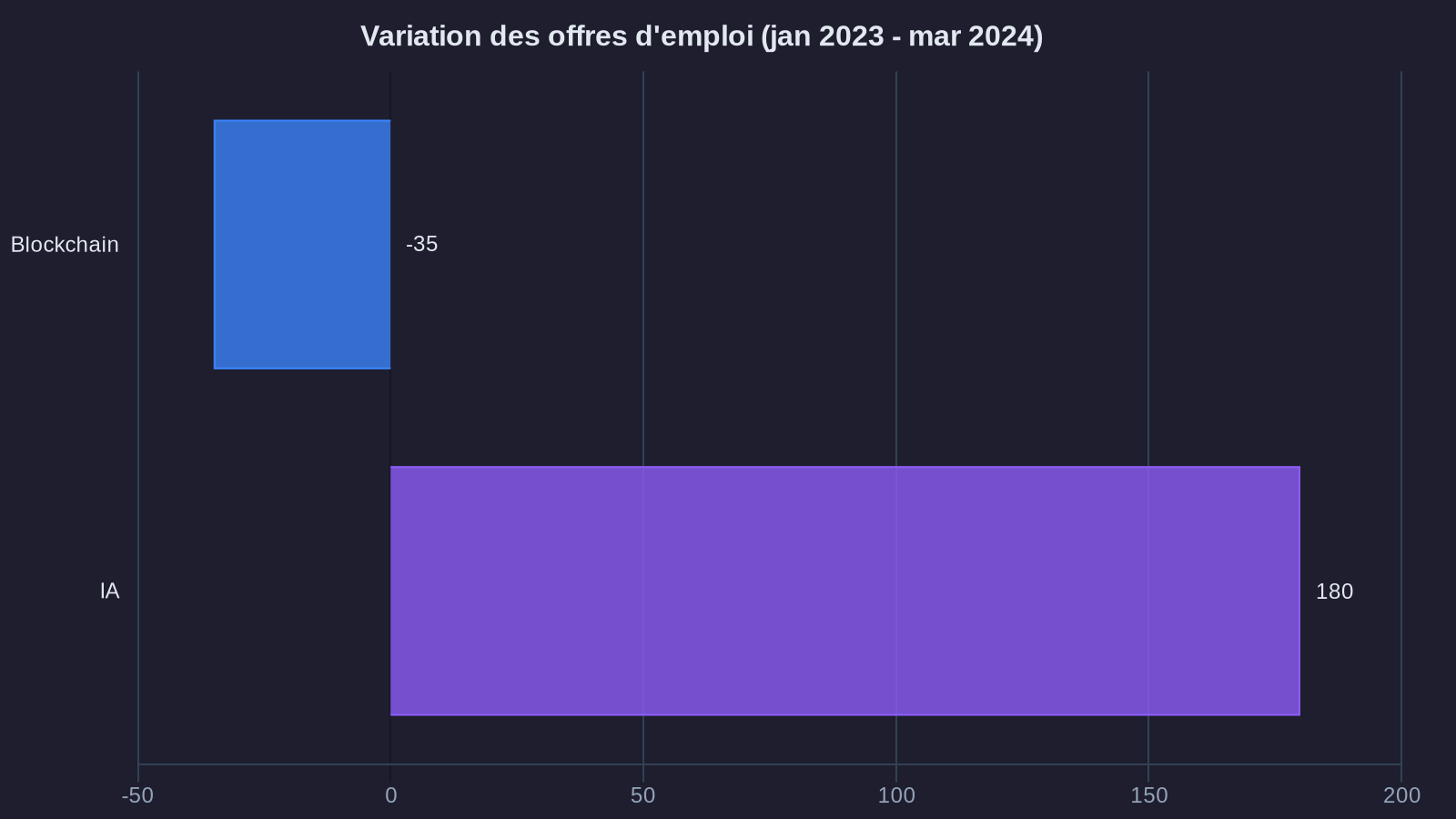
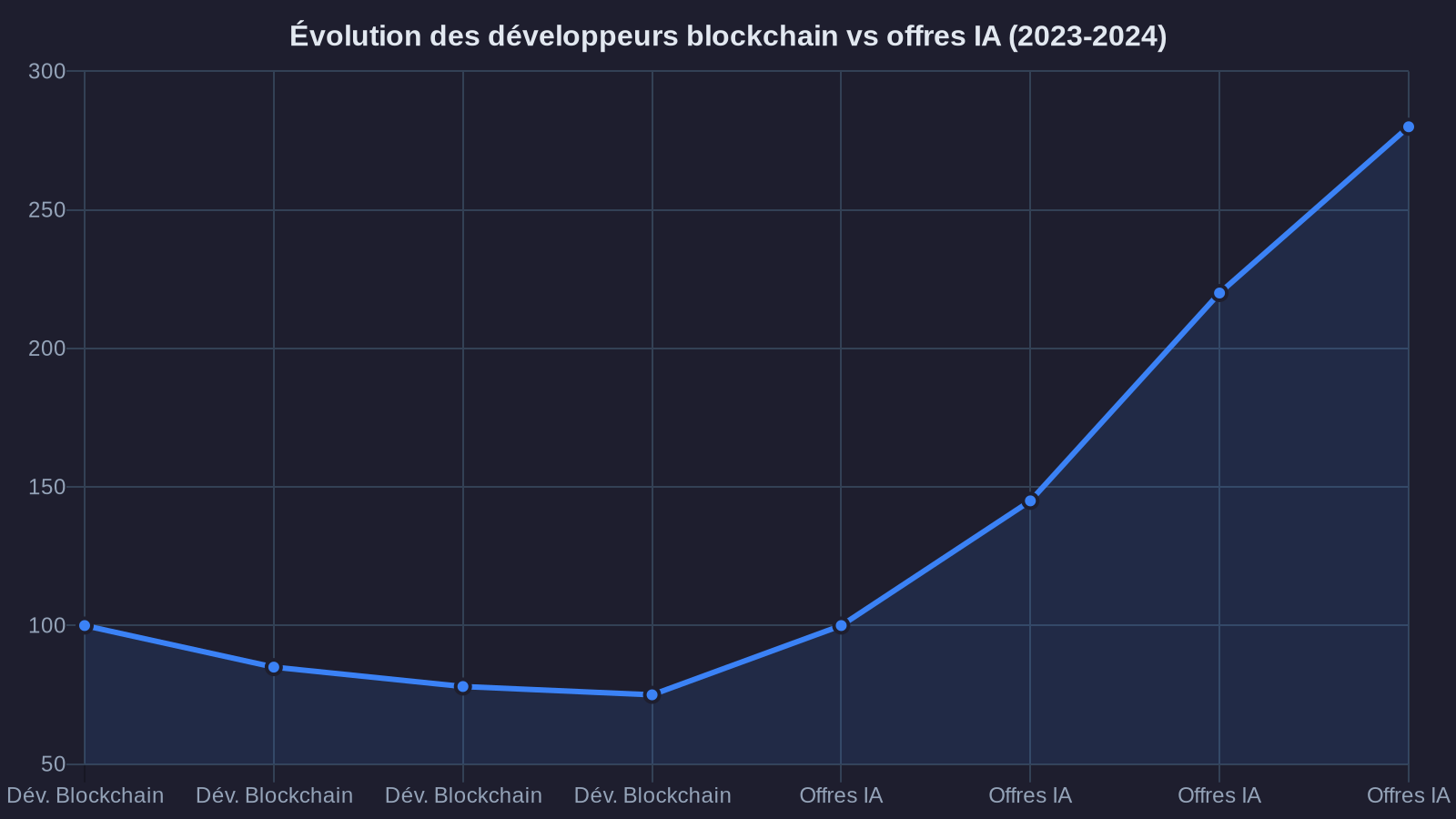
The numbers speak for themselves. According to data from GitHub and LinkedIn analyzed by Electric Capital, the number of active developers on Bitcoin and Ethereum repositories experienced its first significant decline in the fourth quarter of 2023, before stabilizing at a lower level in 2024. This negative crypto developer sentiment is confirmed in employment statistics: blockchain job postings dropped by 35% between January 2023 and March 2024, while AI-related positions surged by 180% over the same period.
This migration is not limited to junior profiles seeking visibility. We're seeing the departure of core contributors—those maintaining essential pieces of Ethereum infrastructure or developing promising layer-two solutions. Some have joined OpenAI, Anthropic, or startups specializing in language models. Others have shifted toward hybrid projects at the intersection of AI and blockchain, often with a pragmatic approach that abandons grand decentralization narratives in favor of concrete applications.
For a CFO evaluating the soundness of a crypto project or technology partner, this signal warrants attention. An ecosystem's vitality is measured by its ability to retain its best contributors. When talent migrates, it often signals that value creation opportunities are shifting elsewhere, as illustrated by MicroStrategy's massive Bitcoin accumulation strategy, which bets on consolidation rather than technical innovation.
The structural reasons behind this exodus
Why this brain drain revealing current crypto ecosystem trends? Three converging factors explain it.
First, development prospects. The blockchain ecosystem has reached a degree of technical maturity. Issues around scalability, consensus, and interoperability are now well documented. Solutions exist, even if implementation remains complex. For an ambitious developer, working on the nth Ethereum layer-two or a marginal Bitcoin protocol improvement may seem less intellectually stimulating than contributing to the emergence of intelligent autonomous agents or multimodal systems.
Next, economic dynamics play a decisive role in this AI vs blockchain talent phenomenon. AI funding rounds have far outpaced crypto in 2024. Salaries offered to senior AI developers reach significantly higher levels than blockchain projects, even when tokens are factored in. A confirmed Solidity developer can expect a package around €150,000 to €200,000 annually in an established crypto project. A machine learning engineer at the same level can negotiate €250,000 to €350,000 in a well-funded AI structure, with clearer growth prospects.
Finally, regulatory fatigue and legal uncertainty weigh on career choices. Building in crypto means navigating permanent regulatory fog. The MiCA framework in Europe does bring welcome clarity, but the environment remains complex. In the United States, the SEC's shifting stance discourages many entrepreneurs and developers. AI, despite its own emerging ethical and regulatory challenges, currently offers less constrained ground for experimentation.
Concrete consequences for the blockchain ecosystem
This talent migration produces tangible effects on the quality and development pace of crypto projects. We're seeing a slowdown in delivering certain expected features. Protocols that announced ambitious roadmaps for 2024 have quietly postponed deadlines. Maintenance of some open-source libraries has become more inconsistent, with longer response times for security fixes.
For a company considering integrating a blockchain solution into its payment, traceability, or asset tokenization processes, this context demands heightened vigilance. It becomes essential to assess not only the technical soundness of a solution, but also the stability of its development team and the depth of its contributor community. A project relying on three main developers, however brilliant, presents an operational continuity risk that must factor into your analysis.
This doesn't mean blockchain innovation has stalled. Bitcoin continues to attract contributors passionate about network resilience and security. Ethereum maintains an active community around its major upgrades. But the dynamic has shifted. The ecosystem is entering a consolidation phase where the strongest projects—those that have built stable teams and diversified funding sources—are gradually pulling ahead.
Strategic implications for financial decision-makers
Given this assessment, what approach should you adopt when managing a company's treasury and considering crypto-assets' role in your allocation?
The first recommendation is to strengthen selectivity. Not all blockchain projects are created equal, and quality gaps are widening. It becomes crucial to evaluate team robustness, their ability to attract and retain talent, and the diversity of funding sources. A project dependent on a single foundation with limited resources presents more fragility than a multi-stakeholder ecosystem with several established companies actively contributing.
Second: prioritize mature infrastructure over promises of revolution. Bitcoin and Ethereum, despite this developer migration, retain proven technical foundations and a sufficiently large community to ensure continuity. For corporate treasury allocation, this stability trumps hypothetical returns from newer protocols that are structurally more fragile, as explained in our analysis on the trade-off between Bitcoin ETFs and direct ownership.
Third dimension: integrate this trend into crypto-asset valuation analysis. If top talent migrates to AI, the blockchain ecosystem's innovation capacity mechanically slows. This doesn't rule out price appreciation, which depends on multiple macroeconomic factors and institutional adoption. But it tempers growth scenarios based on continuous technical acceleration.
For an SME with €500,000 in excess treasury and considering crypto diversification, this analysis argues for a measured approach. Allocating 2 to 5% of this treasury to Bitcoin or Ethereum remains defensible within medium-term wealth diversification logic, with explicit acceptance of capital loss risk. Conversely, betting on next-generation protocols backed by lean teams and ambitious roadmaps constitutes a speculative wager outside the scope of prudent treasury management.
What this developer migration really reveals
Beyond the numbers and talent movements, this blockchain developer exodus to AI reveals a deeper reality: the normalization of the crypto sector. Phases of technological ferment naturally attract the most adventurous profiles. As technology matures, some of these talents seek the next challenge.
This phenomenon doesn't condemn blockchain. It signals rather its transition from exploratory phase to industrialization phase. Use cases are clarifying, actors are structuring themselves, regulations are stabilizing. This evolution is healthy for those seeking predictability and solid fundamentals. It's less so for those seeking the thrill of technological frontiers.
For a CFO, this clarification enables better positioning of crypto-assets in strategic planning. It's no longer a bet on imminent technological revolution, but a reasoned arbitrage on digital assets whose place in the global economy is gradually defining itself, with real advantages in decentralization and financial sovereignty, but also accepted technical and regulatory limitations.
The developer migration to AI doesn't render blockchain obsolete. It simply invites adjusted expectations and refined selection criteria. In an environment where innovation is shifting, only projects with solid fundamentals and resilient teams will durably traverse this transition phase. These are precisely the criteria on which a thoughtfully constructed treasury allocation must now be based.