In November 2023, an institutional investor lost $20 million in USDT. No compromised hardware wallet, no sophisticated phishing attack. Just a simple copy-paste error. The address copied from his wallet history looked correct: the first six and last six characters matched his usual recipient perfectly. Except the 26 characters in the middle led directly to an attacker's wallet.
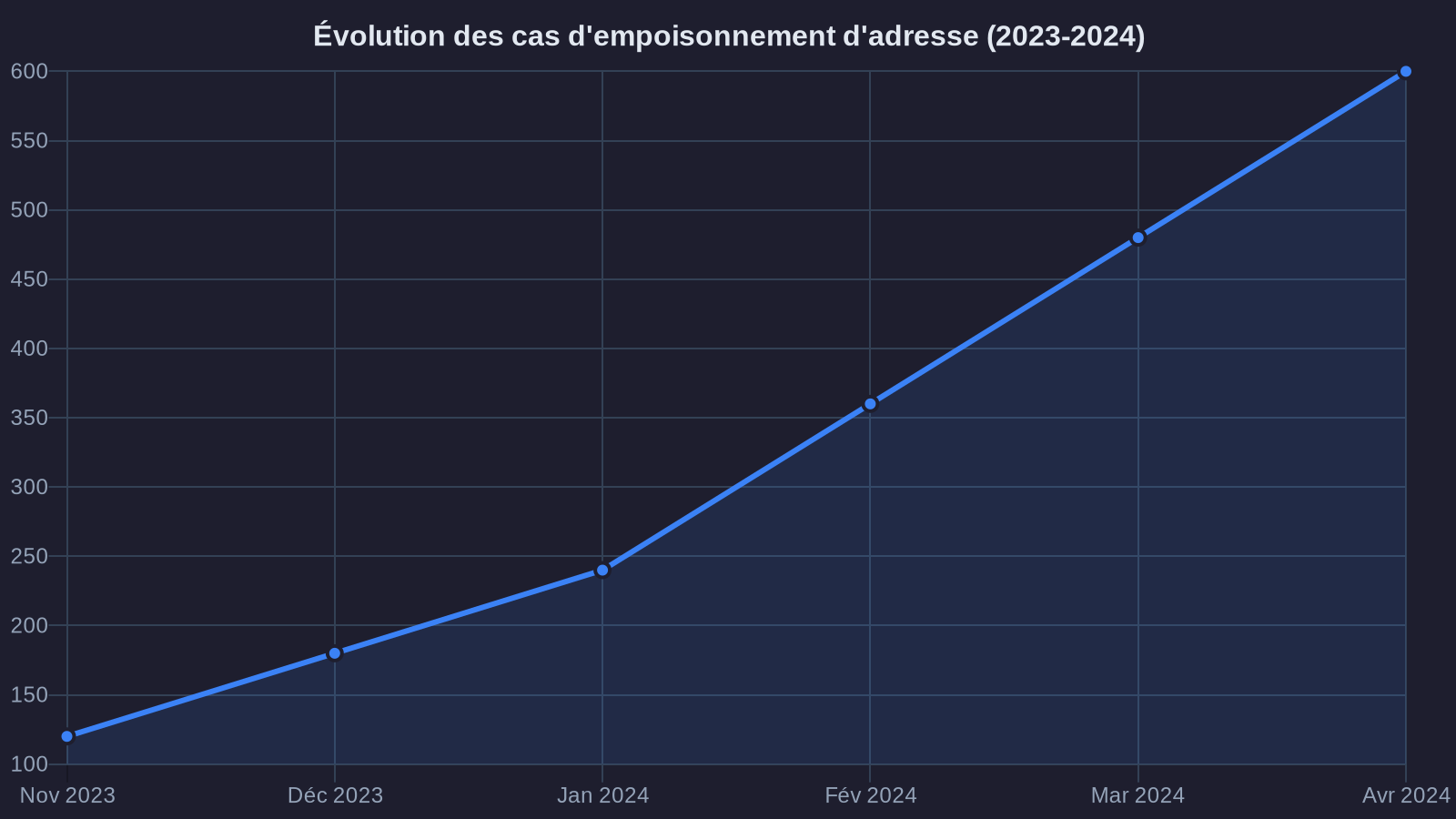
This Ethereum cybersecurity technique, known as address poisoning, has been escalating at an alarming rate. Data from Scam Sniffer shows a five-fold increase in detected cases between 2023 and 2024. What was once a cottage industry attack has become an industrialized operation, particularly effective against wallets managing yield strategies where recurring transactions create a false sense of routine.
The anatomy of an address poisoning attack that has become dangerously effective
Address poisoning relies on a mechanism of disarming simplicity. Attackers monitor on-chain transactions in real time. As soon as a wallet executes a transfer, they instantly generate an address that visually mimics the legitimate recipient's.
Current computing power allows the creation of vanity addresses—these customized addresses—with 6 to 8 identical characters at the beginning and end in just minutes. Some automated tools can even target 10 matching characters, making visual detection nearly impossible. The attacker then sends a micro-transaction of 0.00001 ETH or USDT to the targeted wallet. This transaction appears in the history, just above or below legitimate transactions.
The trap springs on the next transaction. The user opens their history, visually identifies what looks like the usual address for their exchange or staking contract, copies it, and sends. Some sophisticated crypto attacks even go as far as sending multiple poisoned transactions to flood the history and maximize the odds of error.
What makes this technique particularly insidious for yield strategies is the repetition. When you're compounding weekly rewards or regularly rebalancing your portfolio across different protocols, vigilance wanes. You develop automatisms. And those automatisms are exactly what attackers are banking on.
A threat amplified by the industrialization of attacks
The numbers speak for themselves. According to blockchain forensics analyses, losses from address poisoning exceeded $50 million in 2024. But that figure only represents detected and reported cases. The reality is likely far higher, as many victims prefer not to disclose their losses.
Industrialization manifests itself at multiple levels. First, automation: bots now continuously monitor transactions involving significant amounts. Once a threshold is crossed—often around $100,000—the system automatically generates and sends a poisoned transaction. The cost to the attacker is negligible, just cents per attempt, for an extraordinarily favorable risk-reward ratio.
Next, technical sophistication. Early poisoning cases only targeted Ethereum. Today, similar attacks are observed on Binance Smart Chain, Polygon, Arbitrum, and virtually every EVM chain. Some attackers have even adapted the technique for Bitcoin, though the different address structure makes the attack more complex.
The psychological dimension is also becoming more refined. Attackers have learned that certain moments are more prone to error: periods of high volatility when users rush to secure their positions, weekends when vigilance drops, or phases of intensive compounding during yield spikes. These strategies mirror methods used in algorithmic trading automation, but applied for malicious purposes.
Yield wallets: a prime target
Investors optimizing their on-chain returns are particularly exposed. Several factors explain this heightened vulnerability. Transaction frequency, first: regularly moving funds between lending protocols, liquidity pools, and yield farming vaults multiplies opportunities for error. Each interaction is an opportunity for an attacker.
The complexity of strategies also plays a role. When you're juggling between Aave, Curve, Convex, and several other protocols, you accumulate a substantial list of contract addresses in your history. This abundance makes verification tedious. You develop mental shortcuts, you rely on visual recognition of the first and last characters.
The amounts at stake naturally attract attention. A wallet regularly moving six or seven figures in stablecoins becomes a priority target. Attackers know that a single successful transaction can yield tens, even hundreds of thousands of dollars.
Building multi-layered crypto address protection
Facing this threat, vigilance alone is no longer enough. You can't rely solely on your ability to visually verify 42 hexadecimal characters before each transaction. Fatigue, urgency, or simply task accumulation inevitably leads to error. Effective defense rests on multiple complementary layers of Ethereum wallet security.
The first barrier is to systematize the use of an address book. All serious wallets offer this feature, yet it's underutilized. Creating a named entry for each recurring destination eliminates the need to copy from history. It's a simple habit change that completely neutralizes the main attack vector.
But an address book alone isn't enough. You also need to secure its backup, ideally with regular verification of stored addresses. Some wallets allow you to export and version these address books, creating an external source of truth.
Three-point verification becomes essential for significant transactions. Compare the beginning, middle, and end of the address, not just the extremities. This takes a few extra seconds, but those seconds could save months of returns. For very large transactions, some savvy users have adopted an even more robust practice: first execute a minimal test transaction, verify it's received correctly, then only send the main amount.
Emerging protection tools
The ecosystem is beginning to respond with innovative technical solutions. Browser extensions like Pocket Universe or Wallet Guard now analyze transactions in real time and alert when a destination address shows suspicious similarities to an address in your history. These tools integrate directly into the transaction signing flow.
Some wallets now implement native anti-poisoning features. MetaMask, in recent versions, has added visual alerts when a destination address isn't in your address book and closely resembles a recent address. Rabby Wallet goes further by systematically displaying a transaction summary with the destination protocol name when identifiable.
For hardware wallet users, protection is strengthened by requiring visual validation of the address on the device's screen. But this protection only works if you actually take the time to verify, character by character. The temptation to validate mechanically remains the weakest link.
Toward sustainable security hygiene
Beyond tools, it's an entire operational discipline that needs to be built. Teams managing on-chain treasuries or institutional yield strategies have begun formalizing strict protocols. These practices deserve to be adapted at the individual level.
The dual-control rule, borrowed from traditional banking procedures, finds its full purpose here. For any transaction exceeding a certain threshold, address validation by a second person or via a different channel (address verification across multiple devices) drastically reduces error risk. It's inconvenient, certainly, but far less so than an irreversible loss.
History hygiene also becomes a key concern. Some advanced users no longer hesitate to create a new wallet every quarter for routine operations, keeping only the main wallet for cold storage. This segmentation mechanically limits the accumulation of transactions in history, reducing the attack surface.
Documentation of legitimate addresses proves equally crucial. Maintaining an external document, outside your wallet, listing all official addresses of protocols you use with their verification sources, creates an independent reference point. When adding a new address to your address book, you verify it against this reference document.
Address poisoning thrives on our cognitive shortcuts and automatisms. Recognizing this human vulnerability is already the first step toward protecting yourself from it. Attackers count on our decision fatigue, on those moments when we shift into autopilot mode. Interrupting this autopilot with systematic verification rituals transforms a weakness into a defensive barrier.
The irony of this threat is that it exploits no cryptographic flaws or smart contract vulnerabilities. It targets directly the most vulnerable interface of any security system: the human. And in an ecosystem where transactions are irreversible, where no customer service can cancel a mistaken send, prevention isn't an option, it's an absolute necessity. Every transaction is final. Every verification counts.