Imagine a forest shared by several villages. No one owns it, but everyone can harvest wood, pick mushrooms, gather dead leaves for compost. For over a thousand years. Without a written contract at first. Without a court to settle disputes. And yet, it works.
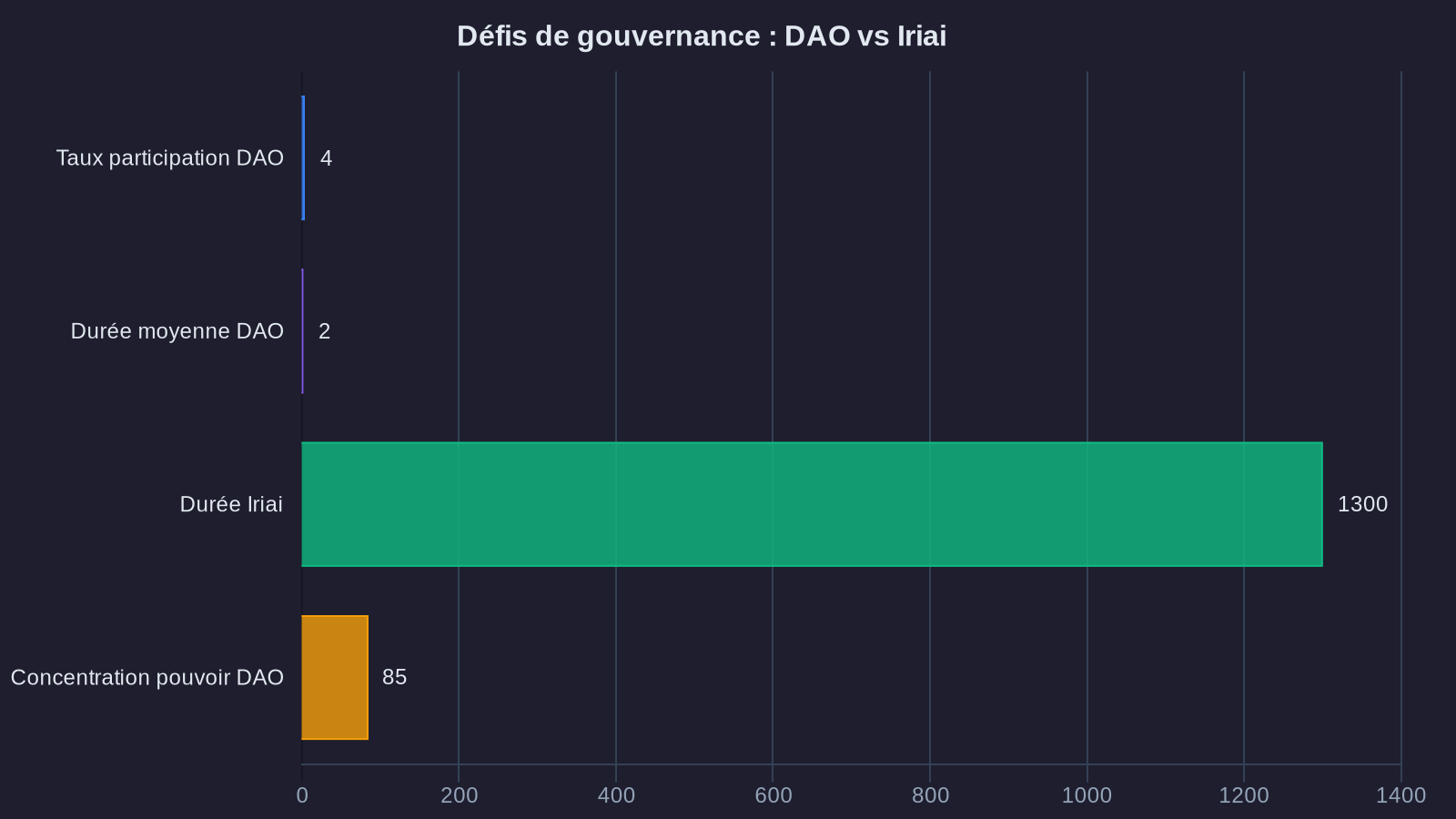
The iriai, these collective Japanese forests, have survived thirteen centuries of history without collapsing. Wars, famines, modernization: the system endured. Meanwhile, in the world of cryptocurrencies, decentralized autonomous organizations (DAOs) often struggle to last more than two years before a governance crisis shakes them.
This comparison is far from trivial. DAOs promise to revolutionize collective governance through blockchain. But in practice, results remain mixed. Voting participation rates often below 5%, power concentrated among a few whales (large token holders), decisions blocked by influence wars. Perhaps these communities from medieval Japan, with their ancient decentralized models proven by time, have something to teach us about DAO governance.
The iriai: when survival forges rules that endure
In the 8th century, rural Japan operates around shared resources. Forests, rivers, certain agricultural lands belong collectively to villages. This isn't idealism: it's necessity. In an environment where resources are limited and survival depends on access to firewood, livestock forage, and building materials, cooperation becomes essential.
The iriai gradually develop sophisticated governance mechanisms. Each village family has usage rights proportional to their needs and their contribution to forest maintenance. They don't vote on everything, all the time. Routine decisions follow customary rules, transmitted orally and later recorded in communal registers.
The system rests on three pillars that anthropologist Elinor Ostrom, Nobel laureate in economics, would later identify as fundamental for governing common resources: clear rules on who can extract what, a peer-monitoring system, and graduated sanctions for violations.
What strikes you about the iriai is their capacity for adaptation. When a family grows, their usage rights increase. When drought threatens, extractions are temporarily limited. The system isn't frozen in an immutable smart contract: it evolves with the community's needs.
Current DAO flaws: too many tokens, not enough engagement
Now back to DAOs. On paper, the promise is attractive: transparent governance, coded into the system, where each governance token holder has voting power proportional to their stake. A system where intermediaries disappear, where decisions are made collectively, in a decentralized way.
In practice, worrying power concentration is often observed. A 2022 Chainalysis study revealed that in many DAOs, fewer than 1% of token holders control over 90% of voting power. The whales — these large holders who bought heavily during early fundraising rounds — carry infinitely more weight than a small contributor who joined the community later.
The "one token = one vote" model is problematic. It transforms governance into plutocracy. Whoever has the most capital decides. Never mind their actual involvement in the project, never mind their understanding of technical or community issues. This logic is the opposite of the iriai, where usage rights were tied to concrete participation in collective life.
Another difficulty: catastrophically low participation rates. In most DAOs, fewer than 5% of token holders vote regularly. Some don't even know they possess decentralized voting power. Others don't care—they bought the token to speculate, not to govern. Result: decisions are made by an active minority, often made up of founders and a few early investors. The Moonwell attack actually revealed how this low participation can be exploited.
The iriai didn't know this abstention problem. Why? Because participation wasn't optional. Your access to resources depended on your contribution to their management. If you didn't attend village meetings, if you didn't participate in forest maintenance, your rights diminished. Engagement was a condition of membership, not a matter of convenience.
Three concrete lessons for improving DAO governance
The iriai offer us valuable insights for rethinking decentralized governance mechanisms. Three lessons in particular deserve attention.
Link voting power to actual contribution
Rather than attributing voting power solely based on the number of tokens held, why not account for actual engagement in the community? Some DAOs are starting to experiment with "reputation" systems where your weight in decisions increases if you participate regularly, contribute code, or help other members.
This is exactly what the iriai did: your voice mattered proportionally to your involvement in collective management. This doesn't mean excluding passive token holders, but giving them less weight than those who invest daily.
Some protocols are testing "time-weighted voting" mechanisms: the longer you hold your tokens without selling, the more your voting power increases. This is a first step toward governance that values sustained engagement over short-term speculation.
Graduate sanctions and avoid binary governance
In the iriai, a villager who cut down too much wood wasn't immediately excluded. Sanctions were progressive: first an informal warning, then a symbolic fine, then temporary restriction of usage rights. Permanent exclusion was an extreme measure, reserved for serious cases.
DAOs often operate in binary mode. A vote passes or fails. A member is in the community or out. This rigidity creates unnecessary tension. When disagreement arises, it quickly becomes existential. Camps form. Forks multiply. The community splinters.
Introducing graduated sanction mechanisms would allow managing conflicts with more nuance. A member abusing their position could see their voting power temporarily reduced, without being permanently banned. A controversial proposal could be amended progressively rather than rejected outright.
Establish deliberation mechanisms before voting
The iriai didn't vote carelessly. Important decisions were preceded by lengthy discussions, often around a fire, where everyone could express their views. The final vote validated consensus built collectively, not a battle of influence won by the richest or fastest.
Current DAOs suffer from a glaring lack of deliberation. A proposal appears on the forum, comments accumulate, then voting launches. Too fast. Too blunt. Token holders often vote without reading the full proposal, without understanding its technical or economic implications.
Several approaches are emerging. Some protocols mandate a discussion period before any vote. Others create "deliberative juries" — small groups selected randomly who study a proposal thoroughly and then share their analysis with the broader community. These mechanisms slow the process, certainly, but considerably improve decision quality.
Blockchain won't replace humans in governance models
The iriai survived thirteen centuries because they didn't rely solely on formal rules. They functioned through dense social fabric, trust built over the long term, interpersonal relationships that made cheating difficult and cooperation natural.
DAOs dream of eliminating the need for interpersonal trust through smart contracts. "Don't trust, verify": verify what, exactly? Code can guarantee that a transaction executes as intended, but it can't guarantee that the decision made was right for the community.
The decentralized organizations that succeed best are often those combining both: blockchain's transparency and immutability on one hand, and on the other, discussion spaces, physical meetings, collective rituals that weave bonds between members. Technical decentralization, as the MiCA debate shows, isn't sufficient by itself. Technology is a tool, not an end.
The iriai remind us of a simple truth: collective governance works when people feel invested, when they have a direct stake in the system's survival, when they can concretely see the impact of their decisions. No smart contract, however brilliantly coded, can create this engagement by itself.
Perhaps tomorrow's most resilient DAOs will be those that have accepted this lesson: technical decentralization isn't enough. You also need to decentralize attention, engagement, real power to shape our collective future. Not just through tokens, but through mechanisms that reward contribution, encourage deliberation, and preserve community bonds.
Thirteen centuries is a long time. The iriai are still here. How many DAOs will be able to say the same in a hundred years?
```