
You may have heard about users who multiply their interactions across DeFi protocols that haven't launched tokens yet, hoping to receive a generous airdrop when the token finally launches. This practice now has a name: codex-maxxing.
The term comes from Codex, a DeFi protocol that popularized a points system rewarding user activity. Since then, the idea has spread: dozens of protocols use this mechanic to build their community before their official launch. But behind what looks like a video game lies a complex economic dynamic, with its opportunities... and its pitfalls.
Where did this practice of protocol points come from?
To understand codex-maxxing, you need to go back to 2020 and Uniswap's launch. At the time, the protocol decided to retroactively reward everyone who had used it before the UNI token launch. The result: thousands of users received between 400 and several thousand dollars, simply because they had tried the protocol a few months earlier.
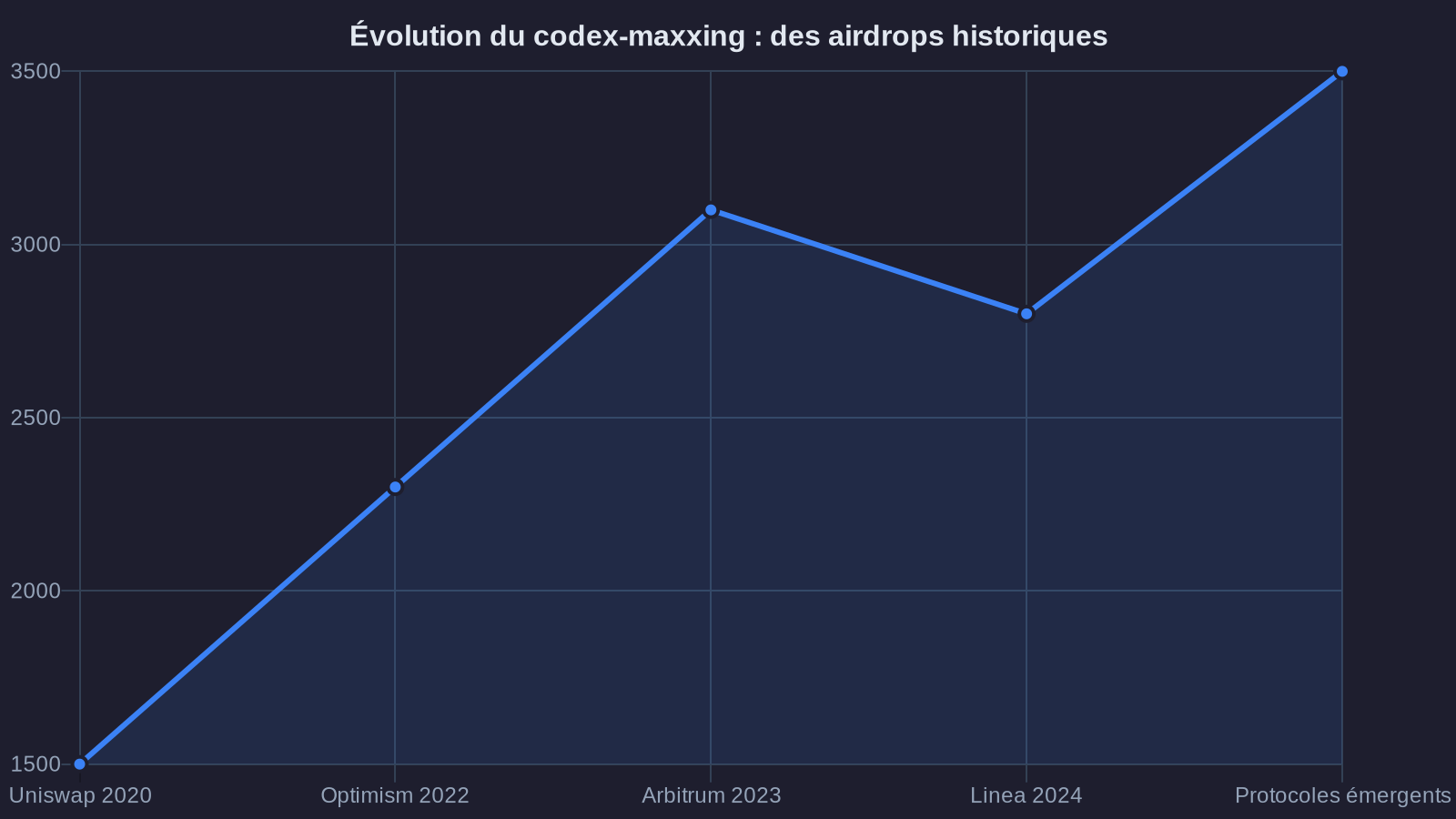
This surprise set a precedent. Users understood that using a promising DeFi protocol before its token launch could be highly profitable. Development teams, meanwhile, saw a brilliant way to build an engaged user base without spending a dime on traditional marketing.
It's like your favorite bakery telling you: "Write down every visit in a notebook, and when we become a national chain, we'll reimburse you for all your baguettes." You'd probably take that notebook very seriously.
The points system: mutual engagement
Protocols gradually structured this approach. Rather than promising an airdrop without clear rules, they created visible and measurable points systems. You lend $1,000 on the protocol for a month? You earn points. You invite friends? Even more points. You use advanced features? Bonus points.
The advantage for the protocol is twofold: it identifies its most active users and creates an engagement dynamic. Users know where they stand. They can track their score, compare with others, adjust their strategy. It's become a genuine game, with leaderboards and optimal strategies.
How does codex-maxxing actually work?
Imagine you identify a new decentralized lending protocol that just launched its points program. The team is solid, the project has raised funds from recognized investors, and the product works well. You decide to try your luck.
First step: you deposit funds. Say $5,000 in stablecoins (cryptocurrencies whose value is pegged to the dollar). The protocol assigns you a certain number of points per day based on the amount deposited. The longer you leave your funds, the more points you accumulate.
But that's not all. The protocol often offers multipliers. If you also borrow funds (in addition to lending), your points are multiplied by 1.5. If you participate in governance by voting on proposals, you earn a 10% bonus. If you invite friends who also deposit funds, you get 5% of their points.
The time-capital-risk equation
Codex-maxxing quickly becomes an optimization exercise. You must decide what amount to commit, how long, and what strategies to adopt to maximize your protocol points. Some sophisticated users even deploy funds across multiple protocols simultaneously, calculating the potential return from each.
That's where it gets interesting: you don't know what your points will be worth. The protocol could allocate 10% of its total token supply to point holders. Or 5%. Or 15%. And you also don't know what the token price will be at launch. So you're betting on multiple unknowns at once.
Let's take a concrete example. You've accumulated 10,000 points on a protocol. At launch, the team announces it's distributing 100 million tokens to users, and 1 billion points were collected in total. You receive 1,000 tokens (10,000 / 1,000,000,000 × 100,000,000). If each token is worth $2 at launch, you've just made $2,000.
The real risks of codex-maxxing
This prospect of gains obviously attracts plenty of people. But several risks await point hunters.
The first is technical: you're trusting your funds to a protocol that hasn't yet proven itself. A bug in the code, a security vulnerability, and you could lose everything. In 2023, several promising protocols were hacked before even launching their token, leaving users with empty wallets and zero compensation.
The second risk is economic: nothing guarantees the token will have value. A protocol can generate lots of points, create buzz, then launch a token that collapses within hours. You'll have spent months accumulating points for a negligible or zero return. Meanwhile, your capital was locked up and wasn't generating returns elsewhere.
Dilution and false hope
A pernicious phenomenon has developed: dilution through the masses. When a protocol becomes very popular for its points program, thousands of users flock to it. Result: the total number of points explodes, and your slice of the pie shrinks. You had 1% of the protocol's points after three months? You now have only 0.1% six months later, despite your continued efforts.
Some protocols have also hardened their conditions along the way. Teams have retroactively excluded users suspected of using multiple accounts, or changed attribution rules without notice. Others simply closed their points program and launched their token without an airdrop, politely thanking their community for their participation.
Codex-maxxing strategies: should you jump in?
The answer depends on your profile and expectations. If you have capital you're willing to lock up for several months, you understand the technical risks, and you accept the idea of losing your time (or even your money), then yes, it could be an interesting strategy.
However, some common-sense rules apply. Never commit more than you can afford to lose on a token-less protocol. Diversify: rather than putting everything on a single protocol, spread your bets across three or four promising projects. And most importantly, seriously research the team, security audits, and the economic viability of the project.
Also keep in mind that the first waves of airdrops were generous because they were unexpected. Today, everyone is hunting points. Protocols know this, adjust their distributions accordingly, and average returns are mechanically declining. What worked brilliantly in 2020-2021 doesn't deliver the same results in 2024.
Nora's insight: the loyalty program analogy
Codex-maxxing is like a loyalty program that promises you points without telling you what they'll be worth. You shop at a new supermarket that says: "Collect points, and when we open our hundredth store, we'll convert them to euros." Maybe your 10,000 points will be worth €500. Maybe €50. Maybe the supermarket will go bankrupt before then. You're playing, but you're playing blind.
What you need to know about codex-maxxing
Codex-maxxing is a strategy of accumulating points on DeFi protocols hoping to receive a generous airdrop when their token launches. This practice became structured after the success of Uniswap and other protocols that rewarded their early users.
The risks are real and multiple: loss of capital due to a hack, dilution of your points by the massive arrival of new users, a protocol that never launches a token or changes the rules mid-course. Your capital is locked up for months with no guarantee of return.
This strategy requires time, capital, and good risk management. If you decide to try it, diversify your bets, only commit what you can afford to lose, and seriously research each protocol before depositing funds.
Codex-maxxing ultimately reveals a tension at the heart of modern DeFi: between the ideal of a decentralized finance accessible to all and the reality of an ecosystem where sophisticated early adopters capture most of the value. Protocols need users to grow, users seek quick gains. In this dance, everyone plays their part, with varying degrees of transparency and success.