In February 2024, a Paris-based investor lost €47,000 in Bitcoin. His Ledger Nano X hardware wallet? Untouched, never compromised. His seed phrase? Still locked in his safe. The problem? A simple SMS allegedly sent by Ledger support, inviting him to "secure his account" via a link. Three clicks later, his funds vanished.
This story illustrates a reality many overlook: hardware wallet security no longer relies solely on your device, but on your vigilance against increasingly sophisticated crypto phishing scams. Hardware wallets remain your best defense against private key theft. But they don't protect you against social engineering.
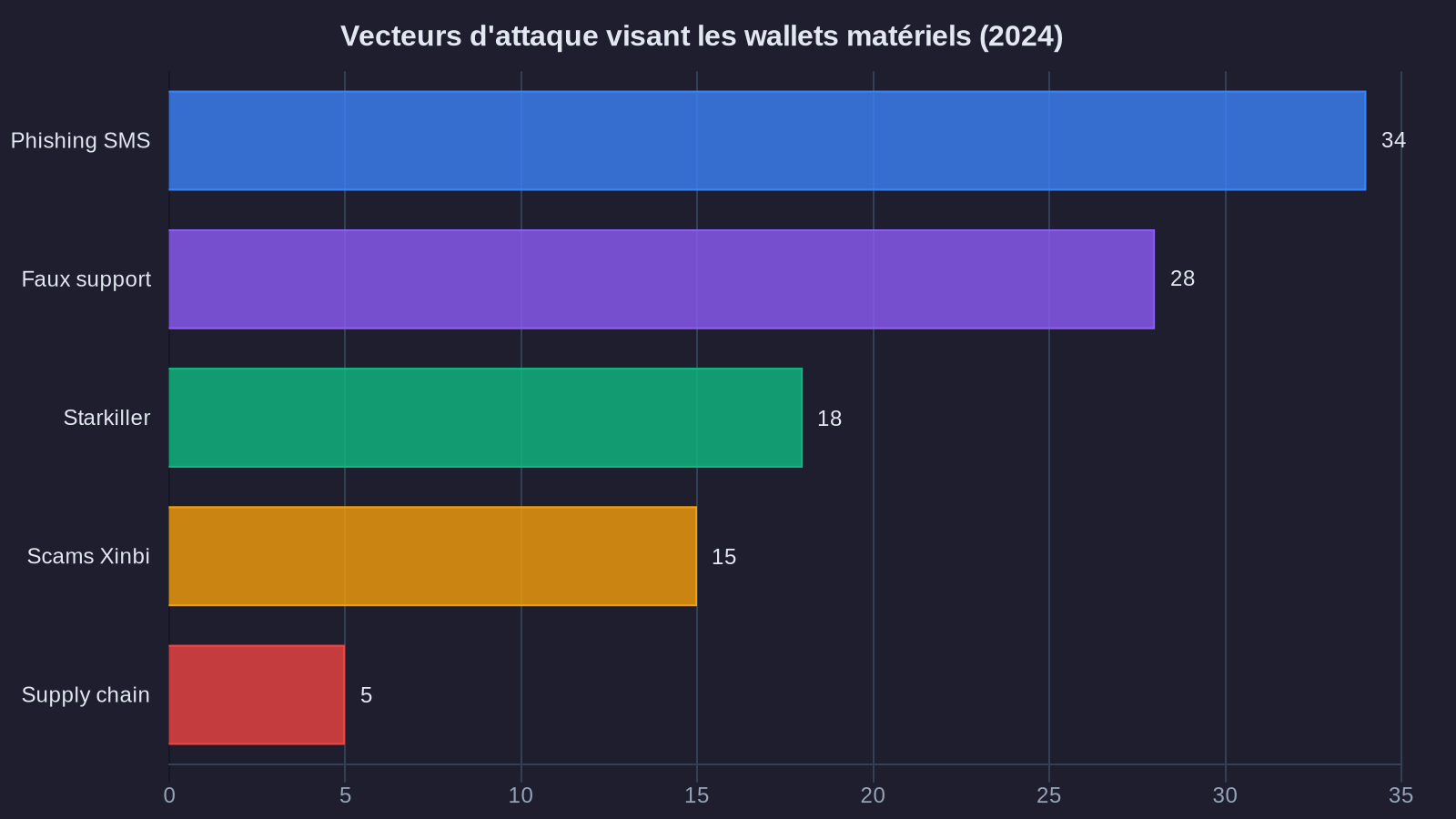
Between the emergence of Starkiller phishing capable of draining a wallet in seconds and massive Chinese Xinbi scam operations targeting hardware wallet holders, the threat landscape has fundamentally shifted in 2024. Understanding these new attacks has become as crucial as knowing how to generate a seed phrase. Besides, as Ledger targets a $4 billion IPO, the security question for hardware wallets has never been more strategically important for the industry.
Starkiller: the attack that drains your wallet while you watch
Traditional crypto phishing relied on a simple promise: stealing your seed phrase. The user would enter their 12 or 24 words on a fake website, and the scammer would take control of the wallet. With Starkiller, the mechanics change entirely.
This technique doesn't seek to obtain your private keys. It exploits the precise moment when you connect your hardware wallet to sign a legitimate transaction. The scammer lures you to a fraudulent site that looks exactly like a platform you know: Uniswap, OpenSea, or even a blockchain bridge interface.
You connect your Ledger to perform what seems like a simple swap or transfer. But the smart contract you're about to sign doesn't match what's displayed on screen. It actually contains an unlimited approval instruction, giving the hacker permanent access to your ERC-20 tokens or NFTs.
The most insidious part? Your hardware wallet does exactly what it's designed to do: securely sign your transaction. Except this transaction serves the scammer's interests, not yours. Once approval is granted, the hacker simply drains your wallet remotely, with no way for you to intervene.
According to Chainalysis data, Starkiller attacks caused over $180 million in losses in the first half of 2024, with an average detection time of 48 hours. By the time the victim realizes they've signed a malicious contract, their funds have already passed through multiple mixers.
Warning signs you should never ignore
Several red flags can help you spot a Starkiller attempt before it's too late. First, always verify the URL of the site you're connecting to. Scammers buy domain names differing by just one character: unisvvap.org instead of uniswap.org, for example.
Next, carefully examine what appears on your hardware wallet screen before confirming. If the message mentions "approval" or "setApprovalForAll" when you thought you were simply swapping tokens, refuse immediately. A standard swap never requires unlimited approval.
Finally, be wary of sites pressuring you to act quickly: "Limited offer," "Only 3 left in stock," "Confirm within 5 minutes." This artificial urgency is designed to bypass your critical thinking. No legitimate operation justifies such haste.
Xinbi and crypto infrastructure scams: the industrialization of hardware wallet fraud
While Starkiller represents a sophisticated technical threat, Xinbi scams illustrate a completely different approach: large-scale social engineering specifically targeting hardware wallet holders. The term "Xinbi" (新币, literally "new currency") refers to a set of fraudulent operations orchestrated from China, primarily targeting European and North American markets.
The typical scheme begins with a private message on Telegram, Discord, or Twitter. Someone posing as an experienced trader or crypto project representative contacts you. They mention exclusive investment opportunities, often tied to tokens not yet listed on major exchanges. To establish credibility, they might share fake profit statements or screenshots of fictional transactions.
Once trust is established, the scammer directs you to an investment platform that looks professional: polished interface, fake market charts, yield simulator. You're encouraged to connect your hardware wallet "to secure your gains" or "to participate in an airdrop reserved for early investors."
This is when the trap snaps shut. Either the site makes you sign a malicious contract (like Starkiller attacks), or it tricks you into transferring funds to an address controlled by the scammers under the guise of "verifying your eligibility." In some cases, you're even asked to temporarily share your seed phrase to "activate a referral bonus"—a complete security nonsense, but it works on uninformed victims.
The scale of these operations is massive. A TRACFIN report published in July 2024 estimates losses related to Xinbi scams in France at over €420 million over the past 18 months. Operational cells typically comprise between 20 and 50 people, with specialized roles: prospecting, relationship building, fund extraction, money laundering through permissive Asian exchanges.
What makes these scams so effective
Unlike traditional phishing that relies on speed and volume (thousands of randomly sent emails), Xinbi scams prioritize personalization and duration. A scammer can spend weeks chatting with their target, simulating a trusting relationship, sharing fake advice that seems relevant.
This approach exploits a well-documented psychological bias: reciprocity. After "helping" for free over days, the scammer asks for something in return—connecting their wallet, transferring a small amount to test the platform. The victim, grateful for the attention received, drops their guard.
Moreover, these operations often target specific profiles: newcomers to the crypto market, people who recently bought a hardware wallet (information sometimes obtained through data breaches from retailers), or investors who've publicly shown interest in certain projects on social media. A situation reminiscent of the Vercel breach and the importance of reacting quickly when your data is exposed.
Protecting private keys: best practices with your hardware wallet
Owning a Ledger Nano X or Trezor Model T is an excellent starting point. But security relies on a consistent set of behaviors, not solely on a hardware device.
Rule number one: your seed phrase never leaves the paper you wrote it on. Never in a text file, never in an email, never in a notes app, never in a digital safe. And most importantly, never entered on a computer or smartphone, even "temporarily." Ledger support, Trezor support, the support of any hardware wallet manufacturer will NEVER ask for your seed phrase. If anyone claims otherwise, it's a 100% scam.
Second principle: create separate wallets for different uses. One wallet for long-term storage of your main assets (this one should almost never connect), another for your regular interactions with dApps or exchanges. This segregation significantly limits damage if you sign a malicious contract. If your "trading" wallet is compromised, your main reserves remain untouched.
Third recommendation: systematically use a dedicated computer or hardened environment for your most sensitive crypto operations. An old Linux laptop, regularly updated, with only the bare essentials installed (Ledger Live, MetaMask, browser), offers an infinitely smaller attack surface than a Windows machine loaded with various software and used for checking emails and browsing the web.
Regularly audit your approvals
Even with utmost vigilance, contract approvals sometimes slip through the cracks. This is why regularly auditing permissions granted to your tokens is an essential practice.
Tools like Revoke.cash (for Ethereum and EVM chains) or Solana FM (for the Solana ecosystem) let you visualize all smart contracts with access to your funds. If you spot a contract you don't recognize, or an approval from months ago for a site you no longer use, revoke it immediately.
This operation takes just a few minutes per quarter and could save you from total asset loss. As a guideline, perform this audit systematically after interacting with a new DeFi protocol, participating in an NFT mint, or testing an obscure decentralized exchange platform. Similar vigilance to that recommended against DeFi security breaches that average $25 million in losses.
The vigilance point
Crypto asset security isn't a state, it's a process. Your hardware wallet is your best defense against private key theft, but it doesn't protect you against your own carelessness or increasingly sophisticated social engineering techniques.
Starkiller attacks and Xinbi scams exploit precisely this gap: they bypass hardware security to target the moment you make a decision. It's that fraction of a second when you validate a transaction, when you trust an interlocutor, when you click a link, that determines whether your assets remain safe or disappear forever.
Facing these threats, three reflexes to anchor permanently: systematically verify URLs before any wallet connection, carefully examine what appears on your hardware wallet screen before signing, and never, ever, under any circumstances, share your seed phrase with anyone.
If you have any doubt about the legitimacy of a request, a website, or a contact, take time to verify. Consult the official channels of the project in question. Ask the question on specialized forums. Contact your crypto asset expert if you have one. In the world of cryptocurrencies, excessive caution doesn't exist. It's simply called due diligence.
```