
You've built substantial savings in tax-deferred accounts — 401(k), traditional IRA, perhaps a Roth IRA. You're considering retirement in Florida, Texas, or another state with no income tax. On paper, the equation seems straightforward: no state tax, fewer deductions, more money available.
Except this logic doesn't hold up against the reality of the American tax system. For retirement assets between $1 and $3 million, the absence of state income tax represents only a small piece of the puzzle. Retirement tax optimization for 2026 requires far more: federal taxation, mandatory distributions (RMDs), estate planning, and Roth conversion strategies are all levers that weigh far more heavily on your bottom line.
Here's how to structure coherent tax planning for your retirement taxes in the United States in 2026, beyond simple geographic choice.
The illusion of the 0% state: what your advisor isn't telling you
Florida, Texas, Nevada, Wyoming, Alaska, South Dakota, Tennessee, New Hampshire, and Washington don't levy state income tax. This feature attracts thousands of American retirees each year. Yet the tax savings realized are often overstated.
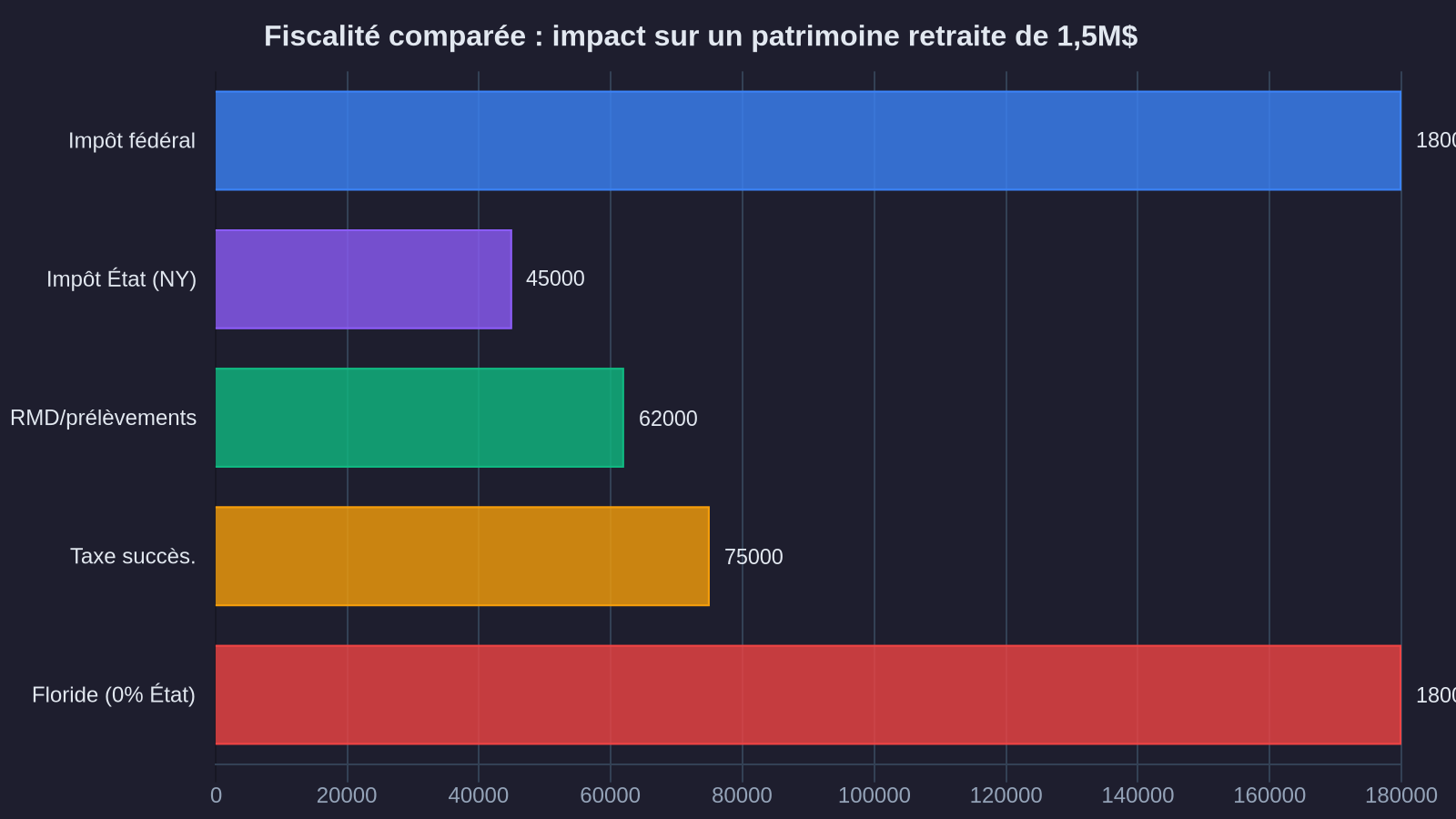
Take a married couple with $1.5 million split between a 401(k) ($1.2M) and a Roth IRA ($300k). At age 73, RMDs (Required Minimum Distributions) mandate a minimum withdrawal from the 401(k). In 2026, this mandatory withdrawal is approximately $44,000 in the first year, based on a $1.2M portfolio. This amount increases each year based on actuarial life expectancy.
These $44,000 are taxable at the federal level. Even in Florida, with a 0% state tax, this couple will pay roughly $4,800 in federal tax (10% then 12% bracket). If this couple lived in California, state tax would add approximately $2,200 more. The annual tax savings from relocating to Florida is therefore $2,200, or $183 per month.
That's not negligible, but it's hardly a game-changer. And more importantly, it does nothing to address the real problem: the fiscal time bomb represented by massive savings concentrated in tax-deferred accounts — a poorly anticipated deferred savings strategy.
The age 73 trap: when RMDs blow up your tax bracket
RMDs are often viewed as a simple administrative formality. In reality, for assets exceeding $1 million, they constitute a formidable tax accelerator.
Back to our couple with $1.2M in a 401(k). At age 73, the minimum withdrawal is 3.77% of assets. At age 80, it rises to 5.35%. At age 85, 6.76%. At age 90, 8.77%. If the portfolio continues to grow (which is likely with a balanced portfolio), the withdrawn amounts increase mechanically.
Concrete simulation: a $1.2M 401(k) growing at 5% annually reaches $1.68M by age 80. The annual RMD then rises to $90,000. This amount propels the couple into the 22% federal bracket, possibly even 24% if other income sources (Social Security, pensions, rental income) are added.
The result? An effective tax rate that can climb to 18-20%, roughly $18,000 in federal tax on RMDs alone. And this is true even in Florida — the Florida tax misconception at its peak.
| Age | 401(k) Portfolio | Annual RMD | Estimated Federal Tax |
|---|---|---|---|
| Age 73 | $1,200,000 | $44,000 | $4,800 |
| Age 80 | $1,680,000 | $90,000 | $18,000 |
| Age 85 | $2,140,000 | $145,000 | $32,000 |
These figures illustrate a reality often underestimated: the more you let your tax-deferred savings grow without intervention, the more you'll pay in taxes later. American tax policy is designed to heavily tax deferred withdrawals after age 73.
Strategy #1: Progressive Roth conversion, well before age 73
A Roth IRA conversion involves transferring funds from a traditional IRA or 401(k) to a Roth IRA. This transfer is taxable in the year of conversion, but it then allows you to benefit from entirely tax-free growth and withdrawals — the essence of tax optimization in retirement.
The classic mistake is waiting until retirement to convert. By then, you often have fewer tools to smooth out the tax impact. The optimal strategy begins well before, ideally between ages 55 and 72.
Consider a concrete scenario: a 60-year-old couple has $1.5M in a 401(k) and no significant retirement income yet. Their current annual income is $80,000. They're at the start of the 12% bracket (which ends at $94,300 of taxable income for a couple in 2026).
Strategy: convert $15,000 each year from their 401(k) to a Roth IRA, staying within the 12% bracket. Annual tax cost: $1,800. Over 13 years (until age 73), this represents $195,000 converted and $23,400 in tax paid.
Result at age 73: instead of having $1.5M entirely in a 401(k), the couple has $1.3M in a 401(k) and $250k in a Roth (with growth). RMDs now apply only to $1.3M, roughly $48,000 instead of $56,000. The cumulative tax savings over 20 years of retirement easily exceed $60,000.
This strategy is even more effective if you go through a period of lower income (job loss, sabbatical, semi-retirement). A year when you fall into the 10% bracket is a golden opportunity for substantial conversion.
Strategy #2: QCDs and charitable giving to reduce RMDs
If you have philanthropic intentions, Qualified Charitable Distributions (QCDs) allow you to transfer up to $105,000 per year (in 2026) directly from your IRA to a charitable organization without that amount being taxable.
Major advantage: the QCD counts as an RMD but doesn't increase your taxable income. You mechanically lower your tax bracket.
Example: at age 75, your RMD is $70,000. You make a $20,000 QCD to a foundation. You only personally withdraw $50,000 in taxable income. Immediate tax savings: approximately $4,400 (22% bracket).
This strategy is particularly relevant for portfolios exceeding $2M, where RMDs become structurally too high relative to cash needs. Rather than withdrawing sums you won't use (and which will be taxed), you might as well direct them toward causes that matter to you — an approach to tax optimization that combines social impact with wealth efficiency.
Strategy #3: Optimized estate planning and Stretch IRA for your children
Passing a traditional IRA or 401(k) to your heirs requires them to empty the account within 10 years of your death (post-SECURE Act 2.0 rule). These withdrawals are taxable at their marginal rate, which can be devastating if your children are in their peak earning years (ages 40-55).
Classic scenario: you pass away at 85 with an $800,000 IRA. Your son, a senior executive at 50, inherits the account. He's in the 32% federal bracket. He must withdraw approximately $80,000 annually for 10 years. Total federal tax on these withdrawals: roughly $250,000. Your son receives only $550,000 net.
Conversely, if you had converted that IRA to a Roth before your death, your son would inherit a Roth IRA. Withdrawals would remain tax-free. Net gain for him: $250,000.
This difference justifies progressive Roth conversion, even if it means paying tax during your lifetime. You pay in the 12-22% bracket; your children would have paid in the 32-35% bracket. The trade-off clearly favors conversion.
Complementary alternative: if you have liquid assets outside retirement savings, consider permanent life insurance (whole life or universal life) to cover the tax bill your heirs will face. The death benefit is paid tax-free and can finance the withdrawals associated with your deferred accounts — a strategy similar to the wealth structuring approaches used by savvy asset managers.
What this means for your portfolio
Retirement taxation in the United States doesn't come down to choosing a zero-income-tax state. For assets between $1 and $3 million, retirement tax optimization rests on three pillars: anticipating RMDs, smoothing taxation through strategic Roth conversions, and structuring estate planning to favor tax-exempt accounts.
A couple actively managing these three levers can save between $150,000 and $300,000 in taxes over 25 years of retirement compared to a passive approach that simply endures mandatory withdrawals. The savings far exceed what a simple move to Florida would achieve.
The key? Start early. The sooner you act before age 73, the more flexibility you have. From that age onward, RMDs impose a payout schedule that severely limits your options — a time constraint similar to what you find in other sophisticated wealth strategies.
```Your portfolio deserves better than a savings account. I'll show you the way, with numbers to back it up.