
Common Lisp, Racket, Clojure, Emacs Lisp. To many, these names evoke esoteric programming languages, reserved for purist computer scientists. Yet the logic underlying this family of languages – the manipulation of nested data structures, function composition, elegant recursion – offers a surprisingly relevant mental model for thinking about retirement savings.
In recent years, we've witnessed an interesting convergence between modern software development practices and wealth management. Professionals who master both domains develop a more rigorous approach to financial planning. Understanding the fundamental principles of Lisp languages means acquiring a conceptual framework that transcends mere technique to inform your strategic thinking on asset allocation.
Lisp philosophy applied to wealth building
Languages in the Lisp family share a fundamental characteristic: everything is an expression. A Lisp program is nothing more than a sequence of nested lists, where code and data adopt the same structure. This apparent homogeneity conceals considerable conceptual power.
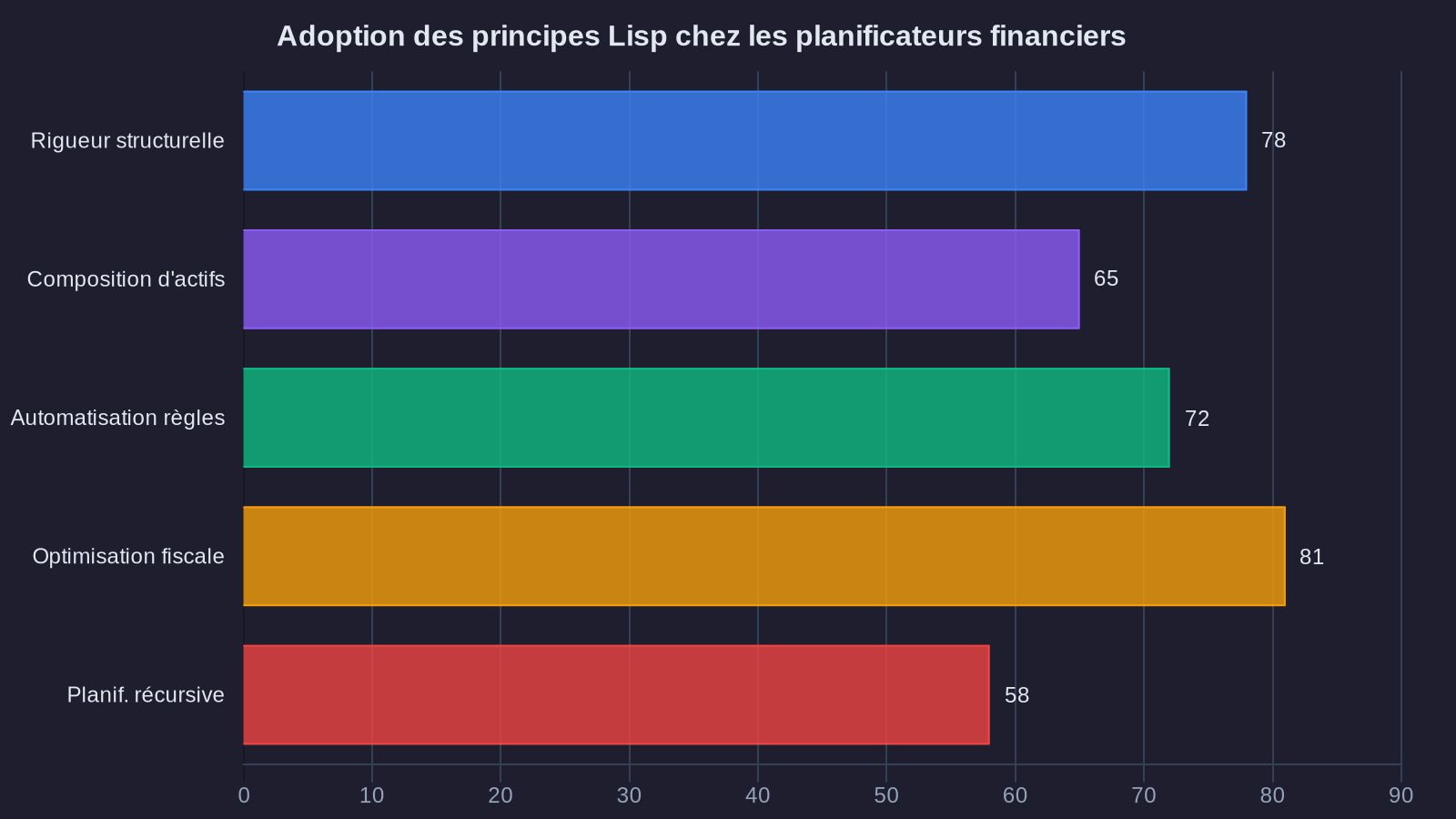
Let's transpose this logic to retirement savings. Your wealth can be modeled as a tree structure: tax-advantaged accounts (PER, life insurance, securities accounts) that contain allocations (stocks, bonds, real estate), themselves composed of specific holdings. Each level of this hierarchy follows its own rules – taxation, liquidity, investment horizon – yet the whole forms a coherent system, similar to the considerations found in optimizing your retirement tax strategy.
Common Lisp, the historical dialect standardized in 1994, excels at manipulating such complex structures. Its macro system allows you to define transformation rules applicable recursively across all levels of your wealth. Imagine being able to express in just a few lines a tactical allocation rule that automatically adapts to each compartment of your portfolio, based on your age and risk tolerance.
This recursive approach finds a direct echo in wealth management. The same diversification principles apply at the global level of your wealth and within each investment bucket. This is precisely what a rigorous wealth manager does: they break down a general strategy into specific, coherent tactics.
Clojure and immutability: rethinking the temporality of retirement savings
Clojure, the modern dialect that runs on the JVM, introduces a fundamental concept: immutability by default. In this language, data structures don't get modified; instead, you create new versions that efficiently share memory with their predecessors. Each transformation produces a new reality while preserving the history.
This philosophy resonates deeply with retirement planning. Your wealth at age 35 isn't a "modified" version of your wealth at age 30. It's a distinct state, the result of allocation decisions, contributions, and market performance. Yet there exists a structural continuity between these successive states.
Professionals who adopt this temporal vision develop particular discipline. They don't "tinker" with their allocation based on market movements. They define coherent trajectories, where each adjustment fits into a logical sequence. Each year, your portfolio becomes a new version of itself, optimized for your current situation, but built on the foundations of previous choices – an approach that echoes long-term retirement strategies.
Clojure also offers powerful abstractions for managing concurrency – multiple processes modifying shared data in a coordinated way. In your wealth life, you'll juggle multiple simultaneous objectives: building your retirement, funding your children's education, preparing wealth transfer. These projects coexist and interfere with each other. Clojure's functional approach proposes patterns for orchestrating these competing priorities without creating inconsistencies.
Racket and modularity: composing custom strategies
Racket stands out for its pedagogical orientation and ability to create domain-specific languages. You can define new syntaxes tailored to a particular problem. This flexibility makes it an excellent tool for prototyping complex models.
Applied to wealth management, this principle suggests a modular approach to retirement planning. Rather than adopting a monolithic strategy – "I invest X% in stocks and Y% in bonds" – you compose basic building blocks that each address a specific objective.
A first block could manage your safety foundation: euro funds, short-term bonds, cash. A second would pilot your stock market exposure according to your time horizon. A third would manage tactical bets on specific themes. Each of these blocks operates according to its own logic, with its own monitoring indicators and rebalancing thresholds.
The value of this modular architecture becomes apparent when making adjustments. You can fine-tune one compartment without calling the entire strategy into question. If you identify a weakness in your currency risk management, you intervene on the relevant module. The rest of your strategy remains stable. This separation of concerns – a central concept in software engineering – reduces cognitive complexity and limits error risk.
Racket also facilitates testing and simulations. Before deploying an allocation modification to your actual portfolio, you can test it against historical data and verify its consistency with your constraints. This experimental rigor, natural in software development, remains too rare in individual wealth management.
Emacs Lisp and intelligent automation of your savings tracking
Emacs Lisp, the language that extends the Emacs text editor, embodies a particular philosophy: everything should be programmable, customizable, automatable. An experienced Emacs user doesn't suffer their tool; they continuously reshape it to adapt to their current needs.
This approach finds a direct extension in steering your retirement savings. The interfaces offered by brokers and banks remain generalist. They don't reflect your specific way of thinking about your wealth, your analysis priorities, your customized alerts.
Intelligent automation starts with aggregating your scattered wealth data. Multiple accounts, multiple institutions, heterogeneous formats. Building your own analysis tools – even just well-structured spreadsheets with thoughtful macros – gives you a consolidated view that standard platforms don't provide.
Beyond simple data collection, automation enables sophisticated calculations: evolution of your savings rate, projections of your replacement income under different performance scenarios, sensitivity analysis to interest rate changes. These analyses, tedious to do manually, become accessible when you invest in the right automation.
Emacs Lisp also illustrates the importance of incremental iteration. You don't build a perfect wealth management system all at once. You start by automating a repetitive task – updating your monthly tracking spreadsheet. Then you add an alert on your rebalancing thresholds. Gradually, you develop a custom management environment suited to your situation and your comfort level with numbers.
From theory to practice: integrating these principles into your approach
One could legitimately object that these parallels remain intellectual, without immediate practical relevance. After all, managing your wealth doesn't require programming in Lisp. That's true. But the underlying principles – recursive structuring, temporal immutability, modularity, automation – transcend the language.
Start by mapping your wealth as a tree structure. Literally draw the tree: your accounts at the first level, your allocations at the second, your individual positions at the third. This visualization often reveals inconsistencies masked by scattered accounts.
Then adopt a discipline of versioning. Keep an annual record of your allocations, your arbitrage decisions, their rationale. This historization lets you identify your behavioral biases – overreaction to market corrections, uncontrolled allocation drift. It's the wealth management equivalent of version control in software development.
Define explicit allocation rules, formalized in writing. Not vague intentions ("I want performance"), but objective criteria that trigger specific actions. "When my stock bucket exceeds 65% of my financial wealth, I rebalance to 60%". These rules automate your decisions and protect you from your emotions during stressful phases.
Progressively invest in your own analysis tools. A well-structured spreadsheet beats a sophisticated platform whose calculation assumptions you don't control. You understand what you build yourself. This intimate understanding of your models gives you the clarity needed to detect their limitations.
The computational thinking of Lisp languages – Common Lisp, Racket, Clojure, Emacs Lisp – won't magically transform your savings into a comfortable income. But it furnishes you with a mental framework for approaching wealth complexity methodically. The principles of composition, recursion, separation of concerns apply beyond code. They structure a rigorous approach to financial planning, where each decision fits into a coherent system rather than responding to the urgency of the moment. Perhaps therein, in this discipline of thought, lies the true value of this apparently roundabout exploration.