On February 5, 2019, the Zcash team published a quiet disclosure that could have sent shockwaves through the entire crypto-assets sector. A critical vulnerability, present since the protocol's launch in October 2016, would have allowed anyone who discovered it to create an unlimited number of ZEC. Not through a complex attack on consensus, but through a simple mathematical flaw in the zero-knowledge proof system, the famous zk-SNARK that underpins Zcash's privacy reputation.
This Zcash flaw enabling infinite ZEC creation went largely unnoticed by mainstream media. Yet it represents one of the most instructive cases of cryptographic vulnerability ever disclosed. Not only for its technical severity, but especially for what it teaches us about the security of decentralized systems and the trust we place in the protocols we use.
A vulnerability invisible by design
To understand the severity of this flaw, you first need to grasp what makes Zcash unique. Unlike Bitcoin where all transactions are public, Zcash offers "shielded" transactions that hide the sender, recipient, and amount. This privacy relies on a mathematical system called zk-SNARK: a cryptographic proof that validates a transaction without revealing its contents.
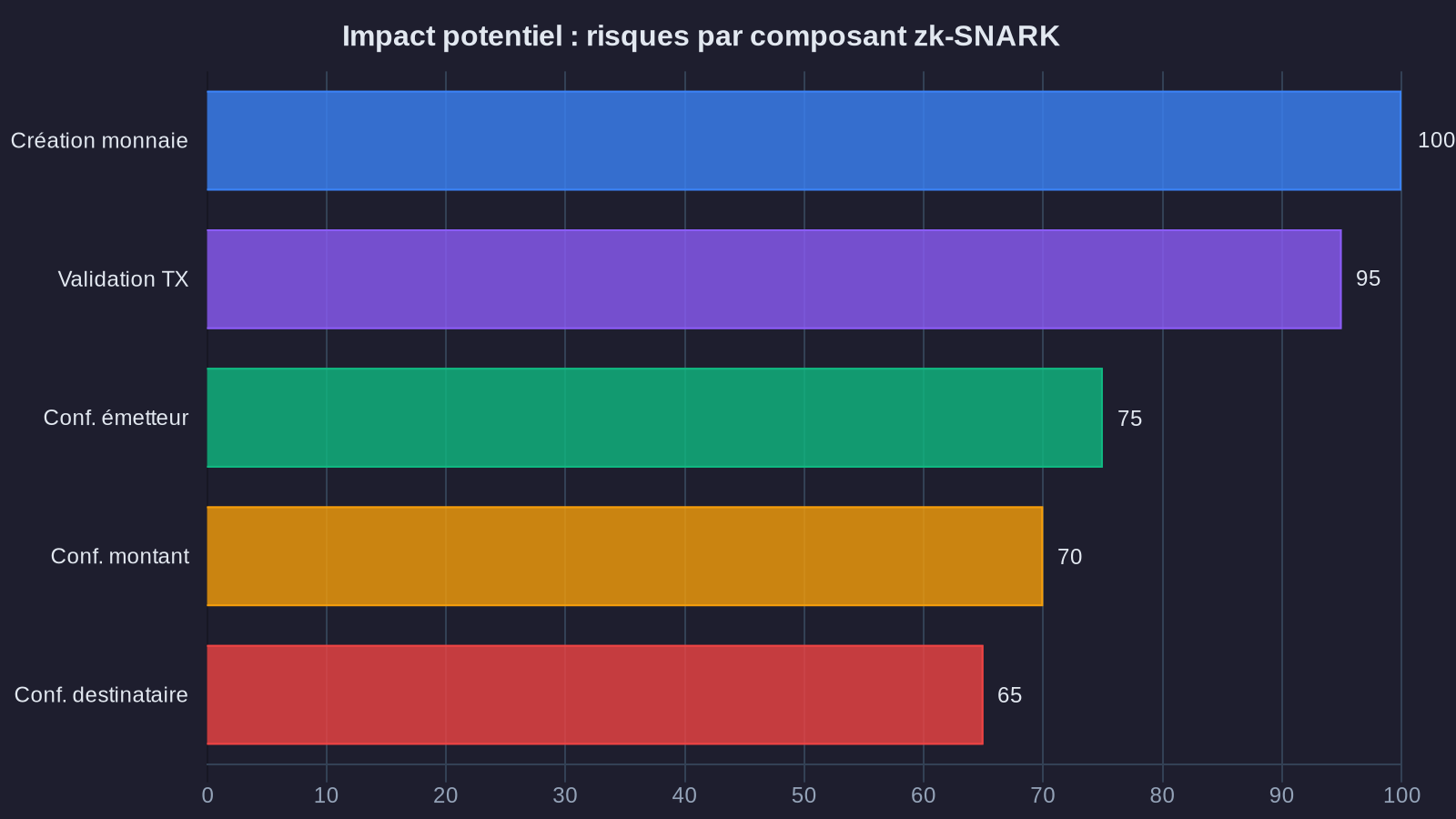
The problem with this architecture is that it creates a fundamental blind spot. On Bitcoin, if someone tries to create bitcoins out of thin air, the anomaly is immediately visible on the blockchain: the sum of transaction outputs would exceed the sum of inputs. But with Zcash, in a shielded transaction, no one can verify that the amounts in and out actually correspond. We rely on the mathematics of zk-SNARK to guarantee this consistency.
The discovered vulnerability exploited precisely this gray area. It allowed constructing a mathematically valid zk-SNARK proof attesting to a balanced transaction when it actually created money from nothing. Technically, it was a weakness in how the protocol verified the cryptographic integrity of "notes" (the Zcash equivalent of Bitcoin's UTXOs).
The impossible crypto security audit: how to detect what leaves no trace
Here's where the problem becomes truly dizzying. After fixing the flaw in the Sapling update (October 2018), the Zcash team published its disclosure in February 2019. And it had to make a chilling admission: it is mathematically impossible to know whether someone exploited this vulnerability during the two years it was active.
The total ZEC supply displayed on block explorers? It means nothing. Someone could have created 10 million, 100 million phantom ZEC without leaving any detectable trace on the blockchain. These phantom ZEC could have been sold gradually on markets, diluting the value of every other holder, without anyone ever being able to prove it.
That's the entire particularity of this case. In most crypto hacks, you can track funds, analyze on-chain movements, estimate losses — like in the case of the $577 million stolen by North Korea. Here, nothing. The privacy system designed to protect legitimate users also creates the perfect framework for undetectable financial crime.
The Zcash team conducted statistical analysis on shielded transaction volumes, searched for anomalies in trading patterns. Nothing conclusive. Their official position? No evidence of exploitation. But no possibility of certainty either. This fundamental uncertainty raises a troubling philosophical question: what distinguishes a perfect heist from a heist that never happened, if both are absolutely indistinguishable?
Lessons from a narrowly averted crisis (or perhaps not)
The Zcash case reveals several uncomfortable truths about the security of next-generation cryptographic protocols. The first concerns the gap between cryptographic innovation and operational maturity. zk-SNARKs represent a remarkable mathematical breakthrough, but their very complexity multiplies potential attack surfaces. Bitcoin uses relatively simple cryptographic primitives proven over decades. Zcash ventures into much more recent cryptographic territory.
This protocol vulnerability wasn't a classic implementation bug that rigorous testing could have caught. It resided in the very design of the proof system. Even top-tier cryptographers who audited the protocol before launch didn't identify it. It was ultimately an internal team researcher, Ariel Gabizon, who discovered it in 2018 during a routine audit before the Sapling update.
The second lesson concerns the governance of vulnerability disclosure. Zcash waited four months after the fix to publish the full disclosure. This caution is understandable: revealing too soon could have encouraged bad actors to exploit the flaw in other protocols using similar zk-SNARKs. But this delay also raises ethical questions. During those four months, investors continued buying ZEC without knowing about this major historical risk.
Zcash isn't even the only privacy protocol to encounter this type of problem. Monero has suffered multiple vulnerabilities allowing creation of false amounts. The difference? On Monero, it was possible to verify after the fact that no abnormal inflation had occurred, thanks to independent verification mechanisms. On Zcash, this verification remains structurally impossible for shielded transactions.
What this flaw teaches us about trust in crypto
The crypto-assets sector is built on a fundamental principle: don't trust, verify. Don't trust, verify. But the Zcash flaw reveals the limits of this principle. There are situations where, even by auditing every line of code and every on-chain transaction, you cannot verify. You must trust. Trust in mathematics, in the cryptographers who designed the system, in the audit process, in the good faith of developers who fix flaws before they're exploited.
This reality should lead you to reassess how you evaluate counterparty risk on the protocols you use or recommend. A protocol that prioritizes maximum privacy necessarily accepts a compromise: an irreducible element of opacity. This opacity protects your privacy, but it also protects potential attackers.
Since 2019, Zcash has significantly strengthened its crypto security audit processes. The Halo 2 update (2020) replaced the old trusted setup ceremony with a system that eliminates this centralized point of trust. Other privacy protocols, like Aztec or Aleo, integrate from inception the lessons learned from this flaw. But the fundamental risk remains: the more sophisticated a cryptographic system, the harder it becomes to formally guarantee complete absence of vulnerability.
The vigilance point: If you hold assets on protocols with advanced privacy features (Zcash, Monero, Tornado Cash), understand that you're accepting a higher residual cryptographic risk than on transparent blockchains. This risk isn't necessarily disqualifying, but it must be conscious and proportionate to your exposure. Prioritize protocols that have undergone multiple audits by recognized independent teams and that have generous bug bounty processes. A protocol that pays $1 million for discovering a critical flaw demonstrates it takes security seriously. To understand how to evaluate these risks in a comprehensive wealth management approach, the drawdown metric can offer you a relevant analytical framework.
Checklist: Evaluating a protocol's cryptographic risk
Before using a protocol relying on advanced cryptography (zk-SNARKs, zk-STARKs, ring signatures, etc.), verify the following points:
- Protocol maturity: Has it been in production for at least 2-3 years with significant volume? Cryptographic vulnerabilities are often discovered after several years.
- Multiple audits: Has the protocol been audited by at least two recognized specialized firms (Trail of Bits, Kudelski Security, NCC Group, etc.)? Are audit reports public?
- Bug bounty program: Is there an active program with substantial rewards (minimum $100,000 for a critical flaw)? Check platforms like Immunefi or HackerOne.
- Transparency on past incidents: Has the team published detailed post-mortems on discovered vulnerabilities? Transparency is an indicator of governance maturity.
- Capacity for independent verification: Even on a privacy protocol, are there mechanisms to verify the integrity of total supply or detect statistical anomalies? Zcash has since implemented tools like the turnstile audit.
- Diversification: Never concentrate a significant portion of your crypto wealth in a single protocol using experimental cryptography, no matter how promising.
Conclusion: Security as a continuous process
The Zcash flaw didn't destroy the protocol. Five years later, ZEC continues to exist and trade. Some see this as proof the flaw was never exploited. Others believe a rational attacker would have precisely incentive to stay discreet to continue monetizing their discovery long-term. We'll probably never know.
What we do know is that this affair should make us more humble about the complexity of the systems we use. There is no perfectly secure protocol. There are protocols whose vulnerabilities haven't yet been discovered. Security isn't a state you achieve; it's a process you maintain: regular audits, generous bug bounties, transparency culture, risk diversification.
For you, as a holder or user of crypto-assets, the lesson is clear. Before using a protocol, ask yourself this simple question: if a critical vulnerability were discovered tomorrow, would I have the means to verify if it was exploited? If the answer is no, you must consider this opacity risk as part of your evaluation. Privacy has a price. That price is an irreducible element of trust in systems you can't entirely verify yourself.