
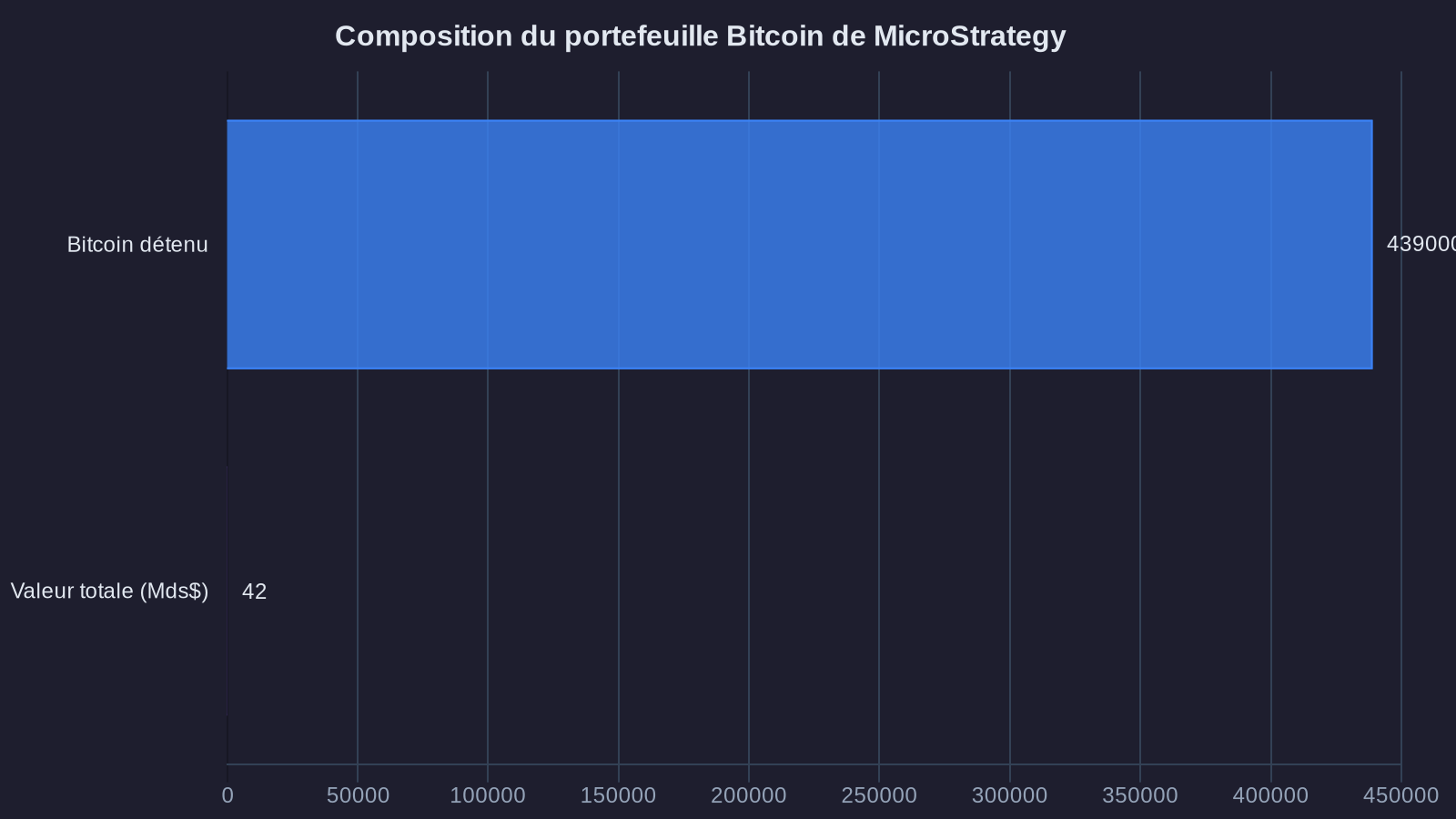
Michael Saylor just announced the acquisition of 24,869 BTC for $2.1 billion. This latest Bitcoin accumulation brings MSTR's total holdings to over 439,000 BTC, worth approximately $42 billion at current prices. For a wealth advisor, this move deserves careful attention. Not to blindly replicate this strategy—a 100% allocation to a volatile asset remains a portfolio anomaly—but to understand what it teaches us about Bitcoin as a component of a diversified portfolio.
Behind this massive accumulation lies precise financial logic: transforming a publicly traded software company into a leveraged Bitcoin investment vehicle. MicroStrategy is no longer really a software publisher. It has become a holding company whose primary asset is Bitcoin, financed through convertible debt and successive capital raises. An audacious strategy that raises concrete wealth management questions: what actual returns? What risk level? And most importantly, what can we learn from this for a balanced corporate Bitcoin allocation?
The financial mechanics behind accumulation: debt, dilution, and the appreciation bet
Let's start by breaking down the economic model. MicroStrategy finances its Bitcoin acquisitions primarily through two levers: issuing zero or near-zero interest convertible debt, and issuing new shares. As of March 2025, the company holds 439,000 BTC with an average cost basis of roughly $66,000 per unit. At current prices (around $95,000), this represents a latent gain of $12.7 billion—approximately 44% unrealized profit.
This raw performance is impressive. But it masks a more complex wealth management reality: the cost of this strategy. MicroStrategy's convertible debt now totals several billion dollars. Its 2027 and 2028 convertible bonds offer rates of 0% to 0.625%, which appears attractive. Yet these instruments create potential dilution pressure: if MicroStrategy's share price exceeds the conversion price, bondholders will convert to shares, diluting existing shareholders.
Moreover, each capital raise through share issuance mechanically dilutes historical shareholders. Between 2020 and 2025, MicroStrategy's shares outstanding increased by over 70%. Admittedly, net asset value per share (Bitcoin holdings divided by share count) has advanced thanks to BTC appreciation. But a wealth manager must factor this dilution into any true return calculation.
Wealth simulation: what if you had invested €100,000 in 2020?
Let's take a concrete case. In August 2020, when MicroStrategy announced its first massive Bitcoin purchase, the stock was trading around $130. With €100,000, you would have bought roughly 770 shares (converting at 1€ = 1$ for simplicity). Five years later, in March 2025, MicroStrategy trades around $300 per share. Your investment would be worth $231,000, a gain of 131% over five years.
Impressive. But compare that to a direct Bitcoin investment. In August 2020, BTC was trading around $11,500. With €100,000, you would have acquired approximately 8.7 BTC. At current prices of $95,000, your portfolio would be worth $826,500—a gain of 726% over the same period.
This gap—726% versus 131%—illustrates the cost of intermediation and dilution. By investing through MicroStrategy rather than holding Bitcoin directly, you would have significantly underperformed. Here's what matters: MicroStrategy offers Bitcoin exposure through a stock exchange-listed instrument, accessible from a regular brokerage account, without the need for custody or private key management. This convenience carries a portfolio price. This evolution fits into the broader trend of Wall Street's institutional adoption of crypto.
Bitcoin as a diversification asset: what does the Saylor strategy teach us?
Michael Saylor's thesis rests on one premise: Bitcoin is a superior monetary asset, a digital store of value more efficient than the dollar or government bonds. In this view, accumulating BTC is equivalent to protecting against structural fiat currency depreciation. It's a strong conviction that some wealth managers share, while others dispute.
But setting aside ideology, what does this strategy teach us about Bitcoin as an allocation component? Three lessons emerge.
First lesson: volatility remains high. Over the past five years, Bitcoin has experienced multiple corrections exceeding 50%, notably in 2022 (a 77% decline from November 2021's peak). MicroStrategy bore the brunt of these corrections. The stock lost up to 90% of its value between late 2021 and end 2022. For a family portfolio, such volatility is barely sustainable, even if the long term rewards patience. An investor needing liquidity in 2022 would have crystallized major losses.
Second lesson: Bitcoin offers partial decoupling from traditional assets. Over long periods, the correlation between BTC and the S&P 500 remains moderate (around 0.3 to 0.4). This decoupling makes it an interesting diversification tool, provided you limit exposure. An allocation of 2% to 5% of financial assets can improve the return/risk profile of a global portfolio without creating systemic risk.
Third lesson: Bitcoin liquidity is improving. With a market cap exceeding $1.8 trillion, BTC is becoming an institutional asset. Spot Bitcoin ETFs, approved in the U.S. in early 2024, collected over $100 billion in just one year. This institutionalization is gradually reducing volatility (though it remains high relative to bonds) and facilitating Bitcoin integration into structured wealth allocations.
Wealth comparison: Bitcoin vs. investment-grade corporate bonds
To better position Bitcoin within wealth management logic, let's compare it to a traditional asset class: investment-grade corporate bonds. Here's a summary table based on 2020-2025 data:
Comparison table—Bitcoin vs. Investment-grade bonds (2020-2025)
- Average annualized return: Bitcoin: +48% | IG Bonds: +2.1%
- Annualized volatility: Bitcoin: 65% | IG Bonds: 6%
- Steepest 12-month decline: Bitcoin: -77% | IG Bonds: -15%
- Correlation with equities: Bitcoin: 0.35 | IG Bonds: -0.10
- Daily liquidity (average volume): Bitcoin: $40B | IG Bonds: $30B
- Taxation (France, flat rate): Bitcoin: 30% on gains | IG Bonds: 30% on interest
This table illustrates the classic wealth management tradeoff: return versus volatility. Bitcoin offers exceptional gain potential, but also exceptional maximum loss risk. Investment-grade bonds offer stability and predictability, but real returns often turn negative after inflation (eurozone inflation 2020-2025: +2.3% average annualized). Institutions are rethinking their strategies by incorporating Bitcoin yield approaches via DeFi.
In a balanced wealth allocation, Bitcoin plays an asymmetric role: it represents a small portfolio share (3 to 5%), but contributes disproportionately to total returns if appreciation continues. Conversely, a major correction impacts only a limited fraction of overall wealth.
What Bitcoin allocation for a €500,000 or €1 million portfolio?
Let's address the practical question: how do you integrate Bitcoin into a structured portfolio? Consider two typical profiles.
Profile 1: €500,000 portfolio, 10-year horizon, moderate risk tolerance
Objective: preserve capital and generate real returns of 3% to 4% after inflation. Suggested allocation:
- 60% bonds and euro funds: €300,000 (expected return 2.5% to 3%)
- 30% diversified equities: €150,000 (expected return 6% to 8%)
- 5% Bitcoin: €25,000 (expected return highly volatile, potential 15% to 20% annualized long-term)
- 5% cash or gold: €25,000 (protection against unforeseen shocks)
With this allocation, if Bitcoin achieves +20% annually over 10 years, the initial €25,000 becomes €154,500, contributing €129,500 in gains. Bitcoin's portfolio weight then moves from 5% to roughly 20% (assuming other assets advance at a moderate pace). This is when rebalancing becomes necessary: sell a portion of Bitcoin to lock in gains and reallocate toward less volatile assets.
If Bitcoin instead loses 50% of its value, the overall impact remains limited: €12,500 in losses on a €500,000 portfolio, or 2.5%. Manageable for a moderately growth-oriented profile.
Profile 2: €1 million portfolio, 15-year horizon, dynamic risk tolerance
Objective: wealth growth and succession. Suggested allocation:
- 40% equities and private equity: €400,000 (expected return 7% to 10%)
- 35% bonds and real estate: €350,000 (expected return 3% to 4%)
- 10% Bitcoin and crypto-assets: €100,000 (expected return highly volatile, potential 15% to 25% annualized)
- 10% gold and commodities: €100,000 (protection against geopolitical risks)
- 5% cash: €50,000 (opportunities and security)
Here, a 10% Bitcoin allocation reflects stronger conviction and the capacity to absorb volatility. Over 15 years, if Bitcoin maintains +18% annualized performance (close to its historical average since 2015), the initial €100,000 becomes €1.34 million. At this point, Bitcoin represents roughly 50% of total wealth (assuming other assets advance at a moderate pace). Rebalancing again becomes critical to lock in gains.
These simulations show that even with modest allocation, Bitcoin can significantly transform wealth over the long term. But they also underscore the importance of rebalancing: letting Bitcoin grow unchecked amounts to progressively concentrating risk on a single volatile asset.
What this means for your wealth
The MicroStrategy strategy fascinates and divides. It illustrates an extreme conviction: concentrating an entire company's resources into Bitcoin. For a family portfolio, this approach remains ill-suited. Diversification remains the golden rule of prudent wealth management.
Yet this strategy reminds us of a truth gaining acceptance: Bitcoin is no longer a marginal speculative bet. With a $1.8 trillion market cap, growing institutional adoption, and surging liquidity, it has become a genuine asset class. Completely ignoring Bitcoin in a wealth allocation amounts to an active choice: choosing not to expose yourself to an asset delivering the best risk-adjusted returns of the past decade (despite its volatility).
The question is no longer "should I own Bitcoin?" but rather "what reasonable portion of my wealth can I allocate to this asset?" The answer depends on your investment horizon, risk tolerance, and liquidity needs. For most portfolios, an allocation of 3% to 5% strikes a reasonable balance: enough to capture appreciation potential, yet limited enough to preserve overall stability.
One final point: unlike MicroStrategy, you don't need to borrow to gain Bitcoin exposure. Leverage amplifies both gains and losses. For a family portfolio, borrowing to buy Bitcoin remains a very high-risk strategy, reserved for sophisticated investors with substantial cash reserves. The safest path remains gradual investment, through regular purchases (DCA: Dollar Cost Averaging), which smooths volatility and reduces timing risk.
Your wealth deserves better than a savings account. I show you the way, backed by the numbers.