Imagine you wanted to use decentralized finance from Paris, Berlin, or Milan. For a long time, you had only one option: go through the dollar. Buy USDT or USDC, absorb the conversion fees, and accept exposure to the EUR/USD exchange rate. A frustrating situation for anyone who simply wanted to invest their savings without leaving their home currency.
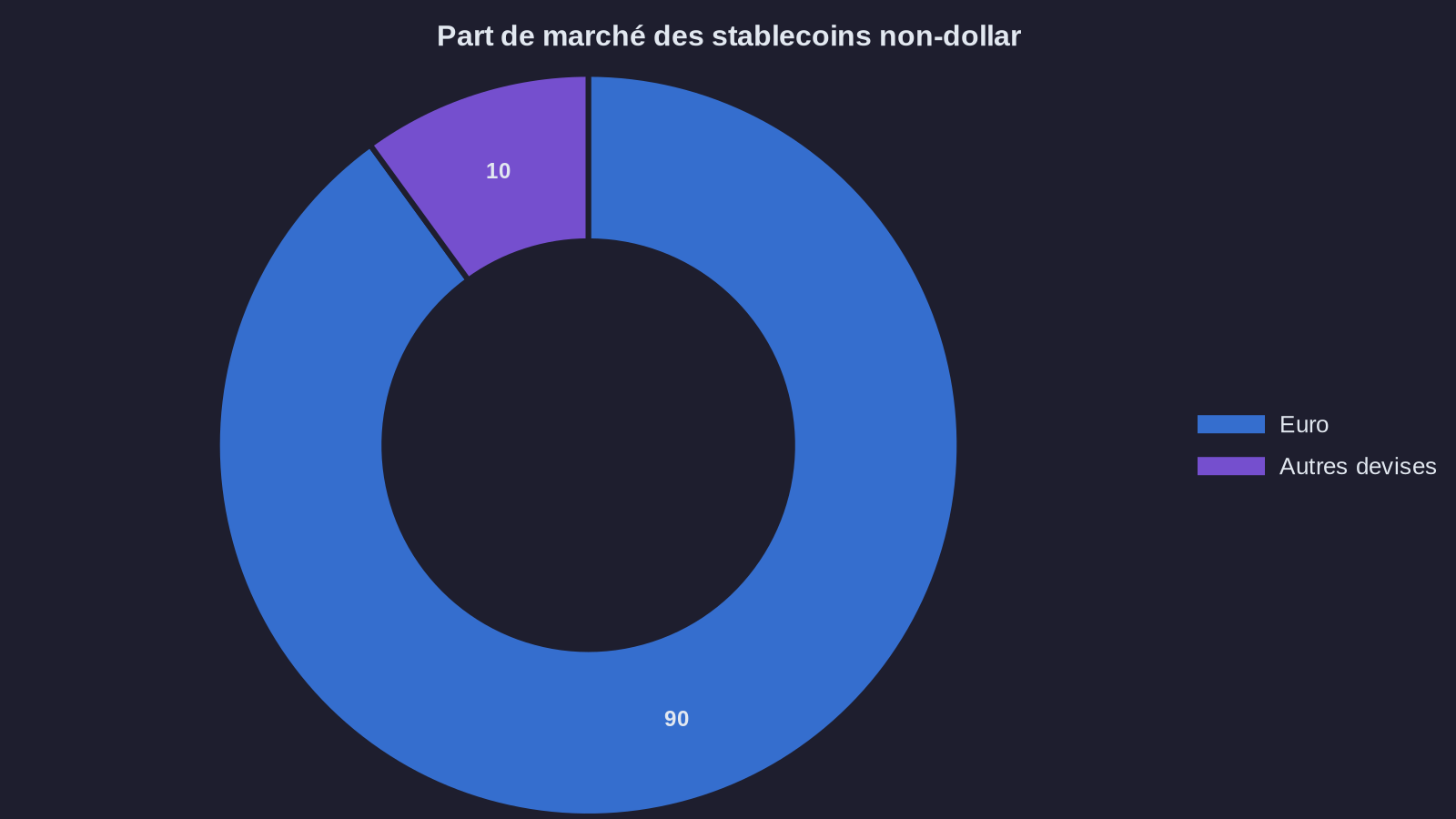
Today, euro stablecoins dominate the non-dollar market with nearly 90% of the share. A figure that might surprise, but which reflects a simple reality: the euro is the only credible alternative to the dollar in the crypto-assets universe. This dominance is not insignificant. It reshapes access to DeFi for European investors and raises strategic questions about the future of digital finance in the eurozone.
The euro versus the dollar: a dominance that makes sense
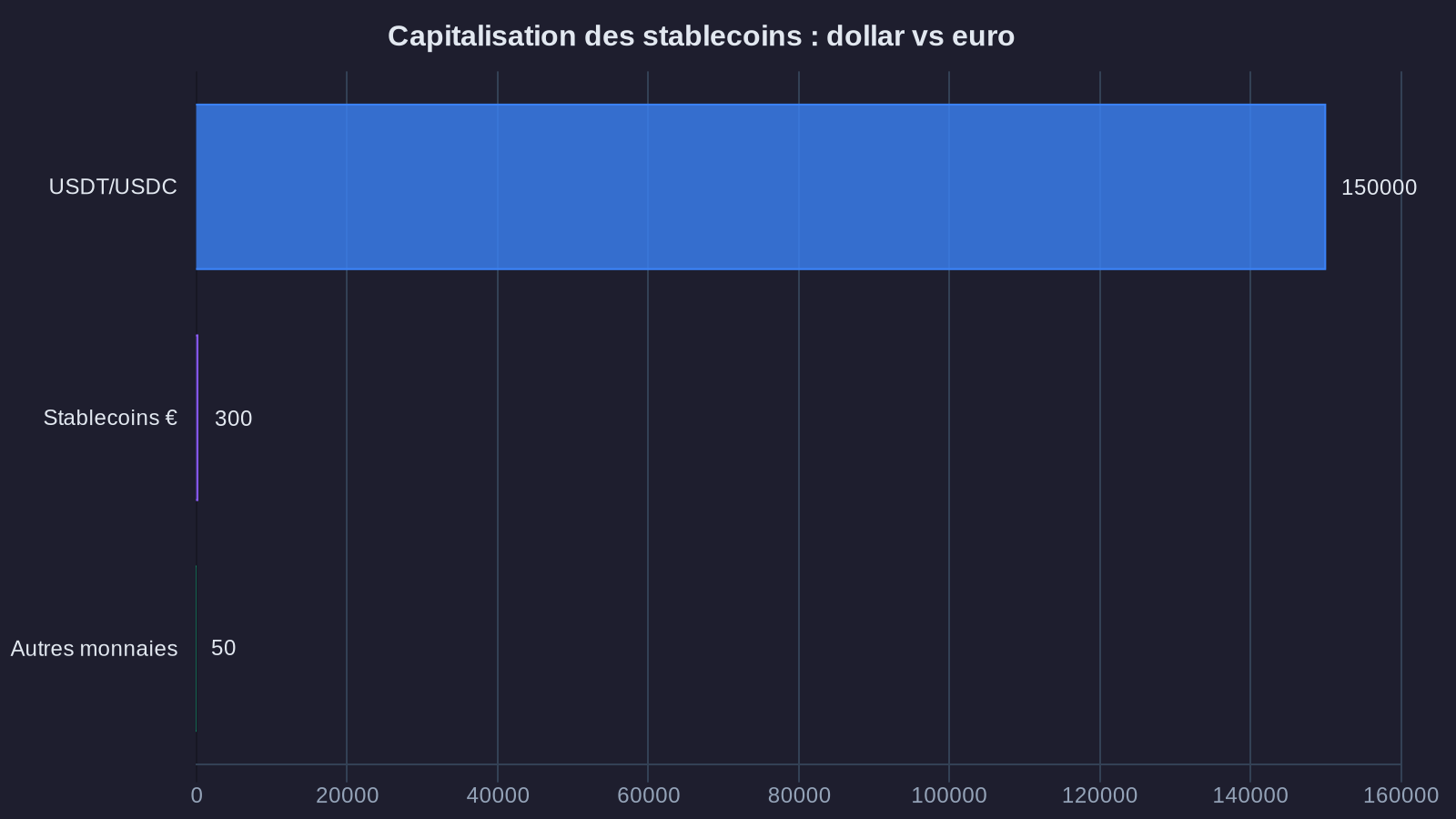
The stablecoin market remains overwhelmed by the dollar. USDT and USDC alone total over 150 billion dollars in capitalization. Against this hegemony, euro stablecoins weigh approximately 300 million euros. That's small in absolute terms, but enormous in terms of non-dollar market share.
Why this concentration on the euro? Three factors explain it.
First, the economic depth of the eurozone. With 340 million inhabitants and a GDP that rivals that of the United States, the eurozone is the only economic bloc capable of supporting an internationally significant stablecoin. Other major currencies (yen, pound sterling, yuan) remain either too constrained by regulation, or too regional to gain widespread adoption on the blockchain.
Second, the European regulatory framework. With MiCA (Markets in Crypto-Assets), the European Union created the first comprehensive framework for stablecoins. This regulation, which came into force progressively from 2023, imposes strict requirements on reserves, transparency, and governance. For serious issuers, it's a constraint. For users and investors, it's a guarantee, similar to what you find in the stablecoin infrastructure that A16z values.
Finally, the genuine demand from European users. When you live in euros, borrowing in euros or investing in euros eliminates exchange rate risk. It's that simple. DeFi protocols that offer pools in EURC or EURT naturally attract Europeans looking for yield without exposure to EUR/USD fluctuations.
Nora's analogy
Imagine an international market where everything is paid in dollars. You're French and earn in euros. At every purchase, you must first convert your euros to dollars, then pay again in euros on your way back. Today, you open a "direct payment in euros" counter. You naturally go there, even if it's smaller than the dollar counter.
The players shaping the euro stablecoin market
A few names dominate this emerging market. Each with its strategy, strengths, and limitations.
Circle, with EURC, remains the largest issuer. The American company, already known for its USDC, launched its euro stablecoin in 2022. Advantage: the credibility of an established player, audited reserves, rapid integration into major DeFi platforms. Limitation: it's an American company issuing a European stablecoin—a contradiction that doesn't escape anyone.
Société Générale – Forge, with EURCV, represents a different approach. A European, regulated banking player that issues directly on blockchain. EURCV primarily targets institutional clients: corporate treasuries, investment funds, family offices. Liquidity is lower than EURC, but institutional trust is maximum.
Tether, with EURT, plays its usual part. Present longer than its competitors, EURT remains used, particularly on trading platforms. But Tether drags along its reputation for lack of transparency. For a serious investor, it's hard to trust an issuer that systematically refuses complete audits.
Other players are emerging: Monerium with EURe, Membrane Finance, Angle Protocol. Some prioritize decentralization, others regulatory compliance. The market is structuring itself, slowly but surely.
Concrete implications for European investors
This rise of euro stablecoins is changing the game for anyone wanting to access DeFi from Europe. Several shifts deserve attention.
Elimination of exchange rate risk is the most immediate benefit. When you stake 10,000 euros on a protocol offering EURC, you know exactly how much you'll get back in euros. No surprises from dollar appreciation or depreciation. For a corporate treasurer or investor thinking in euros, this is fundamental.
Access to yield strategies denominated in euros is expanding progressively. Curve Finance, Aave, and Uniswap now offer pools in euro stablecoins. Returns remain volatile, as everywhere in DeFi, but the calculation basis stays in euros. You're seeing hybrid strategies emerge: lending in EURC, collateral in ETH, yield paid in EURC. Mechanics that were impossible just two years ago.
Regulatory compliance is gaining ground. MiCA imposes strict rules on stablecoin issuers: reserve requirements, quarterly audit publication, guaranteed redemption procedures. For a professional investor, these constraints are assets. They reduce counterparty risk and facilitate integration into a traditional wealth strategy.
But be aware: liquidity remains an issue. Volumes traded in EURC or EURT represent a fraction of those in USDC. On some protocols, spreads can be high. Slippages too. For significant amounts, you need to anticipate these frictions. It's not a deal-breaker, but it requires careful execution.
Risks not to underestimate
The growth of euro stablecoins shouldn't overshadow structural risks. Three points deserve particular attention.
Counterparty risk remains real. A euro stablecoin, regardless of its issuer, rests on a promise: 1 EURC = 1 euro, redeemable at any time. This promise assumes the issuer actually holds corresponding reserves, that these reserves are liquid, and that redemption procedures work. Circle inspires confidence, as does Société Générale. But other players are less transparent. Before placing significant amounts, verify the quality of audits and the issuer's solidity. The precautions are similar to those needed to secure your digital assets.
Regulatory risk is evolving rapidly. MiCA regulates stablecoins, but the regulation is still recent. Interpretations vary by country. Some European jurisdictions apply MiCA strictly, others leave room for maneuver. For an investor, this creates uncertainty. A DeFi protocol offering EURC today might need to adjust its terms tomorrow, or even suspend certain services.
Liquidity risk, finally, shouldn't be overlooked. Under market stress, euro stablecoin liquidity shrinks sharply. Price gaps between EURC and euro can reach several percentage points. Redemption delays lengthen. For anyone who needs to exit a position quickly, that's problematic. A simple rule: never place in euro stablecoins amounts you might need urgently.
Key takeaways
- Euro stablecoins dominate the non-dollar market thanks to the economic depth of the eurozone and the MiCA regulatory framework.
- For European investors, they eliminate exchange rate risk and open access to DeFi strategies denominated in euros.
- Limited liquidity and counterparty and regulatory risks require rigorous selection of issuers.
Toward a European financial infrastructure on blockchain?
The question now goes beyond stablecoins. It concerns the future of European financial infrastructure. Euro stablecoins are just one brick. But a brick that could serve as the foundation for a broader ecosystem.
We're seeing ambitious projects emerge. The European Central Bank is working on the digital euro, a CBDC (Central Bank Digital Currency) that would coexist with private stablecoins. European banks are testing interbank settlements on public blockchain. Investment funds are tokenizing shares on Ethereum, with subscriptions and redemptions in EURC, like what's developing for tokenized stocks.
These initiatives converge toward the same direction: building regulated European digital finance, interoperable with DeFi, but anchored in traditional institutions. Euro stablecoins play a bridging role. They allow regulated players to experiment with blockchain euros without leaving their regulatory comfort zone. They offer DeFi users a gateway to more institutional services.
This convergence will take time. Tensions between innovation and regulation remain strong. The interests of different players don't always align. But the momentum is underway. For a European investor, understanding this dynamic means anticipating opportunities over the next five years. Euro stablecoins aren't a passing fad. They're a symptom of deeper transformation: Europe is building its digital financial infrastructure. And unlike other parts of the world, it's doing so with a clear regulatory framework, solid players, and genuine strategic ambition.