On March 17, 2025, Resolv Labs, a promising DeFi protocol specializing in decentralized stablecoins, saw $80 million disappear from its smart contracts in a matter of minutes. No sophisticated technical exploit. No zero-day vulnerability in the Solidity code. Just a compromised private key, and the instant collapse of an infrastructure meant to protect the funds of thousands of users.
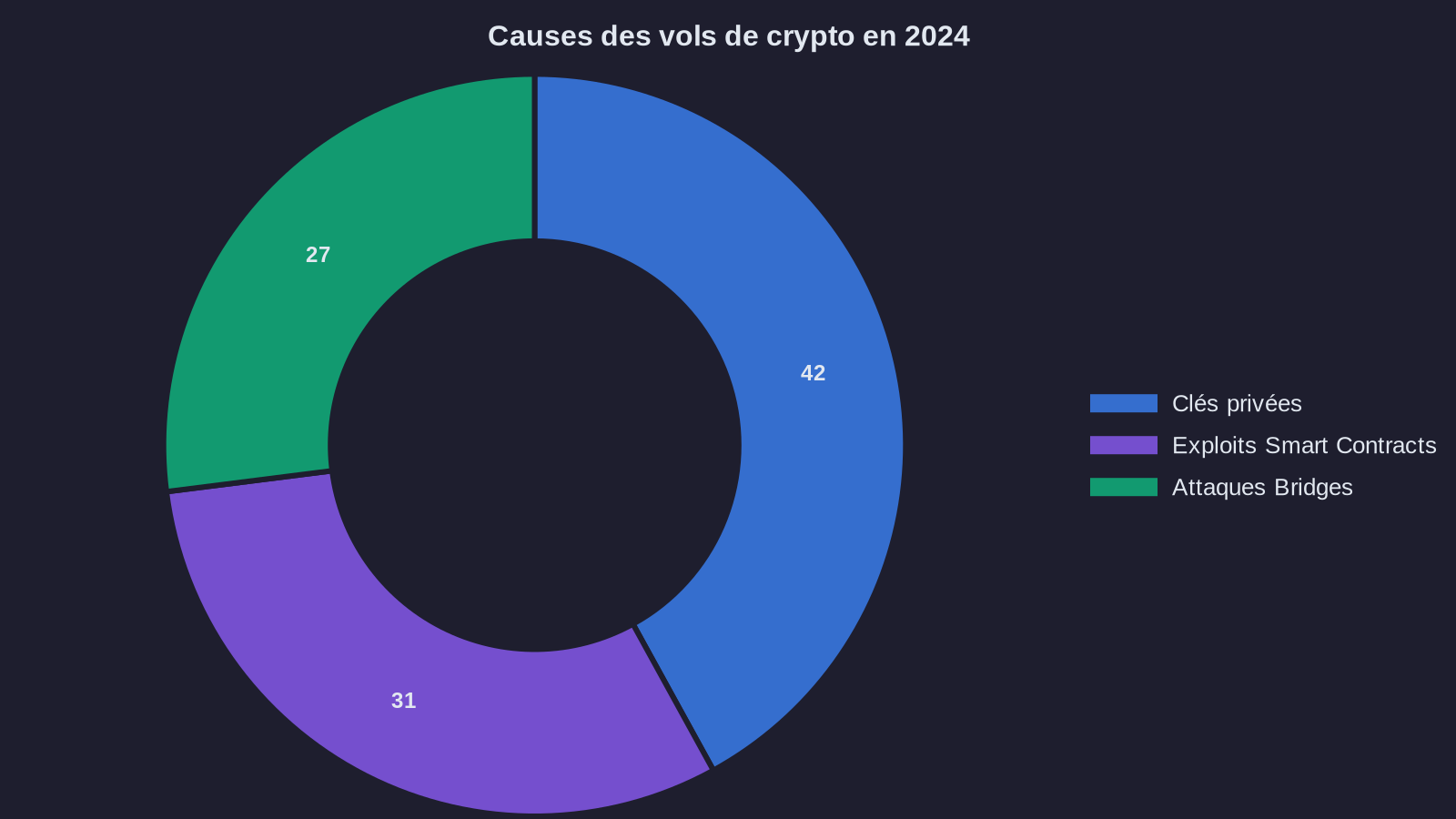
This hack is not an isolated case. It reflects a troubling trend: according to Chainalysis, 42% of crypto asset thefts in 2024 resulted from private key compromises, ahead of smart contract exploits (31%) and bridge attacks (27%). The problem is no longer technical — it's organizational and human.
Anatomy of a Flash Collapse
Around 2:30 PM UTC, the first alerts reached on-chain analysts' Telegram channels. Massive transactions draining Resolv's treasury contracts. The protocol held approximately $80 million at the time, mostly in stablecoins (USDC, DAI) and ETH, backing the value of its own algorithmic stablecoin, USR.
The attacker clearly possessed a private key with extended administrative rights over the main contracts. No multisig signatures to bypass, no timelock to wait for. Funds were transferred to a series of intermediate addresses, then fragmented and sent to mixers like Tornado Cash before vanishing without a trace.
At 3:12 PM, Resolv Labs publishes a terse statement on X: "We are investigating unusual activity. All deposits and withdrawals are suspended." Too late. At this point, $78 million has already left the protocol's wallets. The USR, supposed to be worth $1, collapses to $0.23 in less than an hour. Cascading liquidations on Aave and Compound finish off the remaining holders.
Single-Key Governance: A Fatal Design Choice
How could a protocol managing tens of millions rest on a single private key? The security audit commissioned by Resolv six months before the hack, conducted by Trail of Bits, pointed to precisely this risk. The report explicitly stated: "The use of a single EOA key to administer critical functions constitutes an unacceptable single point of failure for a protocol of this scale."
Resolv had justified this choice by the need to "stay agile" during development. A multisig would have slowed deployments, complicated emergency interventions. The team planned to migrate to decentralized governance "in the coming months." Those months never came.
This configuration reveals a fundamental contradiction in the DeFi ecosystem: on one side, we promise decentralization and the elimination of trusted intermediaries. On the other, we concentrate operational control in a few hands, in the name of efficiency. As long as funds grow, nobody asks questions. Until the day a key is compromised.
How Was This Key Obtained?
Three hypotheses are circulating, none officially confirmed by Resolv to date:
Compromise of a developer workstation. The key would have been stored in plain text or weakly encrypted on a team member's machine. Malware or physical access would have sufficed. This is the most likely scenario according to several cybersecurity experts interviewed by specialized media.
Targeted phishing (spear phishing). A team member would have been the target of a sophisticated social engineering campaign, leading them to sign a malicious transaction or divulge elements allowing the key to be reconstructed.
Insider threat. A current or former team member retained access to the key and decided to exploit it. This hypothesis, while not publicly substantiated, is the subject of an FBI investigation according to anonymous sources cited by Bloomberg.
Whatever the truth, the takeaway remains the same: wallet security infrastructure inadequate to the task. A single key, probably stored on a personal hardware wallet or in a password manager, protected $80 million. No escalation procedures, no multi-level verification mechanisms, no automated monitoring of abnormal fund movements.
The Red Flags You Should Have Spotted
In hindsight, several signals should have alerted Resolv's users and investors. These elements apply to any DeFi protocol you evaluate.
Lack of documented multisig. Resolv displayed nowhere on its website or documentation the governance structure of its smart contracts. No public Gnosis Safe address, no list of identifiable signatories. When a protocol remains opaque about who controls the funds, that's an immediate alarm bell.
Audits without follow-through. Trail of Bits had published its report in September 2024. Critical recommendations were never implemented. A security audit only has value if fixes are applied. Always verify whether the protocol has published a formal response to audits, with a detailed action plan.
Growing TVL without governance maturity. Resolv went from $8 million to $80 million TVL in four months. Spectacular growth, but without proportional evolution of its security mechanisms. When a protocol scales without adapting its structure, risk increases exponentially.
Anonymous or semi-anonymous team. Resolv's founders used pseudonyms and never revealed their full identities. This isn't inherently disqualifying — many legitimate protocols operate this way — but it adds a layer of risk. In case of problems, identifying responsible parties becomes impossible.
What You Can Verify Yourself
You don't need to be a developer to assess a protocol's soundness. A few basic checks suffice:
Consult Etherscan or the relevant blockchain explorer. Identify the addresses controlling the administrative functions of the smart contracts. If it's a simple EOA address (starting with 0x with a single private key), run away. If it's a multisig contract, check how many signatures are required and who the signatories are.
Read available audit reports on the protocol's website or platforms like Code4rena. Don't just verify that an audit was conducted. Read the recommendations and check whether the protocol has published its responses.
Monitor TVL on DeFiLlama. Growth that's too rapid without governance adjustments should make you think twice before committing significant funds.
The Watchpoint: Crypto Theft Prevention
A compromised private key is like a safe whose combination has leaked: no matter how thick the steel, no matter how many alarms, if someone has the code, the contents vanish in minutes.
Before depositing your funds in a DeFi protocol, ask yourself this: if the team disappeared tomorrow, who truly controls my assets? If the answer isn't clear, or if it boils down to "the development team," you're on slippery ground.
DeFi promises to eliminate intermediaries, but it introduces new forms of counterparty risk. A multisig with 5 identifiable signatories and 3 required signatures isn't perfect, but it represents a minimal level of protection. A protocol that refuses to implement this standard doesn't deserve your trust, regardless of how sophisticated its value proposition is.
What To Do If You're Affected
If you hold USR tokens or had funds deposited on Resolv at the time of the hack, here are the concrete steps to take.
Document your exposure. Take screenshots of your positions before the hack (if you still have them), your transactions on Etherscan, your account statements on the protocol. Build a complete file with dates, amounts, and wallet addresses.
Report the incident. In France, you can report the fraud on the THESEE platform of the Ministry of the Interior. In the United States, use the FBI's IC3 portal. Even if recovery chances are slim, these reports feed cross-border investigations and establish legal traceability.
Consult a specialized lawyer quickly. If your loss exceeds €10,000, legal advice becomes relevant. Several law firms now specialize in crypto disputes. They can assess whether a class action is possible and whether recourse exists against auditors or platforms that listed the protocol.
Don't pay any "fund recovery" services. In the days following a major hack, scammers contact victims posing as investigators or asset recovery specialists. They request upfront fees or your private keys "for analysis." No legitimate professional operates this way.
Anticipate the tax impact. A loss from a hack doesn't automatically generate a tax deduction. In France, crypto losses are only deductible from gains of the same nature realized in the same year or the ten following years (Article 150 VH bis of the French Tax Code). To understand the subtleties of crypto taxation, consult our analysis on Bitcoin ETF vs Direct Ownership: Tax Compliance and Optimization for French Investors. Don't let this drag on; tax authorities will be particularly vigilant about declarations of significant losses without documentation.
Lessons for the Ecosystem
The Resolv hack is not an anomaly. It's a symptom of an industry scaling faster than it matures. Every quarter, tens of millions disappear through similar patterns: poorly protected private keys, centralized governance, ignored audits, growth prioritized over security.
DeFi protocols must stop treating operational security as a "later" problem. A multisig is not a luxury, it's a minimum standard. A timelock on critical functions is not excessive constraint, it's user protection. Total transparency on governance is not optional, it's the foundation of trust. To better understand the risks inherent in crypto assets, discover why 34% of Bitcoin are vulnerable to quantum computing.
For you, investors and users, the lesson is simple: never delegate your vigilance. The high returns promised by a protocol mean nothing if the infrastructure supporting them rests on fragile foundations. Learn to read smart contracts, or at minimum verify public elements. Diversify your exposures; never concentrate your core capital on a single protocol, however promising. If you seek to optimize your allocation, explore how drawdown reveals the real risks in your portfolio.
And keep this harsh reality in mind: in the crypto universe, no one will come to save you. No FDIC, no guarantee fund, no easy recourse. Your best protection remains your own diligence. The Resolv hack won't be the last. Whether you figure among the next victims is entirely up to you.
```