The Solana blockchain has just reached a major technical milestone with its Alpenglow upgrade: transaction finality time has dropped from several seconds to 150 milliseconds. To the general public, this figure might seem trivial. For professionals designing yield strategies in decentralized finance, it represents a profound transformation of the ecosystem.
This improvement goes far beyond raw speed. It fundamentally changes the mechanics of arbitrage, liquidations, and lending protocols. Understanding what's changing makes it possible to anticipate shifts in target yields and identify new risks emerging in an environment where every millisecond counts.
What blockchain finality really means
When you execute a transaction on a blockchain, there's a delay between when it's broadcast and when it becomes definitively irreversible. This delay is called blockchain finality. On Bitcoin, a transaction typically requires six block confirmations to be considered final—roughly an hour. On Ethereum, probabilistic finality is measured in minutes.
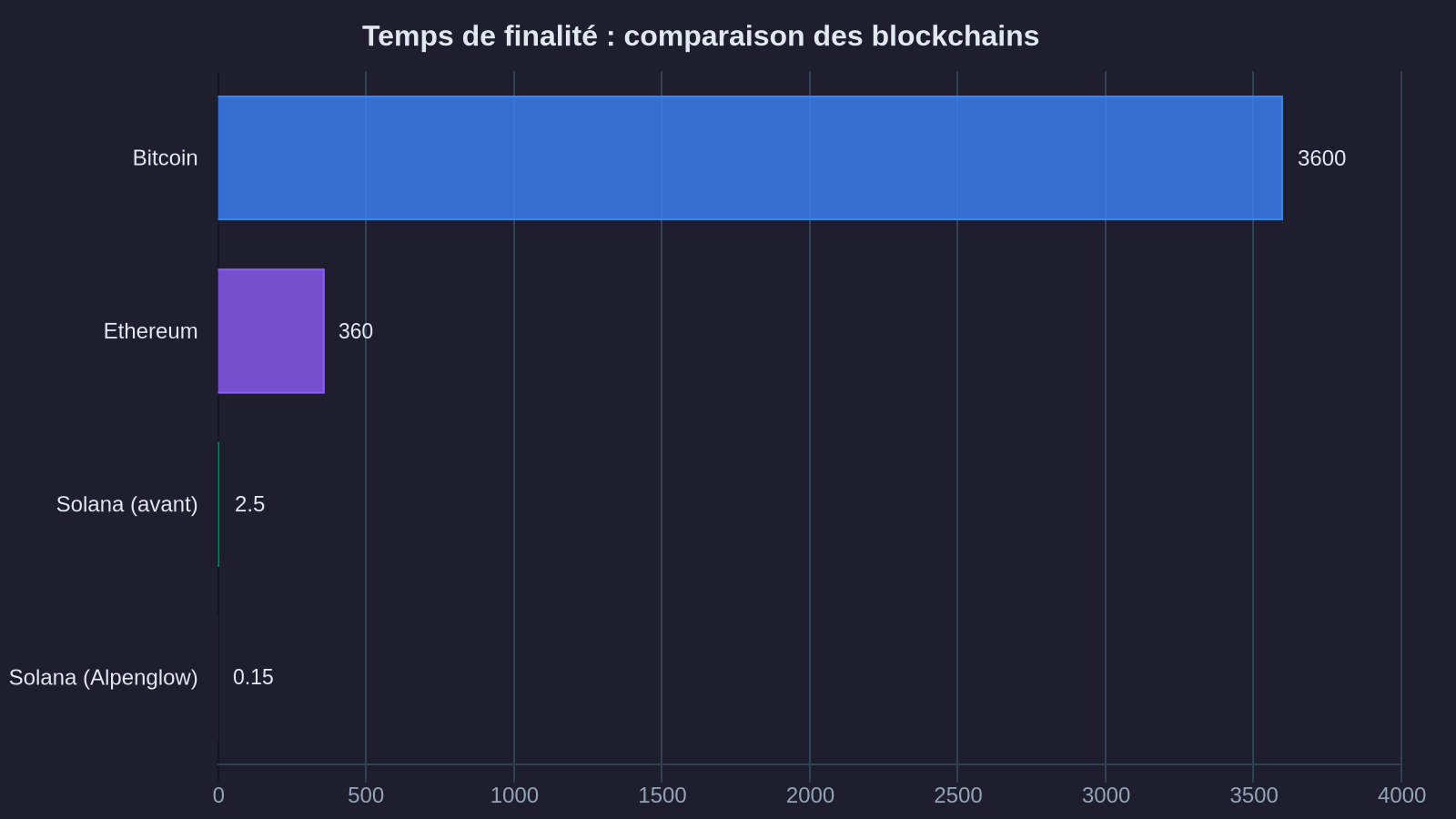
Solana was already operating with fast confirmation times, but effective finality remained at several seconds. With Alpenglow, that delay drops to 150 milliseconds. In practical terms, a transaction becomes irreversible in the blink of an eye. This technical difference has direct consequences for decentralized finance protocols built on this chain.
Consider a simple example. On a lending protocol, if you deposit assets as collateral to borrow, the system must ensure your deposit transaction is truly final before authorizing your loan. With finality measured in seconds, there's a window where a malicious actor could attempt to manipulate transaction ordering. At 150 milliseconds, that window closes almost instantly.
The concrete impact on yield and arbitrage strategies
Decentralized finance relies heavily on arbitrage mechanisms. When the same asset trades at slightly different prices on two protocols, specialized actors capture that spread by buying on one and reselling on the other. These operations are often measured in fractions of a percent, and every second counts.
With finality reduced to 150 milliseconds, arbitrageurs can chain operations with greater confidence and lower risk exposure. They no longer need to wait several seconds to confirm that a transaction is final before launching the next one. This acceleration in crypto transaction speed allows them to multiply the number of operations within a given timeframe, which mechanically increases potential returns for those who master these arbitrage strategies.
But this dynamic also creates a new form of competition. The best-equipped actors can now capture arbitrage opportunities that disappear in a few hundred milliseconds. Protocols generating yield through incentive mechanisms or fee distribution see their flows reorganize. Some liquidity pools become more attractive, others lose competitiveness.
For an investor using yield protocols on Solana, this means displayed rates can fluctuate more rapidly. A pool offering stable target returns may see that yield compressed by increased competition. Conversely, new opportunities emerge on protocols leveraging this improved finality to offer more sophisticated products.
Liquidations and systemic risk
Another area where finality plays a decisive role is liquidation mechanisms. On lending protocols, if your collateral value falls below a certain threshold, your position can be liquidated to protect the system. This liquidation must happen quickly to prevent the protocol from accumulating bad debt.
With finality measured in seconds, cases would arise where sharp market movements could trigger cascading liquidations while transactions awaited confirmation. These events, sometimes called liquidation cascades, can generate volatility and substantial losses for users. At 150 milliseconds, the system can react almost instantaneously, limiting such phenomena.
This doesn't eliminate capital loss risk—far from it. Market movements remain unpredictable, and a sharp price collapse can still trigger mass liquidations. But the system's enhanced reactivity reduces technical blind spots where malfunctions can occur. For an investor, this translates to a more robust infrastructure, even though market risk remains unchanged.
There's also a flip side to consider. Ultra-fast finality lets protocols react quickly, but it also intensifies competition between automated robots constantly monitoring positions at risk. These robots, called liquidators, capture fees by liquidating risky positions before others do. With Alpenglow, the race now plays out at the millisecond level, favoring actors with advanced technical infrastructure.
What doesn't change: fundamental risks
Improving a blockchain's technical finality doesn't alter the nature of assets circulating through it or their associated risks. A volatile cryptocurrency remains volatile whether confirmed in 150 milliseconds or ten seconds. A decentralized finance protocol can suffer a security flaw, governance issue, or loss of confidence regardless of the underlying network performance.
The Alpenglow upgrade improves infrastructure efficiency, but it guarantees nothing about the soundness of protocols built on Solana. We've seen protocols collapse in the past despite technically flawless blockchain performance. Diligence remains essential: understand how a protocol works, who controls it, how liquidity is managed, and what risk vectors exist. To verify a platform's soundness, consult our guide on how to verify actual solvency through proof of reserves.
Moreover, this technical improvement changes nothing about one fundamental reality: investing in yield strategies through decentralized finance exposes you to capital loss risk. Target yields are never guaranteed, and market conditions can shift rapidly. Faster infrastructure can make certain strategies more efficient, but it doesn't create performance out of thin air.
Questions to ask before acting
Faced with a technical evolution of this magnitude, the initial instinct might be to capitalize on it immediately. But before repositioning holdings or exploring new Solana protocols, a few questions deserve consideration.
First, do the protocols you use actually benefit from this reduced finality? Not all Solana projects are equally positioned to leverage this improvement. Some, particularly those relying on fast arbitrage or liquidation mechanisms, benefit directly. Others, more focused on long-term holding strategies, see no meaningful difference.
Next, does this improvement change the competitive landscape within the protocols you already use? If better-equipped actors now capture a larger share of arbitrage opportunities, target yields for standard users could compress. It becomes relevant to reassess whether those protocols remain attractive.
Finally, does this technical evolution change your own risk tolerance? Faster, more robust infrastructure can be reassuring, but it eliminates neither market risk nor technical risk. If you weren't comfortable with crypto before Alpenglow, this upgrade doesn't fundamentally change the equation. To better understand how to verify a platform is trustworthy, read our article on how to verify a platform's regulatory approval.
Toward a new generation of protocols
The finality improvement on Solana paves the way for protocols that wouldn't have functioned efficiently before. We can anticipate the emergence of more complex derivatives, more sophisticated automated market-making strategies, or hedging mechanisms leveraging this enhanced reactivity.
These innovations could offer new yield opportunities, but they'll also introduce new risk vectors. The more complex a financial product, the harder it becomes to precisely evaluate its mechanisms and potential failure points. Execution speed doesn't compensate for lack of transparency.
For actors designing yield strategies, or those preparing to launch offerings in this space, this technical evolution is another building block to integrate. It enables more refined mechanisms, but it also demands heightened vigilance about how underlying protocols are designed and audited.
Alpenglow isn't a revolution changing everything overnight. It's a gradual improvement that subtly shifts the balance of power within the Solana ecosystem. Those who understand these subtleties can adjust their strategies accordingly. Others will continue navigating an environment they understand less well, with all the risks that entails.