Every day, USDT represents roughly $100 billion in trading volume across crypto markets. That's more than Bitcoin's daily volume. This stablecoin issued by Tether has become the de facto monetary infrastructure for millions of users and hundreds of platforms. Yet for many, how USDT actually works remains opaque: how can a digital token maintain strict parity with the dollar? What really backs each USDT issued? And most importantly, is this mechanism as solid as it claims to be?
To understand USDT, you need to follow a thread connecting three distinct worlds: traditional finance and its instruments (those Treasury Bills everyone mentions), blockchain logic with its smart contracts, and a reserve system supposedly ensuring that each token is worth exactly one dollar. It's not magic—it's financial engineering applied to a decentralized environment. Let's see how it actually fits together.
The stablecoin principle: anchoring digital to reality
Imagine you want to use a digital token to buy a coffee. If that token is worth €10 at 9am and €8 at 10am, using it as currency becomes impractical. That's exactly the problem with Bitcoin or Ethereum: their volatility makes them poorly suited for everyday transactions or temporarily storing value.
A stablecoin addresses this need by offering a digital asset whose value stays stable relative to a reference currency—typically the US dollar. USDT is designed to be worth $1 at all times. This stability rests on a simple promise: for every USDT in circulation, Tether claims to hold the equivalent of one dollar in reserve.
But concretely, how is this parity guaranteed? Two mechanisms work together: on one side, financial reserves supposedly covering 100% of issued tokens. On the other, an issuance and destruction system that adjusts supply based on demand. This is where Treasury Bills enter the picture.
Treasury Bills: the foundation of Tether's reserves
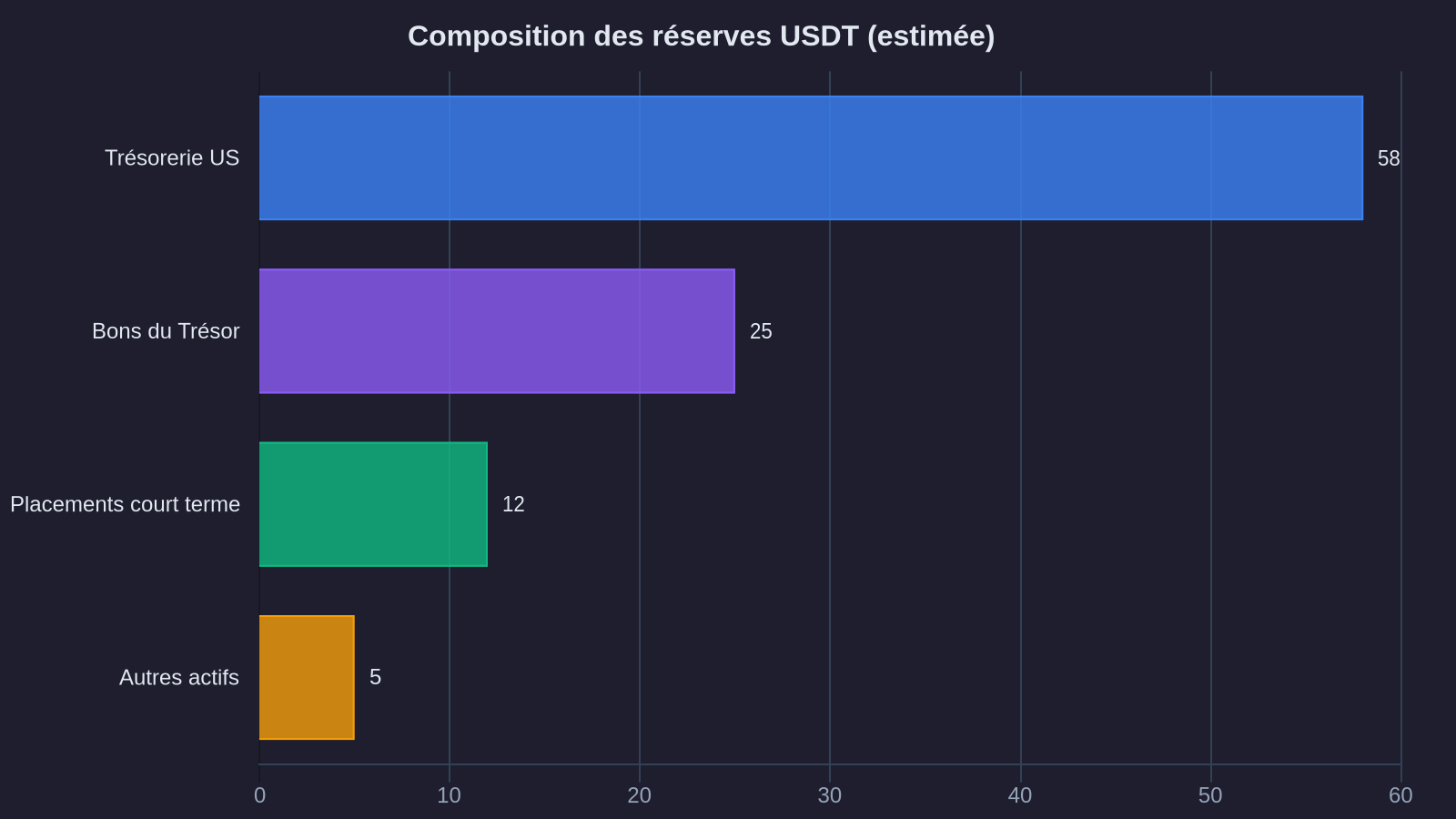
When Tether releases reports on its reserves, one term comes up repeatedly: Treasury Bills, or US Treasury securities. These financial instruments now represent over 80% of the reserves backing USDT. You need to understand what this really means.
A Treasury Bill is a short-term debt obligation issued by the US government. You lend money to the US Treasury for a period typically under one year, and in return, you get your capital back with modest interest. It's considered one of the safest investments in the world, as markets judge the default risk of the United States to be virtually nil.
Tether therefore uses the dollars it receives when issuing new USDT to purchase these Treasury securities. The advantage? These assets are highly liquid (easily resold), stable, and generate targeted returns. Tether can thus build revenue streams while guaranteeing that its reserves retain their dollar value.
But here's the catch: these Treasury Bills aren't immediately liquid cash. If billions of USDT had to be redeemed simultaneously tomorrow, Tether would need to sell some of its Treasury holdings on the market. Under normal conditions, this isn't a problem. In a panic scenario, liquidity could tighten, exposing Tether to capital loss risk if sales occur under stressed conditions. This is a structural risk worth understanding.
Beyond Treasury Bills: other components of Tether reserves
Tether's attestation reports show that Treasury Bills don't represent 100% of reserves. You'll also find bank deposits, money market funds, and a residual share of other assets (secured loans, precious metals, even Bitcoin). This diversification might seem prudent, but it also raises questions: where are these deposits held? Which banks hold them? What is the actual quality of these secondary assets?
For a long time, Tether faced criticism for lack of transparency regarding the exact composition of its reserves. Since 2021, the company publishes quarterly attestations conducted by an audit firm. It's not a full audit in the strict sense, but it's progress. These documents confirm that reserves do cover the amount of USDT in circulation, but they don't provide the level of detail you'd expect from a standard bank balance sheet.
Smart contracts: issuance and destruction of USDT
Reserves, however solid, aren't enough to maintain parity. You also need a technical mechanism that adjusts USDT supply in real time. This is where smart contracts come in—programs deployed on blockchains that execute actions automatically.
USDT exists on multiple blockchains: Ethereum (as an ERC-20 token), Tron (TRC-20), and others like Solana or Avalanche. On each blockchain, a smart contract manages token issuance and destruction. But here's the thing: it's not an entirely automated and decentralized process like you might imagine. Tether controls these contracts. The company can issue new USDT or destroy existing ones as needed.
Concretely, here's how it works. A customer (an exchange platform, a fund, a business) wants to acquire 10 million USDT. They send 10 million dollars to Tether. Tether then creates 10 million USDT via smart contract and transfers them to the customer. Conversely, if that same customer wants to cash out, they send their USDT back to Tether, which destroys them (they're "burned") and refunds the corresponding dollars.
This system therefore relies on trust: trust that Tether actually holds the reserves it claims, and trust that the company honors redemption requests. It's not an autonomous algorithm maintaining parity—it's a centralized entity making a commitment to do so. This is a fundamental difference from other types of algorithmic stablecoins that attempt (often unsuccessfully) to maintain parity without reserves, and whose failure can result in total capital loss for investors.
Market mechanisms: arbitrage and price stability
In practice, USDT doesn't always trade at exactly $1.00 on secondary markets. Sometimes it exchanges at $0.998, sometimes at $1.002. These micro-fluctuations are normal and reflect supply-and-demand dynamics. But they're quickly corrected through what's called arbitrage.
If USDT drops to $0.98 on a platform, traders will buy heavily at that discount, knowing they can theoretically redeem these tokens for a dollar directly from Tether. This buying pressure pushes the price back toward $1. Conversely, if USDT rises above $1, holders can redeem it from Tether (for a dollar) and sell it on the market for a small profit.
This arbitrage mechanism works as long as confidence in Tether remains intact. If serious doubt emerges about reserve quality or Tether's ability to honor redemptions, the price can break sharply, with capital loss risk for holders. We saw this during periods of stress, such as May 2022, when USDT briefly lost its peg before stabilizing. These moments reveal the inherent fragility of a centralized system.
Gray areas: transparency, regulation, and residual risks
Understanding how USDT works also means accepting that gray areas remain. Tether has long been accused of lacking transparency, and even though the company has made progress, several questions still linger.
First, published attestations aren't full audits. They confirm reserves exist on a given date, but they don't thoroughly verify the quality of each asset or compliance with internal processes. A complete independent audit would settle these doubts, but Tether has never fully submitted to one. To learn how to verify a platform isn't misleading you about its regulation, the principles remain the same: verify official sources.
Second, Tether's regulatory framework remains unclear. The company is based in jurisdictions with limited transparency (British Virgin Islands, Hong Kong), making supervision difficult. In the United States, the CFTC fined Tether in 2021 for misleading statements about its reserves. In Europe, the MiCA regulation will soon impose strict requirements on stablecoin issuers, potentially forcing Tether to adjust its model or exit certain markets.
Third, there's liquidity risk in a systemic crisis. If a significant portion of USDT holders decided to redeem simultaneously, Tether would need to quickly sell large quantities of Treasury Bills. Even if these assets are liquid, a massive sale could create temporary tensions and delay redemptions, exposing users to capital loss risk. This scenario remains hypothetical, but it's not impossible.
Alternatives and risk diversification
Faced with these uncertainties, other stablecoins have emerged with different models. USDC, issued by Circle, emphasizes transparency and publishes regular audits. It primarily holds bank deposits and Treasury Bills, with governance considered more rigorous. DAI, issued by MakerDAO, relies on a decentralized mechanism with cryptocurrency collateral, making it more censorship-resistant but also more complex and volatile, with increased capital loss risk during sharp market swings.
USDT remains dominant in volume, largely because it's integrated into nearly every platform and offers unmatched liquidity. But understanding its mechanisms also lets you measure its limitations and think about diversification. Concentrating all your digital holdings in a single stablecoin concentrates risk. Using multiple stablecoins based on your needs (liquidity, security, decentralization) can be a more prudent approach, even though no stablecoin completely eliminates capital loss risk.
Key takeaways on how USDT works
USDT isn't a magical asset that stays stable through autonomous algorithm. It's a hybrid system combining traditional financial reserves (mainly Treasury Bills), an issuance-and-destruction mechanism via smart contracts, and a redemption promise backed by a centralized company.
This architecture has allowed USDT to become the dominant liquidity infrastructure in the crypto ecosystem. But it rests on trust: trust that reserves exist, are well-managed, and that Tether will honor its commitments under all circumstances. Transparency improvements are real, but gray areas remain.
For crypto users, understanding these mechanisms is essential. USDT can be a practical tool for temporarily storing value or facilitating exchanges, but it's not a risk-free asset. Reserves may be solid today and weaken tomorrow, exposing you to capital loss risk. Smart contracts may function perfectly until regulatory pressure or a crisis of confidence tests them.
Disintermediated finance promises to make financial mechanisms more transparent and accessible. USDT illustrates that this promise remains partial: behind the code and blockchains, there are always institutions, management choices, and human risks. Understanding these mechanisms gives you the tools to navigate this ecosystem with clear eyes.