
You might be using a VPN to protect your browsing. You pay your monthly subscription, you click "Connect," and boom—you're anonymous. Or at least, that's what you're promised. But have you ever stopped to think about what it really means to trust a VPN operator? You're replacing your Internet Service Provider with a company that sees all your traffic too. It's a bit like locking your front door and then handing a spare key to a stranger who assures you they'll never use it.
Decentralized VPNs built on the Nostr protocol offer a radically different alternative. Imagine a network where no single actor controls your data, where your connection passes through multiple independent nodes, and where the protocol itself guarantees that nobody—not even the operator—can reconstruct your activity. This isn't science fiction. It's already emerging.
The fundamental problem with traditional VPNs
Let's start by understanding what you're really trusting your current VPN with. When you connect to a traditional VPN server, your Internet Service Provider no longer sees what you do online. Perfect. Except now the VPN operator sees everything: the sites you visit, the services you use, your connection times. It becomes your mandatory gateway.
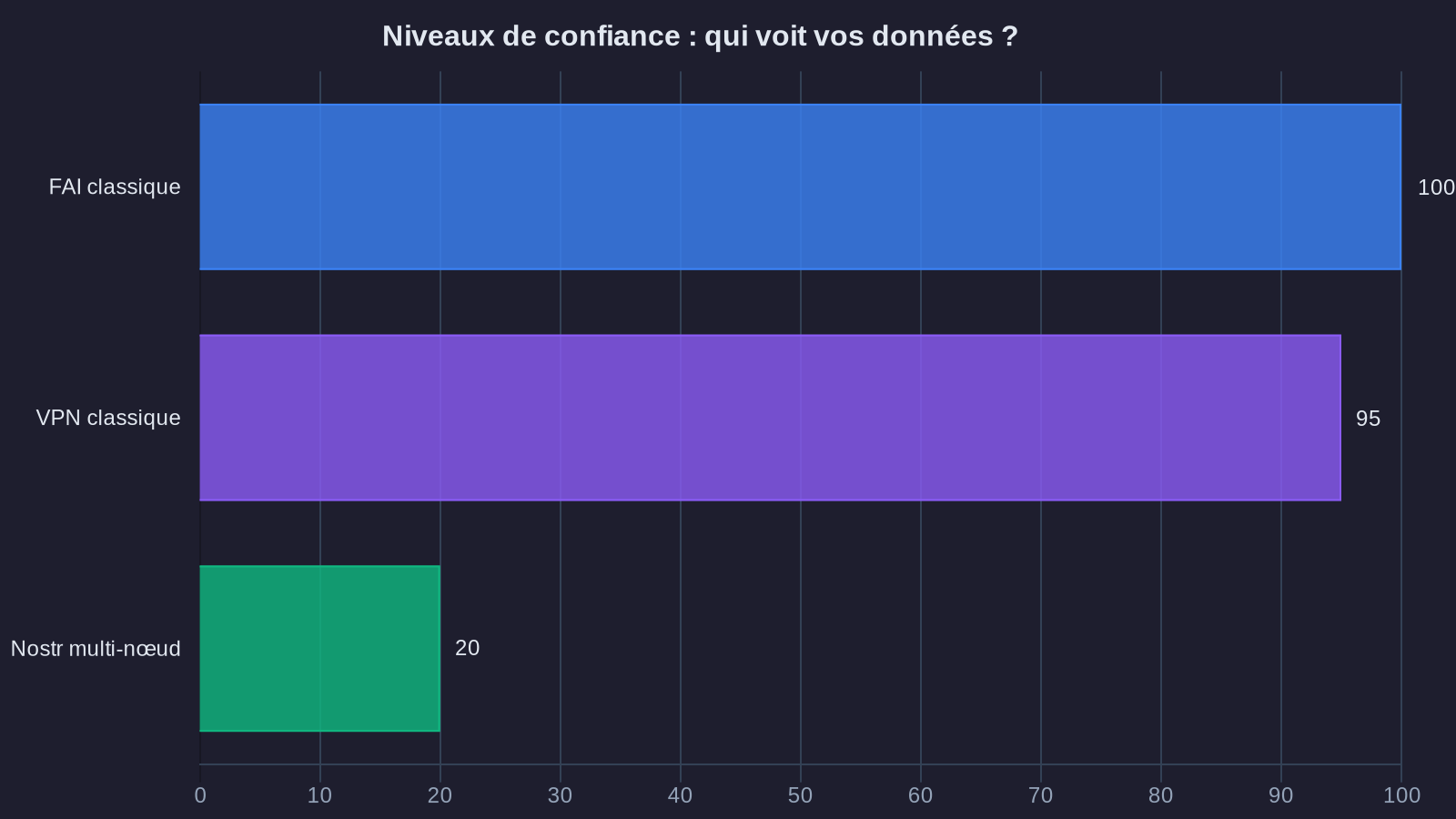
Sure, the big names in the industry promise you they keep no logs, that they're based in privacy-friendly jurisdictions, that they've been audited by independent third parties. All of this might be true. But it still comes down to trust. You have to take their word for it. Yet recent history has taught us that some supposedly "no-log" VPNs have ultimately handed data over to authorities. Others have been acquired by companies with questionable practices.
The centralized model contains a structural flaw: there's always a single point of failure. A server can be compromised, a company can change its policy, a jurisdiction can impose new regulations. You have no way to verify what's actually happening on the server side. This centralized trust problem shows up in other crypto contexts too, like governance flaws in DAOs that concentrate too much power.
Nostr: an open source protocol designed for decentralization
To understand how a decentralized VPN can work, you first need to grasp what Nostr is. It's not a blockchain, not a token, not an app. It's a simple, open source communication protocol, designed to enable message exchange without relying on a central server.
Think of it this way: Imagine traditional mail, but where each post office is independent and interchangeable. You can drop your letter at any office, and it will still reach its destination. If one office closes, the others keep operating. Nobody can stop you from sending or receiving mail.
Nostr works with relays—lightweight servers that pass encrypted messages between users. You can connect to one relay, ten relays, a hundred relays. If one disappears, the others take over. No single actor controls the network. It's this decentralized architecture that makes Nostr resistant to censorship and single points of failure.
Now apply this model to a VPN. Instead of routing all your traffic through a single server owned by a company, you route it through multiple independent nodes on the Nostr network. Each node sees only a fragment of your connection. None of them can reconstruct your complete activity. The protocol guarantees cryptographic privacy by design, not by marketing promise.
How a decentralized VPN on Nostr works
Concretely, a decentralized VPN based on Nostr rests on three pillars. First, multi-node routing. Your connection doesn't pass through a single server but traverses multiple Nostr relays before reaching its destination. It's like sending a letter that passes through three different post offices before arriving at the recipient. Each office only knows the previous step and the next one, never the original sender or final recipient.
Second, layered encryption. Your traffic is encrypted multiple times, like an onion (hence the name of the Tor network, actually). Each relay peels off one encryption layer to know where to forward the data, but can't read the content or identify the real origin. This technique isn't new, but Nostr makes it more accessible and lighter.
Finally, decentralized coordination. In a traditional VPN, it's the operator who manages the servers, assigns IP addresses, monitors network load. With Nostr, these functions are distributed among relay operators who have no connection to each other. You can even run your own relay if you want. The open source protocol is transparent, auditable by anyone.
This architecture fundamentally changes the trust question. You're no longer trusting a company; you're trusting a verifiable mathematical protocol. That's the difference between taking someone's word for it and verifying the mechanism's soundness yourself.
Digital sovereignty and emerging open source protocols
Beyond simply protecting online privacy, decentralized VPNs on Nostr raise a bigger question: who controls your online presence? Today, that control is concentrated in the hands of a few players. Your Internet Service Provider can throttle certain services. Your VPN can decide to block certain content. Governments can impose surveillance obligations.
Decentralized open source protocols like Nostr flip this logic on its head. They put control of your connectivity back in your hands. You choose your relays. You decide your privacy level. Nobody can arbitrarily disconnect you. This is what we call digital sovereignty: the ability to participate in the network without permission, without a mandatory intermediary, without a central control point.
This approach resonates particularly in contexts where censorship is strong. Journalists, activists, and citizens living under authoritarian regimes are already using decentralized tools to bypass surveillance. But beyond these extreme cases, the issue concerns all of us. Do we accept that our digital lives depend entirely on the goodwill of private companies or governments? Or would we rather have neutral, open, tamper-resistant infrastructure?
Decentralized VPNs on Nostr are still emerging. They won't replace established solutions overnight. Their performance is improvable, their adoption limited, their usability sometimes rough around the edges. But they point a direction. They prove that another architecture is possible, where trust is no longer a prerequisite but a choice. This philosophy of verification over blind trust also applies to securing your crypto API keys, where audit and transparency take priority over promises.
Key takeaways
1. Traditional VPNs ask you to trust a single actor. They replace your Internet Service Provider with a private company that sees all your traffic. It's a centralized model with a single point of failure.
2. Nostr enables you to decentralize this architecture through an open source protocol. Your connection passes through multiple independent nodes, each seeing only an encrypted fragment. No single actor can reconstruct your complete activity. The protocol guarantees cryptographic privacy by design.
3. These tools redefine digital sovereignty. They enable you to participate in the network without permission, without a mandatory intermediary, without possible censorship. It's a break from the current model where a few actors control most of our connectivity.
Decentralized VPNs on Nostr aren't a magic bullet. They won't make established VPNs obsolete overnight. But they open a path forward. One toward a network infrastructure where privacy is no longer a marketing promise but a technical guarantee. Where your anonymity no longer depends on a company's goodwill but on the robustness of an open source protocol. Now that you understand what Nostr is, you can explore other decentralized applications that share this philosophy of sovereignty and transparency.