
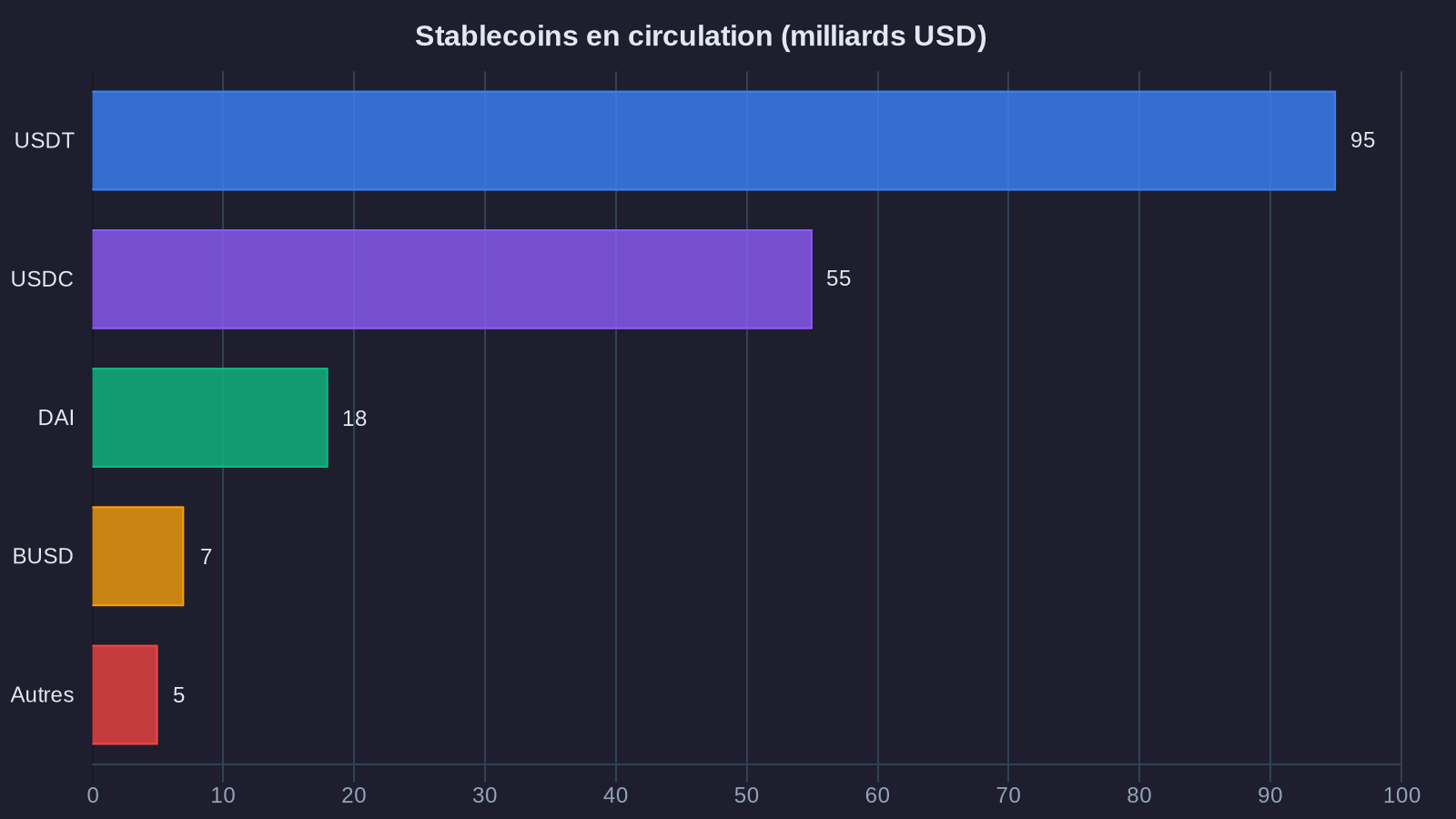
Stablecoins now represent more than $180 billion in circulation. Every day, billions of dollars flow through USDC, DAI, or USDT. Yet a critical layer is still missing: the infrastructure that transforms these stablecoins into a genuine foundation for tokenized finance. Imagine you have a state-of-the-art highway network, but there are no gas stations between Paris and Marseille. That's exactly the problem A16z has just targeted by investing $10 million in a startup specializing in this critical stablecoin infrastructure.
This funding round highlights a strategic issue often overlooked: the invisible infrastructure that enables stablecoins to actually function. Not just to circulate, but to serve as a solid foundation for complex financial applications.
The missing layer: understanding what's lacking
When we talk about stablecoins, we immediately think of USDC or DAI. These tokens work perfectly for transferring value. You send $1,000 in USDC from your wallet to your business partner's wallet in Brazil, and the transaction settles in seconds. Simple, efficient, transparent.
But the moment you want to do more than transfer, things get complicated. Let's take a concrete example: you want to deploy a yield farming strategy (putting your stablecoins to work to generate returns) that automatically switches between three different protocols based on interest rates. Your strategy must monitor rates in real-time, move your funds at the right moment, manage transaction fees, and most importantly, maintain the stability of your capital.
That's where it gets tricky. Current stablecoins don't natively integrate the tools needed to orchestrate these complex operations. Imagine you want to build a smart home, but your walls have no electrical wiring planned. Technically, you can add exposed wires everywhere, but it will be clunky, expensive, and unreliable.
The missing layer is precisely this stablecoin infrastructure that allows stable tokens to become building blocks for sophisticated financial applications. We're talking about automated management protocols, interoperability standards, and guarantee and reconciliation systems that transform a simple stable token into a programmable financial tool.
Why this infrastructure has become critical
The crypto ecosystem has matured considerably over the past three years. Institutions are beginning to take stablecoins seriously, and not just for speculation. Companies are using USDC to pay their international suppliers. DeFi protocols are managing billions of dollars in liquidity. Lending platforms offer yields on stablecoins that far exceed what traditional banks offer.
But this growth reveals structural weaknesses. Consider an investor who wants to place $500,000 in stablecoins across multiple yield farming protocols. Without proper infrastructure, they must manually manage each fund movement, monitor rates across three different platforms, and hope that no security breach will compromise everything. It's like managing a stock portfolio without a broker, without a trading platform—just calling different sellers on the phone.
The startup A16z just invested in is tackling this exact problem. It's developing an infrastructure layer that allows you to automate, secure, and optimize stablecoin usage in complex contexts. It's like going from a basic road network to a complete highway system with automatic tolls, gas stations, control centers, and preventive maintenance.
Concrete use cases for yield farming
Let's return to yield farming, because it's one of the areas where this infrastructure is most needed today. The principle of yield farming is simple: you put your stablecoins to work by lending them to DeFi protocols, and in return, you receive interest. Like a savings account, but with rates that can reach 5 to 15% per year depending on the platforms and periods.
The problem is that the best yields never stay in the same place for long. Today, the Aave protocol offers 8% on USDC. Tomorrow, Compound is up to 10%. Next week, a new liquidity pool on Curve offers 12% for a few days before rates normalize. To optimize your returns, you should constantly move your funds. Except that each move costs transaction fees, takes time, and requires active monitoring.
The infrastructure developed by this startup solves this puzzle by creating an intelligent orchestration tokenized finance layer. Concretely, this means your stablecoins can be deployed across multiple protocols simultaneously, with automated rules that manage movements based on predefined criteria (minimum rate, maximum exposure per protocol, risk management). It's like having a wealth manager who monitors your investments 24/7 and optimizes your allocation without you having to intervene.
Another critical use case concerns risk management. When you place your stablecoins on a lending protocol, you take on smart contract risk (a code flaw could lose your funds) and liquidity risk (if everyone withdraws their funds at once, you might not be able to recover yours immediately). A robust infrastructure allows you to automatically diversify your positions, monitor risk indicators in real-time, and move your funds to a safer position if certain alert thresholds are breached.
The strategic stakes behind A16z's investment
Andreessen Horowitz doesn't bet $10 million on a simple technical tool. This investment fund, renowned for funding Facebook, Airbnb, and Coinbase, identifies the infrastructure that will structure tomorrow's economy. By investing in this missing layer of stablecoins, A16z is betting on a major shift: stablecoins moving from the status of simple payment method to foundation for programmable finance.
This vision aligns with what we're seeing in the field. Traditional financial institutions are beginning to tokenize real-world assets (bonds, stocks, fund shares) and are looking for stable payment rails to circulate this value. Stablecoins are the natural candidate, but they need infrastructure that guarantees traceability, regulatory compliance, and risk management. That's exactly what this infrastructure layer brings.
We can draw a parallel with the evolution of the Internet. At first, the Internet allowed you to send emails and view static web pages. That was already revolutionary. But what truly transformed the economy were the infrastructure layers added later: secure payment protocols, distributed database management systems, APIs allowing different services to communicate with each other. Without these invisible layers, there would be no e-commerce, no Netflix, no mobile applications.
Stablecoins are at the same stage. They work for basic uses, but to unlock their full potential, they need this invisible infrastructure that enables building on top of them. A16z has understood this, and other major players will likely follow this path in the coming months.
What this means for you, investor or enthusiast
Concretely, this infrastructure will make using stablecoins much more accessible and far less risky. Today, to deploy an effective yield farming strategy, you must master multiple protocols, understand the mechanisms of each platform, monitor rates daily, and accept spending considerable time on repetitive tasks. It's almost a full-time job.
With this infrastructure layer, these tasks become automated. You define your objectives (target return, acceptable risk level, holding period), and the system optimizes your allocation. It's the difference between managing a stock portfolio yourself by placing manual orders, and using a robo-advisor that does the work for you.
For institutions, the stakes are even more strategic. A bank wanting to offer interest-bearing stablecoin accounts to its customers can't afford to manually manage allocations across thousands of accounts. It needs industrial-grade infrastructure that's auditable and compliant with financial regulations. This missing layer, once mature, will allow traditional players to offer crypto services without reinventing the entire technology stack.
This evolution also opens the door to hybrid financial products. Imagine a savings account that combines the stability of stablecoins, the transparency of blockchain, and the flexibility of yield farming, all with an interface as simple as a conventional banking app. That's the type of product this infrastructure makes possible.
The coming months will be decisive. Other startups are working on similar building blocks, and existing DeFi protocols are beginning to integrate some of these features. The battle for stablecoin infrastructure is just beginning, but A16z has shown where the strategic stakes lie. Those who master this invisible layer will control a significant portion of tokenized finance tomorrow.