
Imagine your bank opening its doors 24/7, eliminating mandatory appointments, and letting you place your savings directly with borrowers worldwide. That's essentially what Aave has been doing in DeFi for years. But with Aave v4, the protocol takes a major leap forward: it brings traditional credit into the fold.
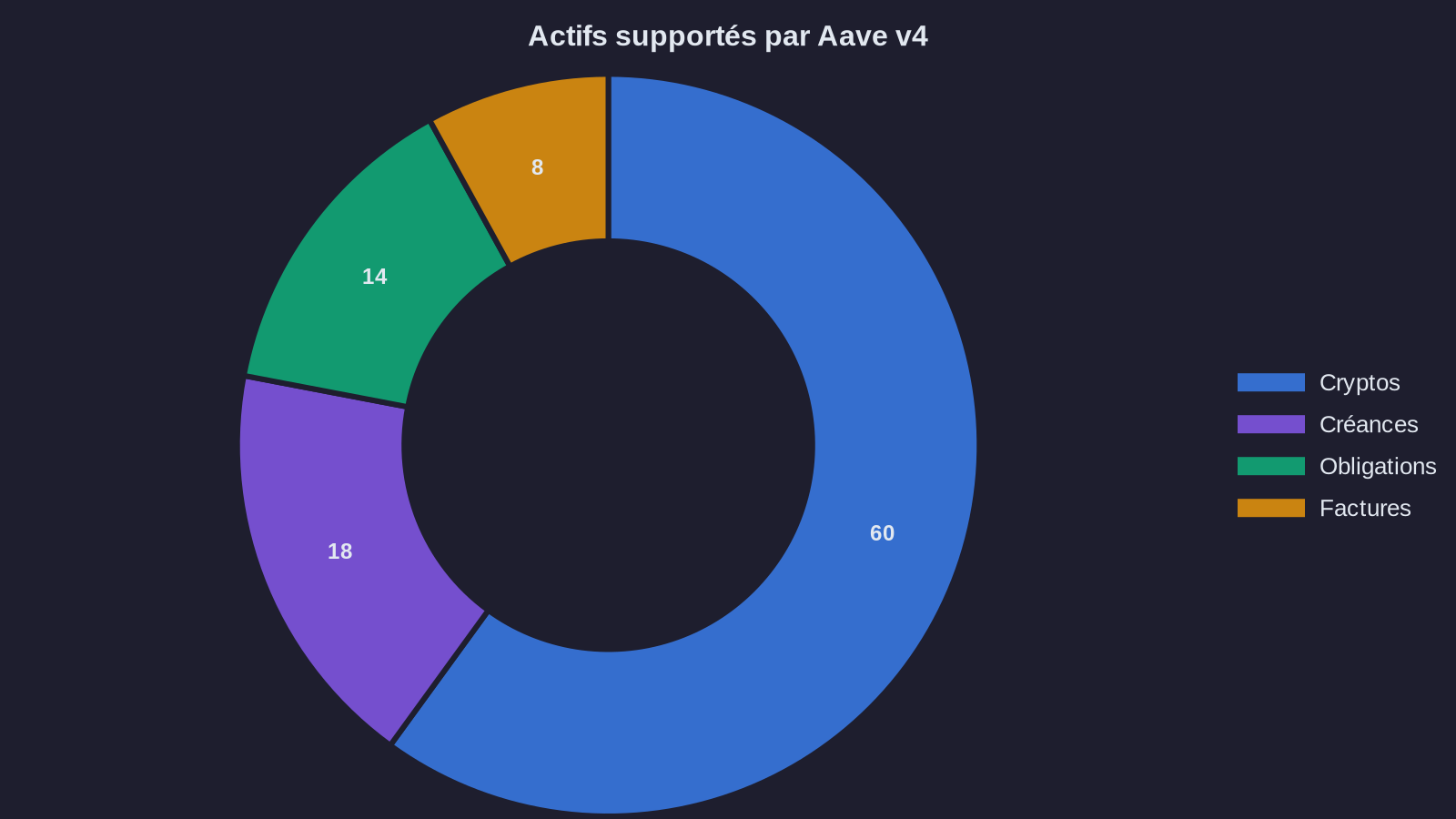
This Aave protocol upgrade is a game-changer. Until now, Aave allowed users to borrow and lend cryptocurrencies against other cryptocurrencies. Now, the platform opens its doors to real-world assets: corporate receivables, bonds, commercial invoices. For investors, this means new opportunities to generate passive yield on crypto-assets. For the DeFi ecosystem, it's a direct confrontation with the rules of traditional finance.
How Aave v4 bridges two opposite universes
Traditional credit and DeFi operate on radically different logics. In classical finance, you borrow based on your history, physical collateral, and reputation. A banker reviews your file, assesses your creditworthiness, then decides. The whole process takes days, sometimes weeks.
In DeFi, it's the opposite. You deposit cryptocurrencies as collateral, the protocol automatically calculates how much you can borrow, and you receive your funds in seconds. No paperwork. No credit committee. Just algorithms applying predefined rules.
Aave v4 builds a bridge between these two worlds. Concretely, the protocol now allows tokenizing traditional assets: a company can transform its customer receivables into tokens, deposit them on Aave, and borrow against these guarantees. As a lender, you can finance these loans and earn interest.
It's as if your savings account funds an unpaid invoice from a German SME, while remaining liquid and accessible 24/7. The difference? Everything runs through smart contracts instead of going through a bank.
New DeFi yields opening up for investors
This openness to traditional credit fundamentally reshapes the yield landscape. Until now, interest rates on Aave depended solely on supply and demand for cryptocurrencies. High demand for USDC borrowing? Rates went up. Excess liquidity? Rates fell.
With real-world asset integration, a new dimension emerges. Corporate receivables, for example, offer yields reflecting the issuer's credit risk, not just crypto dynamics. An invoice from an AAA-rated company won't yield the same rate as a receivable from a startup.
For investors, this unlocks unprecedented diversification strategies. You can now combine traditional yield farming on stablecoins with commercial receivable financing. Concretely, your portfolio could look like this: 40% in USDC lending on volatile pools to capture rate spikes, 30% in corporate invoice financing for steady returns, 30% in Aave token staking to benefit from protocol fees.
Expected yields vary. On traditional crypto pools, rates typically range from 2% to 15% depending on market conditions. On tokenized real assets, initial estimates hover around 4% to 8% annually, with much lower volatility. The arbitrage between these two DeFi lending yield types becomes a key skill.
The compliance risks accompanying this evolution
Integrating traditional credit into DeFi also means importing its regulatory constraints. And that's where things get complicated.
Take a simple example. You lend stablecoins on Aave, which finances a commercial receivable issued by a French company. The company defaults. In the traditional world, you'd have clear legal recourse: commercial courts, collection procedures, bank guarantees. In DeFi, these mechanisms don't exist natively.
Aave v4 solves this by introducing permissioned pools. Think of them as separate compartments within the protocol, accessible only to users who've passed identity verification (KYC). These pools can host regulated assets without contaminating public, anonymous pools, as explained in our analysis on DeFi facing MiCA.
This approach raises practical questions. First, it fragments liquidity. A KYC-verified user can access both pool types, but an anonymous user stays confined to pure crypto pools. Result: less liquidity in each segment, potentially higher rate volatility.
Second, it imposes new operational constraints. To access real-asset yields, you'll need to go through a verification process. This takes time, requires documents, and diminishes one of DeFi's main attractions: immediate, frictionless access.
Finally, it raises the jurisdictional question. A smart contract on Ethereum has no nationality. But corporate receivables do. Which law applies in case of dispute? The issuer's country? The lender's? The protocol's? These legal gray areas represent a meaningful risk for institutional credit onchain.
How to adapt your investment strategy
Facing these developments, the question for investors becomes: how do you position your capital intelligently?
For retail investors, the baseline rule remains diversification. Don't deploy all your capital into real-asset pools on day one. Start with limited amounts, observe rate behavior, evaluate actual liquidity. The first months of a new pool type are often the most unpredictable.
Next, understand the risk structure clearly. A pool financing investment-grade corporate receivables has a different profile than one financing invoices from unrated SMEs. The higher yield of the latter comes with elevated default risk. Ask yourself: does this extra return really compensate for the added risk?
For institutional investors, the main concern is compliance. Verify that your regulatory framework allows exposure to this asset type through DeFi protocols. Some jurisdictions impose strict restrictions on tokenized assets. Others require regular audits or detailed reporting on fund origins.
A prudent approach is to clearly separate your allocations: traditional crypto pool capital on one side, permissioned real-asset pool capital on the other. This separation simplifies reporting, limits regulatory contamination risk, and lets you manage each segment with its own risk-return logic.
Finally, monitor protocol developments. Aave v4 is just the beginning. Other DeFi protocols are preparing similar integrations. MakerDAO has been exploring real-asset financing for years. Compound could follow. This multiplication of options will create new arbitrage opportunities across protocols.
What this convergence means for the future
Aave v4's integration of traditional credit marks a turning point for DeFi. For a long time, the ecosystem functioned in isolation, with its own assets, its own rules, its own users. That era is ending.
The convergence between traditional finance and DeFi will be neither swift nor linear. It will raise technical, regulatory, and operational challenges. But it's inevitable. Real-world assets represent hundreds of trillions of dollars. DeFi, a few hundred billion. The growth potential is obvious.
For investors, this transition opens new territory. Yields will become more diversified, perhaps more stable, but also more complex to analyze. The ability to navigate between volatile crypto pools and regulated real-asset pools will become a competitive advantage, like any effective diversification strategy.
One thing is certain: DeFi in 2025 won't resemble DeFi in 2020. Aave v4 is just the first stone in building this new hybrid ecosystem. The question is no longer whether traditional finance will enter DeFi, but how you'll position yourself to benefit from it.