
On March 14, 2026, the Commodity Futures Trading Commission (CFTC) published a directive that sent shockwaves through the prediction markets ecosystem: prediction markets on political events now officially fall under its federal jurisdiction. The announcement came after two years of legal uncertainty during which several U.S. states had developed their own regulatory frameworks, often contradictory with one another.
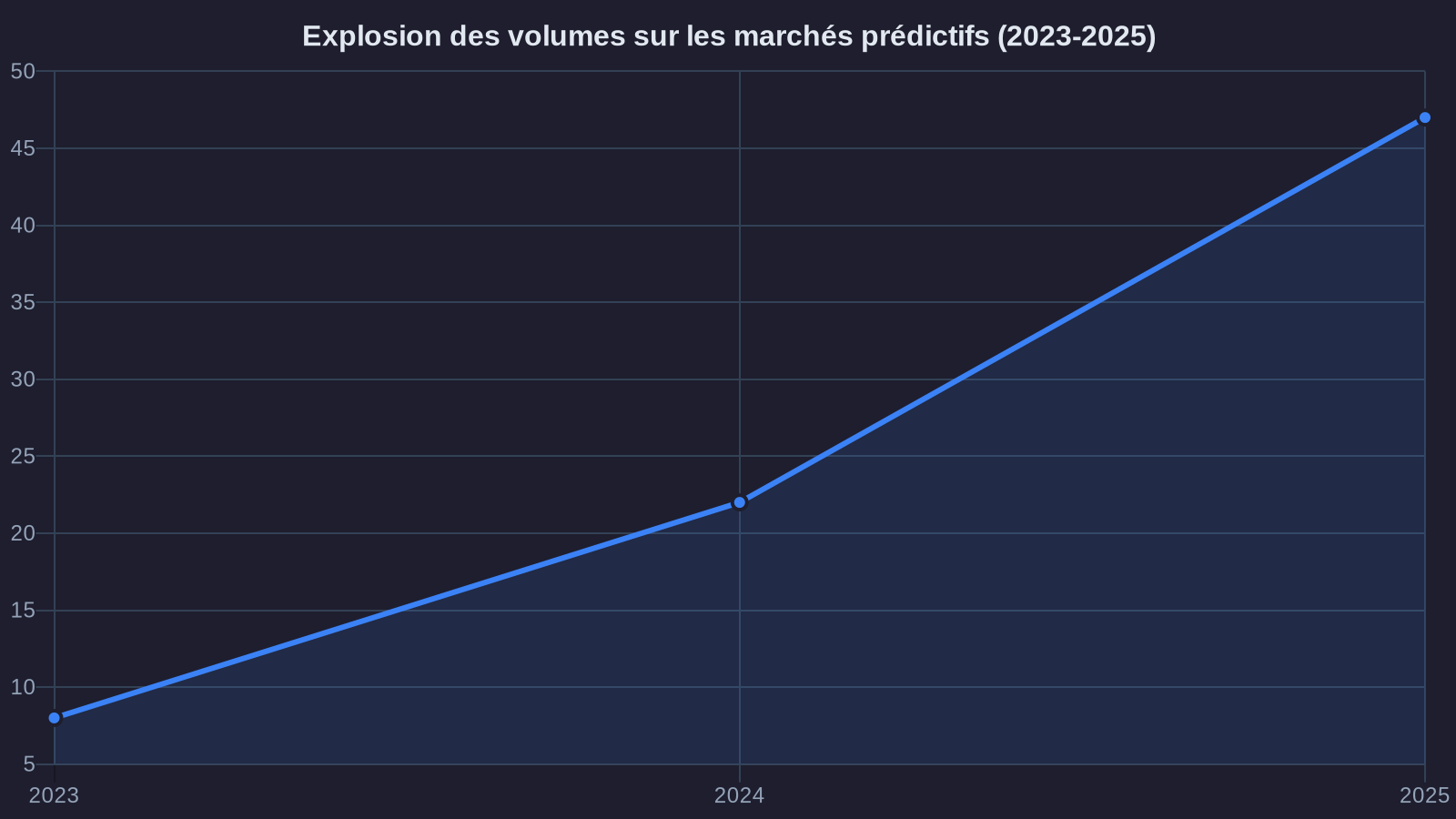
The timing is no coincidence. Trading volumes on prediction markets have exploded: $47 billion exchanged in 2025, compared to $8 billion in 2023. Polymarket, Kalshi, PredictIt, and a dozen emerging platforms are competing in a sector undergoing rapid structuring. But this spectacular growth raises a central question: who actually regulates these markets?
A jurisdictional conflict that's nothing new
The tension between federal regulation and state sovereignty runs through American history. In the financial sector, this fault line manifests particularly on hybrid instruments—those that borrow from sports betting, derivatives, and information markets.
Prediction markets check all three boxes. Technically, they are futures contracts on binary events: electoral victory, monetary policy decision, sports outcome. The CFTC views them as event contracts, therefore derivatives products under federal jurisdiction. Several states, notably New Jersey and Nevada, see them as locally regulated betting.
The March 2026 directive settles the matter in the CFTC's favor. But on the ground, the situation remains complex. Wyoming adopted a law in January 2026 explicitly authorizing tokenized prediction markets, subject to state approval. Texas is preparing similar legislation. These initiatives create a patchwork of regulations that forces platforms to navigate between several simultaneous legal frameworks.
Kalshi's experience illustrates this friction. The platform, approved by the CFTC since 2021, launched contracts on midterm elections in February 2026. The New York Department of Financial Services (NYDFS) immediately requested that it restrict access to New York residents, citing state law on online betting. Result: Kalshi operates under two distinct regimes depending on its users' geolocation.
What the CFTC's position concretely changes for legal prediction markets
The federal directive brings three major clarifications. First, it establishes that contracts predicting on political, economic, or sports events fall under the Commodity Exchange Act. This means any platform offering these instruments must obtain a Designated Contract Market (DCM) license or operate under limited exemption.
Second, the CFTC imposes strict liquidity and transparency criteria. Platforms must publish order books and volumes in real time and guarantee segregation of client funds. These requirements align prediction markets with the standards of traditional derivatives exchanges.
Third—and this is the most controversial point—the directive restricts contracts on "socially sensitive" events. The wording remains vague, but the CFTC explicitly cites presidential elections, court decisions, and natural disasters. This restriction aims to prevent prediction markets from becoming instruments for manipulating public opinion.
For traders, these changes have direct implications. Trading volumes on Polymarket, which lacks CFTC approval, have dropped 34% since the announcement. The Bermuda-based platform temporarily blocked U.S. user access on certain contracts. Conversely, Kalshi has seen volumes jump 58% over the same period. The market is restructuring around compliant players, a dynamic also observed in other segments of on-chain prediction markets.
Hidden opportunities in this regulatory battle
Paradoxically, this jurisdictional war opens opportunities for players who know how to adapt. Regulatory fragmentation creates geographic arbitrage. A platform approved in Wyoming can offer contracts banned in other states, thus capturing unserved local demand.
We're also seeing a race for product innovation. Faced with CFTC restrictions, several platforms are developing indirect instruments. Instead of betting directly on an election, a trader can take position on a basket of stocks correlated with the electoral outcome, or on interbank rate spreads that react to political announcements. These second-order derivative products currently escape the explicit scope of the directive.
Market data itself becomes an asset. Price histories on political events offer valuable insights for hedge funds and risk departments. Kalshi launched a paid API service in March 2026 that distributes its real-time data. This division already represents 12% of the platform's total revenue.
Finally, this regulatory clarification attracts institutional capital. Several traditional market makers, previously absent from the sector, are beginning to provide liquidity on CFTC-compliant contracts. Jane Street and Jump Trading both announced dedicated prediction markets desks in February 2026. The arrival of these professional players professionalizes the sector and reduces bid-ask spreads, improving price efficiency. This institutionalization echoes the recent arrival of financial giants in this segment.
What ForYield thinks about this
At ForYield, we're following this evolution closely because it redefines the boundary between speculative instruments and exposure management tools. Prediction markets compliant with the CFTC can serve as hedges against risks that are difficult to hedge otherwise.
Take a concrete example. A portfolio exposed to the American tech sector mechanically suffers the impact of regulatory decisions on AI or crypto assets. Rather than reducing exposure or buying expensive puts, you can now take position on prediction contracts linked to these decisions. If unfavorable regulation materializes, gains on the contract partially offset the portfolio decline.
We're progressively integrating these instruments into our portfolio construction models, prioritizing approved platforms and liquid contracts. The goal isn't to speculate on political events, but to use the information that market prices aggregate to adjust our allocations in real time, an approach grounded in rigorous exploitation of market data.
The current legal battle creates noise in the short term. But it also forces the sector to structure itself. The platforms that survive this consolidation phase will offer robust, compliant infrastructures that can be integrated into institutional strategies. This progressive maturation is what interests us.
The question is no longer whether prediction markets have a place in the financial ecosystem. They already do. The real question concerns their operational integration into disciplined management processes. Regulatory clarification, even imperfect, accelerates this integration. And for asset managers willing to navigate the current legal complexity, real opportunities exist.
```