On March 12, 2026, Citigroup launched its tokenized private company stock trading platform on blockchain. Three days later, the SEC repealed Rule 611 of the National Market System, which since 2005 had mandated best-execution across all regulated exchanges. These two events are no coincidence. They mark the end of one model and the emergence of a new market: liquid private equity, accessible 24/7, outside traditional stock exchange circuits.
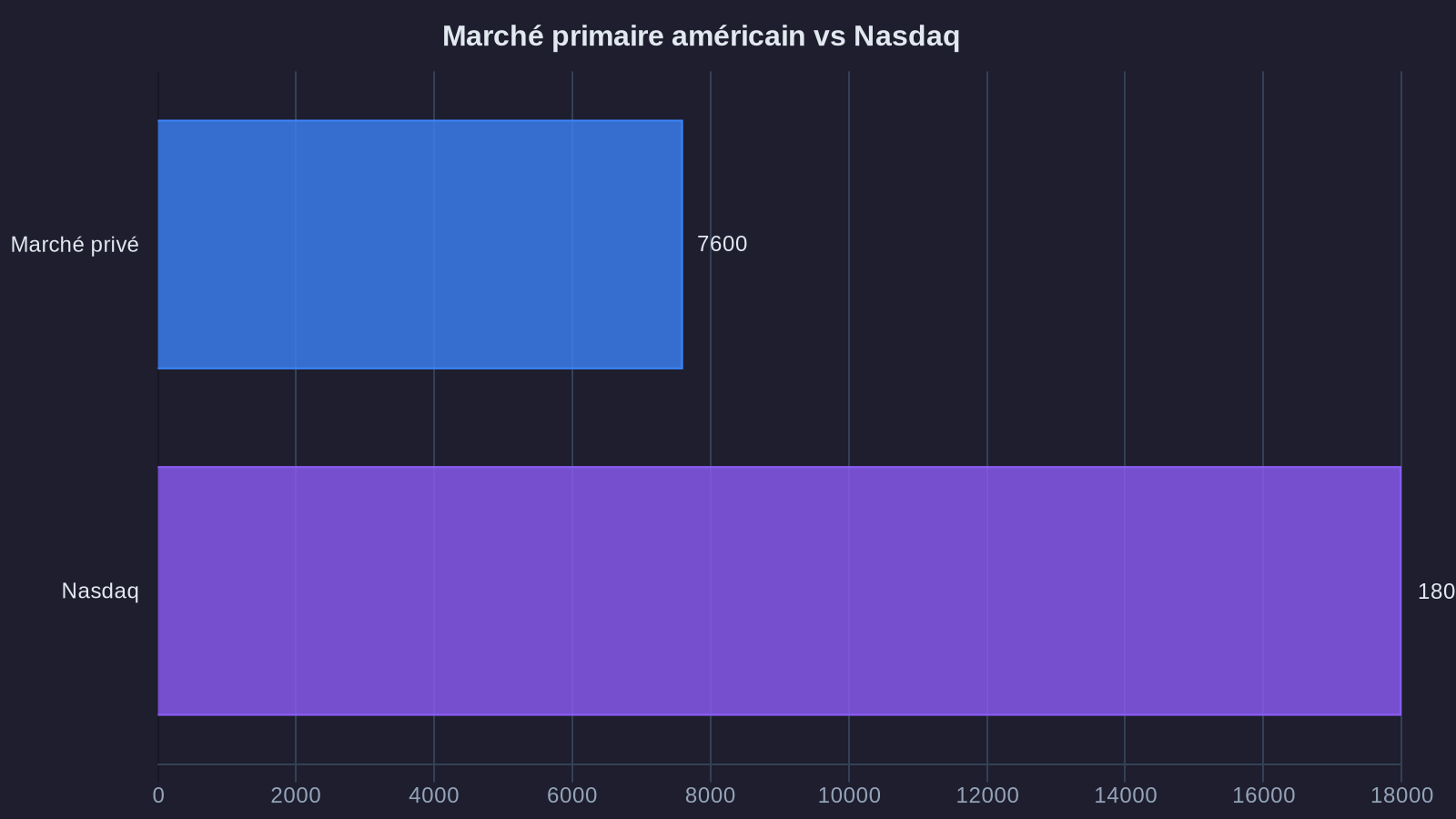
To grasp the scope of this shift, start with this reality: the U.S. primary market today represents $7.6 trillion in assets—roughly 30% of Nasdaq's market cap. These companies—from tech startups to real estate funds—remain private longer than ever, often until reaching multi-billion-dollar valuations. Yet their shares remain largely illiquid. Investors with access (funds, family offices, insiders) are locked in for years, lacking an efficient secondary market. Tokenization changes that.
What Citigroup just launched
Citigroup's new platform, called Citi Digital Assets Exchange, enables trading of tokenized shares in unlisted companies on a private blockchain infrastructure. In practical terms: a private company issues its shares as ERC-3643 tokens (a regulatory security standard), which are then tradeable among qualified investors on the platform. Each token represents one ordinary share, with associated voting rights and dividends.
Early issuers are growth-stage venture-backed companies valued between $500 million and $3 billion. Transactions settle in USD stablecoins (primarily USDC), with near-instant settlement via smart contracts. Transaction fees: 0.15% versus 0.50% to 1% on traditional secondary marketplaces like SharesPost or EquityZen. The platform operates 24/7, unlike standard market hours.
This model responds to clear demand from Citigroup's affluent clients. Pension funds and family offices investing in private companies have long sought a way to partially exit positions without waiting for an IPO or acquisition. Employees at unicorn startups holding restricted stock options for 4 to 7 years want to liquidate part of their wealth before a hypothetical exit. Tokenization delivers this liquidity while remaining confined to qualified investors.
SEC Rule 611 repeal: what changes for Nasdaq and private markets
The SEC's announcement three days after Citigroup's launch is not incidental. Rule 611, the Order Protection Rule, required brokers to route orders to the exchange with the best price—NYSE, Nasdaq, or other ATS (Alternative Trading Systems). This rule guaranteed optimal execution for the end investor, but it effectively prevented the emergence of parallel markets disconnected from centralized quotation systems.
By repealing this rule, the SEC implicitly authorizes private blockchain platforms to operate their own markets without obligation to connect with traditional exchanges. Translation: Citigroup can manage an internal order book for tokenized shares, with its own price discovery rules, without comparing to any reference price on a regulated exchange. This is a major turning point for traditional finance and RWA (Real World Assets).
Supporters of the repeal offer two arguments. First, Rule 611 was never designed for unlisted assets. Applying it to tokenized private shares would have created an untenable legal vacuum. Second, the primary market already operates on an over-the-counter model with bilaterally negotiated prices. Tokenization merely adds transparency and traceability via blockchain, without changing the market's fundamental nature.
Critics, meanwhile, point to one risk: fragmentation. If every bank launches its own platform with its own tokens, you end up with dozens of isolated markets, making price comparison and effective arbitrage impossible. This is exactly what happened in DeFi in 2021-2023, with an explosion of siloed liquidity pools and sometimes massive price spreads across platforms. The difference here is that the players are systemically important, regulated banks with mandatory reporting. Still, segmentation risk remains.
What this means for your portfolio
If you're a qualified investor (annual income > $200,000 or net worth > $1M), you can now access private company shares with unprecedented liquidity. Concretely: you invest $100,000 in a fintech valued at $2 billion, receive tokens in a custodied wallet with Citigroup, and can resell part of your position three months later if the secondary market is active. This was impossible before without locking up 7 to 10 years in a closed-end fund.
But beware of illusions. Liquidity doesn't mean volume. In Citigroup's platform's early weeks, average daily volumes hover around $15 to $30 million spread across roughly fifteen issuers. That's negligible compared to Nasdaq's $500 billion daily. If you hold a significant position in a thinly traded company, you may not find a counterparty without accepting a substantial discount. The market is nascent, narrow, and subject to the same supply-and-demand laws as thinly floated public stocks.
Then there's valuation. On a centralized market, a share price reflects the continuous clash of thousands of orders. On a private token platform, price reflects the perception of a restricted pool of qualified investors—often better informed than the public market, but sometimes less diversified. Result: valuations that can diverge meaningfully from those in recent fundraising rounds. We've already seen 20% to 30% gaps between the last financing round price and the secondary tokenized market price, in both directions.
Finally, taxation. In the U.S., tokenized stocks are treated as standard securities by the IRS. Sale = taxable capital gain, just like a Nasdaq stock. But blockchain's traceability imposes absolute rigor: every transaction is timestamped, recorded, auditable. Impossible to manipulate acquisition dates or fuzzy purchase prices. This is an advantage for compliance, a drawback for those relying on traditional over-the-counter opacity to optimize taxes. For French investors, rules differ—see our analysis on tax compliance and optimization for French investors.
What ForYield thinks
We've been tracking this since Citigroup's pilot project announcement in November 2025. Our position: tokenizing private shares is a structural trend, not a fad. It addresses real liquidity demand in private markets and fits into the broader digitization of financial assets (RWA: Real World Assets). The numbers speak for themselves: according to a BCG report published February 2026, tokenized assets could reach $16 trillion by 2030, with 40% in private equity and debt. This aligns with the same dynamics as crypto adoption by Wall Street that we've tracked since 2024.
But we remain cautious on timing and how to integrate these into a diversified portfolio. Today, these platforms are reserved for qualified U.S. investors, with entry tickets often exceeding $50,000 per position. Access for European investors remains limited due to regulatory differences between the SEC and local authorities (AMF, BaFin, CONSOB). The EU's Markets in Crypto-Assets Regulation (MiCA) doesn't explicitly cover private action tokens, creating legal ambiguity.
Our recommendation: if you consider allocating portfolio capital to tokenized private shares, start with limited exposure (5% to 10% maximum of private equity capital), focused on issuers with solid revenue history and transparent governance. Favor platforms backed by regulated financial institutions (Citigroup; Goldman Sachs is exploring something similar), and demand full documentation on token rights (voting, dividends, liquidation preference on exit). Finally, anticipate higher volatility than public markets, especially as the secondary market matures.
We're integrating this asset class into diversification strategies for institutional clients and family offices, complementing traditional crypto allocations (Bitcoin, Ethereum) and DeFi protocol positions. The goal: capture private market return potential while benefiting from blockchain transparency and traceability. But this doesn't replace rigorous due diligence on each issuer. A token is worth only what the underlying company is worth.
SEC's next regulatory steps for 2026
Citigroup's launch is just the beginning. Goldman Sachs announced in January 2026 it's working on a competing platform with a slightly different approach: direct integration with private company cap tables to enable automatic transfer of voting rights via smart contracts. Morgan Stanley is exploring a hybrid model where tokens would be backed by shares in private equity funds rather than individual stocks, allowing risk mutualization at the cost of diluted exposure.
On the regulatory side, the SEC opened public consultation on tokenized securities through June 30, 2026. Key points: issuer reporting obligations, platform market-making rules, investor protection in case of technical failure or breach. Responses will determine the regulatory framework for the next 5 to 10 years. Europe, meanwhile, awaits MiCA II finalization, expected early 2027, which should include specific provisions for financial RWA.
Finally, the technology question. Current platforms rely on private blockchains (Ethereum private or Hyperledger for Citigroup; Polygon PoS for others). But several players are considering migration to public infrastructure with enhanced privacy layers (zero-knowledge proofs, state channels). Advantage: interoperability across platforms, composability with existing DeFi protocols, censorship resistance. Disadvantage: technical complexity, potential high gas costs during network congestion, and regulator hesitation over decentralized infrastructure beyond an identified legal entity's control.
What we take away: tokenizing private shares is no longer an experiment. It's a market taking shape, with top-tier institutional players, evolving regulation, and real investor demand. Volumes will stay modest near-term, but the trend is here. For portfolios seeking diversification and private market access, it's an opportunity to watch closely, with the rigor required for illiquid assets—an approach similar to what we recommend for AI-automated asset allocation.