
On June 8, 2025, the Chicago Mercantile Exchange (CME) launches its first weighted cryptocurrency index futures contracts, crossing a threshold that many observers have awaited for years. Not on Bitcoin alone, not on Ethereum in isolation, but on a diversified basket of crypto assets. For investors wondering how to integrate digital assets into their institutional yield strategies, this development is a game-changer.
Why does this announcement deserve your attention? Because it marks the transition of crypto assets from speculative asset status to structured wealth exposure. Since 2017, the CME already offered futures contracts on Bitcoin, then Ethereum. But a diversified weighted index represents a qualitative leap: it provides access to an entire asset class, not just a single instrument.
In practical terms, this means a French investor with €100,000 to deploy can now gain crypto exposure through a regulated instrument, without opening an exchange account, managing private keys, or dealing with counterparty risk. What gold became in the 2000s with physical ETFs, crypto assets could become today with these new CME futures contracts.
Composition and methodology of the CME CF Diversified Cryptocurrency Index
The CME CF Diversified Cryptocurrency Index rests on precise methodology. The index currently integrates Bitcoin (roughly 70% weighting), Ethereum (25%), and three other crypto assets selected based on liquidity and market cap criteria: Solana, Cardano, and Polkadot. The weighting is reviewed quarterly, using an approach similar to traditional equity indices.
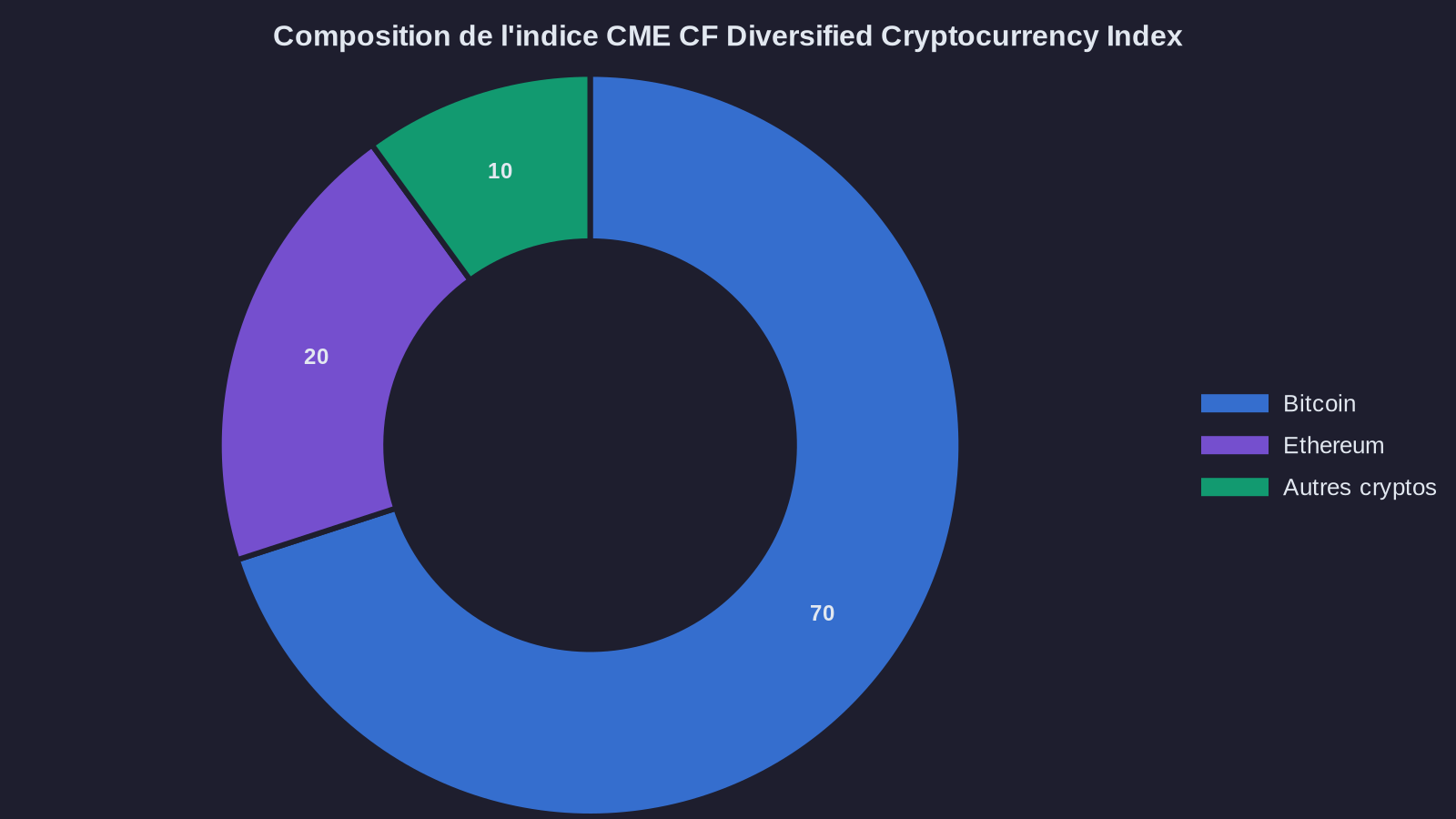
This composition is deliberate. It reflects a wealth management vision: Bitcoin as a digital store of value, Ethereum as decentralized finance infrastructure, and the three others as bets on technological innovation. An investor exposed to this weighted crypto index isn't betting on a single asset, but on the crypto ecosystem as a whole.
Let's compare this with existing alternatives. Until now, a French investor wanting to diversify crypto exposure either had to buy multiple tokens directly on platforms like Coinbase or Kraken (with the security constraints that entails), or go through specialized investment funds (often reserved for qualified investors and charging 2% in annual management fees). The CME futures contract offers a third path: regulated access, liquidity, and potential integration into life insurance or a standard brokerage account.
Returns, risks, and comparison with traditional investments
Let's put numbers on the table. Over the past three years (2022-2024), a comparable diversified crypto index would have delivered annualized returns of roughly 18.3%, with volatility of 65%. For comparison, a balanced 60% equities / 40% bonds portfolio delivered approximately 6.2% annualized over the same period, with volatility of 12%.
The picture is clear: institutional crypto exposure offers superior return potential, but with significantly higher risk. This isn't a conservative investment in the traditional sense. It's a satellite allocation, which should represent a measured portion of a diversified wealth portfolio.
Let's simulate a concrete wealth allocation. Take an investor with €200,000 in financial assets and a balanced risk profile:
Traditional allocation (no crypto):
- 60% international equities (€120,000) — expected return: 7% annually
- 30% government and corporate bonds (€60,000) — expected return: 3.5% annually
- 10% real estate funds (€20,000) — expected return: 5% annually
Overall expected return: approximately 5.9% annually, before inflation.
Allocation with crypto exposure (5%):
- 55% international equities (€110,000)
- 30% bonds (€60,000)
- 10% real estate funds (€20,000)
- 5% CME crypto index futures contract (€10,000) — expected return: 15% annually (conservative estimate)
Overall expected return: approximately 6.4% annually. Adding 5% crypto exposure improves expected returns by 0.5 percentage points, without disrupting the overall risk profile of your portfolio.
This simulation illustrates a simple wealth management principle: a small allocation to a high-potential asset can significantly boost portfolio performance, provided you maintain reasonable proportions.
Key considerations before investing in CME crypto futures contracts
Enthusiasm must be tempered with clear-eyed analysis. Crypto index futures contracts have specific features you need to understand before diving in.
First point: the nature of a futures contract itself. Unlike an ETF that physically holds underlying assets, a futures contract is an obligation to buy or sell the index at a future date and predetermined price. This involves carrying costs (the quarterly "roll" between two expiries), which can erode returns if the market is in contango (where future prices exceed spot prices). Over the past three years, this cost has represented roughly 2-3% annually on CME Bitcoin contracts.
Second point: liquidity. While the CME is the world's most liquid derivatives market, a new index always takes a few quarters to reach sufficient market depth. In the early months, bid-ask spreads (the difference between buying and selling prices) may be wider than on established contracts like Bitcoin alone.
Third point: French taxation. Gains on futures contracts are taxed as securities gains at the flat rate of 30%. This is the same treatment as traditional stocks or ETFs. However, losses can only be offset against gains of the same nature realized in the same year or the following ten years. If you take a loss in 2025, you can only offset it fiscally against future gains on derivative instruments.
Finally, fourth point: volatility. A crypto index can lose 30% in a few weeks, as happened in May 2022 or November 2022. If you invest €10,000, you must be prepared to see that amount fluctuate between €7,000 and €13,000 over a few months. This volatility is only tolerable if it fits within a balanced overall allocation.
Wealth strategy: how to integrate these contracts into your portfolio
The question isn't whether crypto assets belong in modern wealth management — the answer is yes for a growing number of investors — but how to integrate them intelligently.
The rule I recommend: crypto exposure should not exceed 5-10% of total financial assets, depending on your risk tolerance and investment horizon. Beyond that, volatility risk can destabilize your entire allocation.
Concretely, if you have €150,000 in financial assets, an exposure of €7,500 to €15,000 via this type of contract makes sense. This allows you to benefit from the upside potential of the asset class without jeopardizing your medium-term wealth objectives.
The recommended investment horizon is at least three years. Crypto cycles are shorter than traditional equity cycles, but they remain subject to phases of euphoria and sharp corrections. A short horizon (under 18 months) exposes you to unfavorable timing risk.
Another approach is to implement a dollar-cost averaging strategy. Rather than investing €10,000 all at once, you invest €1,000 monthly over ten months. This method reduces the risk of entering at market peaks, though it can also limit upside potential in case of sustained gains.
Finally, it's essential to regularly rebalance your allocation. If your crypto exposure grows from 5% to 12% of your portfolio following a strong rally, it's prudent to take partial profits to return to your target allocation. This is a basic wealth management principle: you sell what has gone up, you reinforce what has gone down.
What these CME futures contracts mean for your wealth
The launch of this futures contract by the CME is no market footnote. It's a powerful institutional signal: crypto assets are transitioning from the speculative sphere to that of structured wealth management.
For a French investor, this opens a new opportunity: access this asset class via a regulated, liquid, and fiscally clear instrument. The return potential justifies a measured allocation, provided you accept the volatility that comes with it.
My advice: if you're considering integrating crypto assets into your wealth portfolio, this type of product is today one of the most coherent solutions. Start with a limited allocation (5% maximum), with a minimum three-year horizon, and rebalance regularly. Your wealth won't be revolutionized, but it will be better positioned to navigate the structural shifts in financial markets.
Your wealth deserves better than a savings account. I'll show you the way, with the numbers to back it up.