Coinbase just crossed a milestone that's redefining the boundary between traditional finance and blockchain. The American exchange now offers tokenized shares of major companies, with automatic on-chain dividend distribution. No banking intermediaries, no settlement delays, no trading hours cutoffs: dividends land in your wallet the moment they're paid to traditional shareholders.
This isn't the first attempt at tokenizing financial assets. But it's the first time an actor of this scale — Coinbase has a $60 billion market cap as of March 18, 2026 — natively integrates on-chain revenue distribution. The signal is unmistakable: blockchain is no longer a testing ground for exotic assets, it's becoming distribution infrastructure for mainstream equity markets. This shift is part of a broader trend where Wall Street is gradually adopting crypto infrastructure.
How automatic blockchain dividend distribution works
The principle looks straightforward on the surface, but it's technically rigorous. When a company pays dividends to shareholders, Coinbase holds the underlying shares through a regulated custody vehicle. At payment time, the equivalent is automatically converted to a stablecoin (USDC for dollar dividends, EURC for euros) and distributed proportionally to token holders.
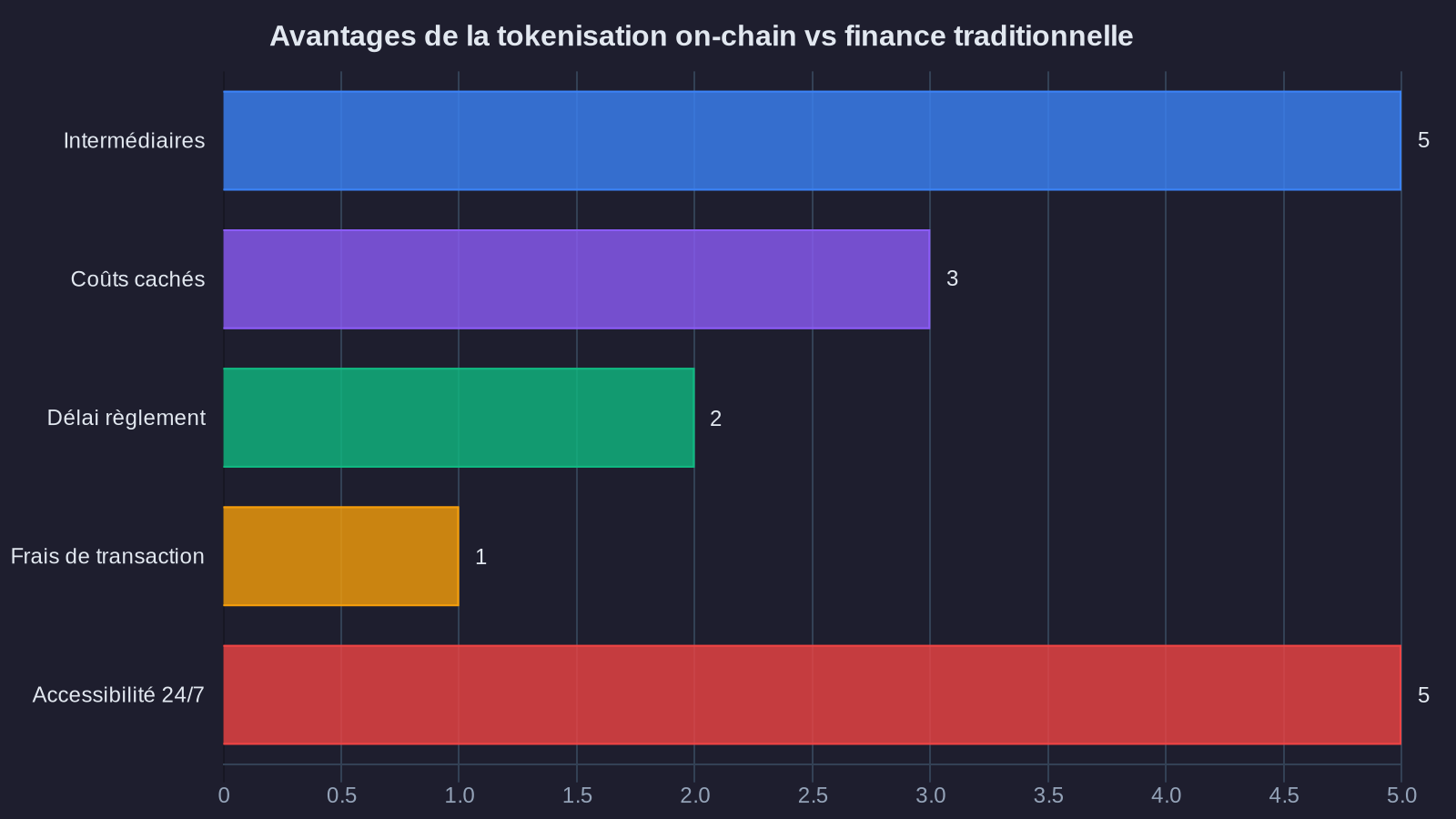
Let's walk through a concrete example. If you hold the tokenized equivalent of 100 Apple shares, and Apple pays a $0.24 dividend per share on February 15, you receive 24 USDC in your Coinbase wallet that same day. No banking delays, no forced currency conversion, no hidden FX fees. The dividend arrives atomically, verifiable on-chain, traceable in blockchain history.
This transparency is a game-changer for international investors. Historically, a European investor holding U.S. stocks through a broker faces multiple friction points: IRS withholding tax, USD/EUR conversion with banking spreads, credit delays sometimes exceeding 30 days. With on-chain distribution, the tax withholding remains (it's a legal obligation), but everything else disappears.
The RWA infrastructure battle: tokenized shares vs yield products
Coinbase isn't alone in this space. Since 2023, several players have tested real asset tokenization: BlackRock with its BUIDL money market fund on Ethereum ($1.2 billion in assets under management as of March 12, 2026), Franklin Templeton with its OnChain U.S. Government Money Fund ($490 million), and even Société Générale through its SG-Forge subsidiary, which issued tokenized bonds worth €850 million.
But these initiatives focused mainly on fixed-income products: money market funds, government bonds, fixed-income instruments. Tokenized shares with dividends represent a higher level of complexity. You need to handle voting rights (which remain with the custodian), corporate actions (splits, mergers, takeovers), and above all ensure sufficient liquidity so the token stays pegged to the underlying share price.
Coinbase leverages its status as a regulated U.S. platform to navigate these obstacles. Tokenized shares are technically securities tokens, subject to SEC regulation. This isn't regulatory arbitrage, it's complementary infrastructure to traditional markets. Moreover, tokens don't circulate freely: they stay within the Coinbase ecosystem, with mandatory KYC verification and geographic restrictions based on jurisdiction.
What this changes for your investment portfolio
The real impact depends on your profile and tax jurisdiction. For an investor based in a country with complex foreign dividend taxation, on-chain distribution radically simplifies tracking. Each payment is time-stamped, traceable, and linked to an auditable smart contract. No more incomplete bank statements or dividends "lost" in SWIFT system complications.
For holders of diversified portfolios, receiving all dividends in the same stablecoin (USDC) reduces fragmentation. You can reinvest immediately without suffering interbank transfer delays. This is particularly relevant for a passive income strategy: dividends flow continuously, you reallocate continuously, without friction.
But beware: this fluidity has a tax cost. In most European jurisdictions, a dividend received in USDC remains taxable income at standard income tax rates. The fact that it arrives via blockchain doesn't change its tax classification. You'll need to declare these revenues exactly like traditional share dividends, with the same withholding rates. Blockchain simplifies distribution, not taxation. To optimize your tax strategy, check out our guide on tax compliance for crypto assets.
Structural limitations of tokenized shares
Tokenizing shares raises a fundamental legal question: who actually owns the asset? In Coinbase's model, a custody vehicle owns the underlying shares. You, as a token holder, have economic rights (dividends, appreciation), but not voting rights (shareholder meetings). This isn't a detail: for an activist investor or a fund seeking to influence a company's governance, this model is useless.
Then there's the secondary liquidity question. For now, tokens stay within the Coinbase ecosystem. You can't transfer them to an external wallet or trade them on a competing platform. It's a closed infrastructure, which limits network effects and composability with other DeFi protocols. You can't, for instance, use your tokenized Apple shares as collateral in a decentralized lending protocol.
Finally, token valuation depends entirely on Coinbase's ability to maintain the peg with the underlying stock price. If a price gap appears (the Apple token trades 2% below the NYSE price), who guarantees arbitrage? In a truly decentralized model, market makers step in to correct these inefficiencies. Here, Coinbase plays that role. If the exchange faces operational or regulatory difficulties, the peg can degrade.
What ForYield thinks
We're closely following the evolution of tokenized shares, but we remain cautious about integrating them into our short-term yield strategies. On-chain dividend distribution is an interesting innovation for investors seeking to simplify the administrative burden of managing passive income. But it doesn't fundamentally change the risk/return equation of the underlying shares.
For our clients, the arbitrage remains clear: native blockchain yield products (staking, lending, liquidity providing) currently offer risk-adjusted real returns superior to what you can get from tokenized share dividends. A tokenized money market fund like BUIDL distributes roughly 4.5% annually (Fed funds rate). A balanced portfolio of staked ETH and stablecoins in lending generates between 6% and 9% depending on configuration, with controlled volatility.
That said, we're integrating this evolution into our strategic outlook. If volumes on tokenized shares reach critical mass, and if secondary liquidity infrastructure develops (lending protocols accepting these tokens as collateral), then the equation changes. Composability between traditional finance and DeFi becomes real, and arbitrage opportunities emerge.
Until then, our advice remains unchanged: for share exposure with dividends, stick with traditional ETFs or regulated trading accounts. For native blockchain yields, use proven protocols with track records spanning multiple years. Don't mix the two universes until the infrastructure matures.
```