
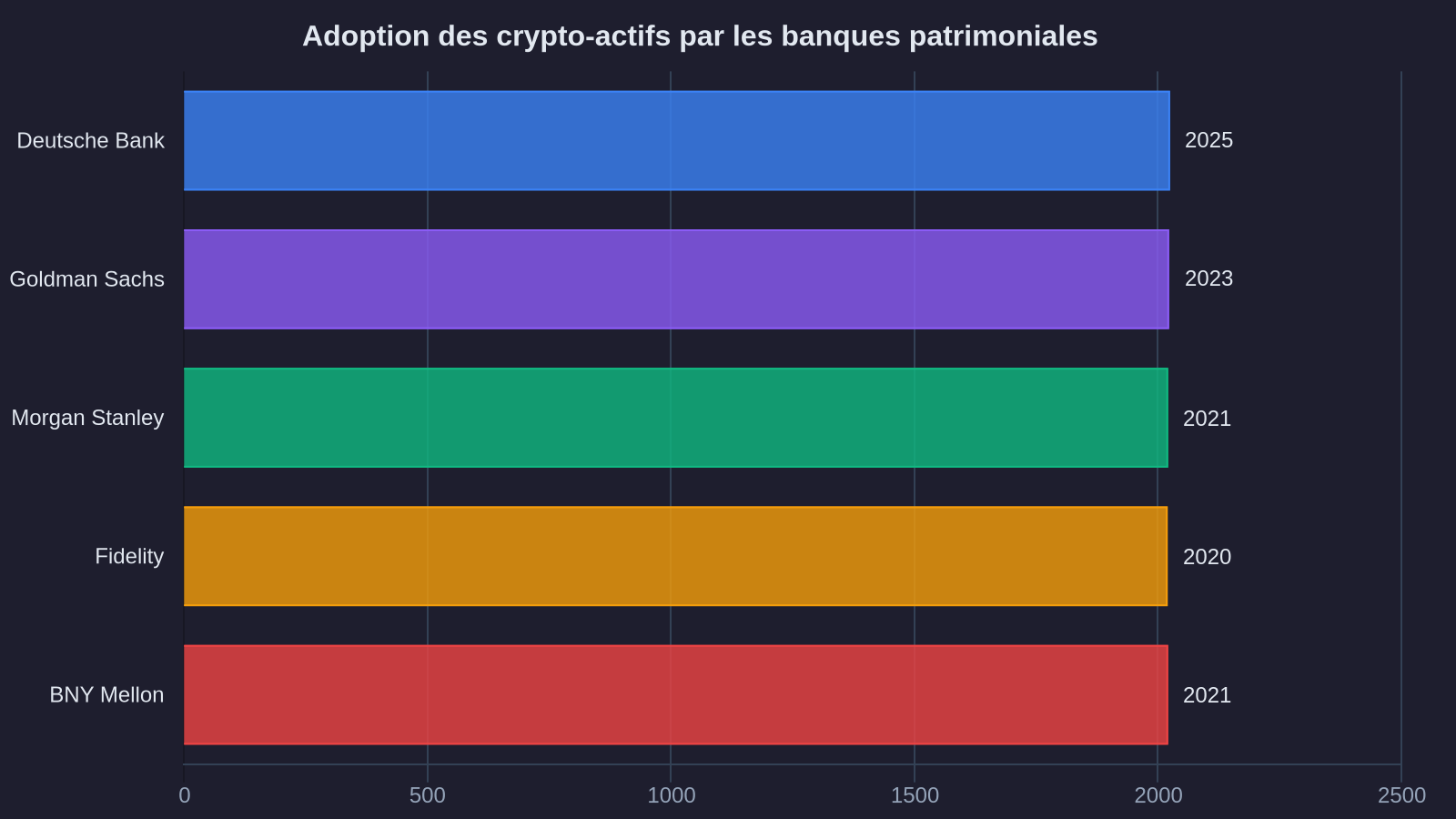
When Deutsche Bank announced in March 2025 the launch of an institutional custody offering for crypto-assets to its high-net-worth clients, it was far more than a press release. It represented a symbolic threshold crossed. An institution 155 years old, which survived two world wars and weathered every financial crisis of the twentieth century, now offers its wealthy clients the ability to hold Bitcoin under the same security conditions as their government bonds.
For an investor managing a portfolio of €500,000 or more, this development raises a very concrete question: should crypto-assets still be considered a marginal alternative investment, or as a full-fledged asset class in modern wealth allocation?
The answer depends less on Bitcoin itself than on what this announcement reveals about the sector's evolution. Let's examine what's actually changing.
Why institutional custody is a wealth management game-changer
For fifteen years, one major obstacle has hindered crypto-asset adoption among high-net-worth portfolios: custody. Self-holding private keys requires considerable technical responsibility. Entrusting them to an exchange platform exposes you to bankruptcy risk, as the collapse of FTX in November 2022 brutally demonstrated, with $8 billion in client assets evaporated. The failures of crypto platforms have left a lasting mark on institutional investors' minds.
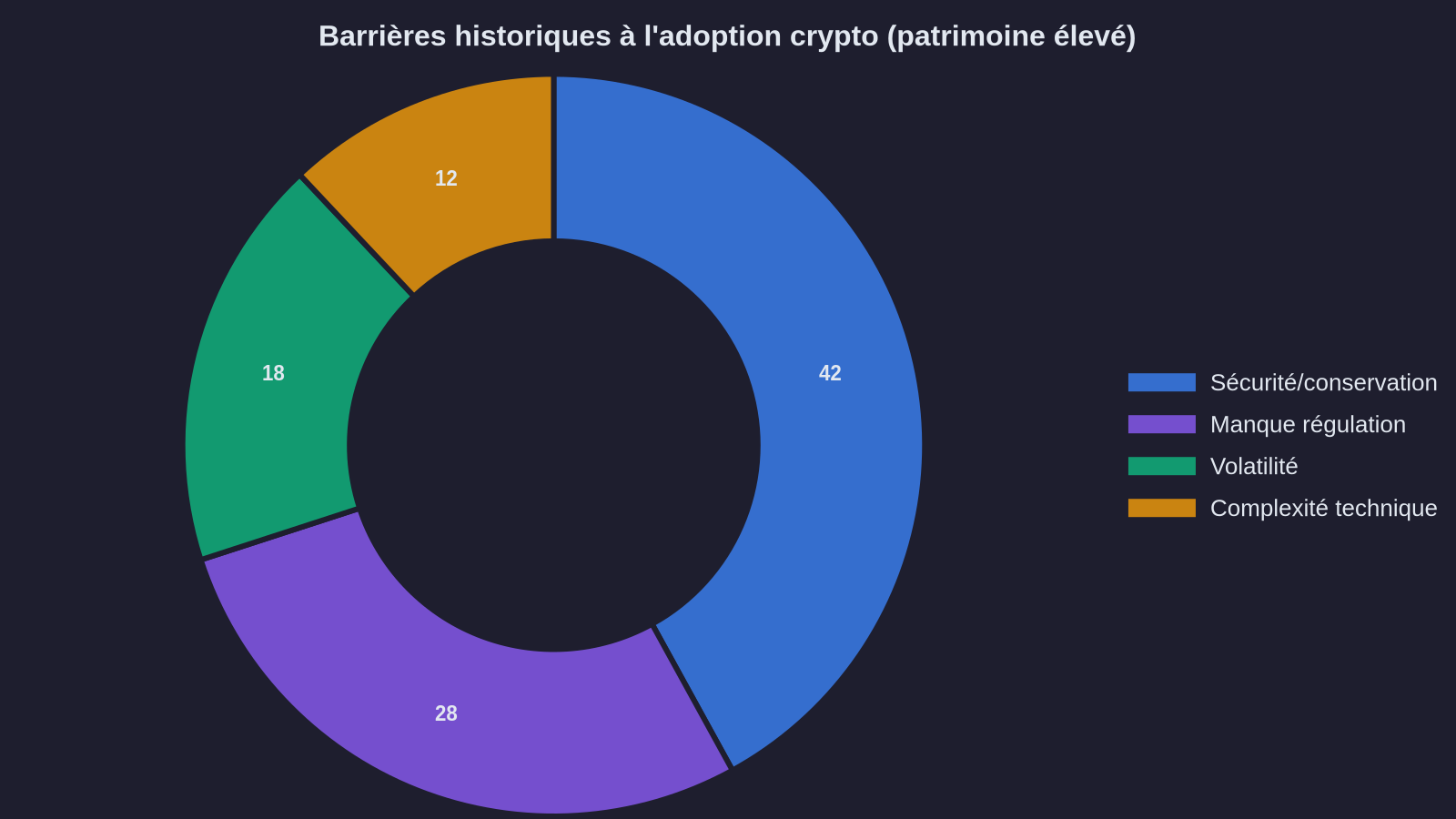
An investor holding €200,000 in Thales bonds through their broker doesn't question custody. The security is dematerialized, registered with Euroclear, protected by solid regulatory frameworks. That same person wanting to hold €50,000 in Bitcoin faces a dilemma: assume sole responsibility for a cryptographic key whose loss means permanent capital disappearance, or place trust in young operators, sometimes domiciled in exotic jurisdictions, without protections equivalent to deposit guarantee schemes.
This is precisely the lock that Deutsche Bank's crypto-asset custody solution breaks open. The announced offering rests on qualified custody infrastructure compliant with MiCA regulations that came into force at the end of 2024. Concretely, this means:
- Complete segregation of client assets, recorded on the bank's balance sheet separately from the bank's own assets
- Specific insurance coverage against theft, loss, or hacking
- A legal framework guaranteeing your crypto-assets belong to you, even if the institution fails
- Supervision by BaFin, the German financial regulator, recognized for its rigor
For the first time, holding Bitcoin becomes as straightforward and secure, from a wealth management perspective, as holding a Total share or a real estate fund unit. This is not trivial.
The real cost of institutional custody: detailed comparison
One key question remains: what's the price tag? Deutsche Bank hasn't yet publicly disclosed its detailed fee schedule, but current institutional custody offerings provide a clear picture. Let's compare options for a €100,000 crypto-asset portfolio held over three years.
| Solution | Annual fees | Insurance | Regulatory framework | Total cost over 3 years |
|---|---|---|---|---|
| Exchange platform (Binance, Kraken) | €0 (free custody) | Partial, capped | Varies by jurisdiction | €0 |
| Independent custody (Anchorage, Copper) | 0.35% to 0.50% | Yes, Lloyd's of London | US/UK regulated | €1,050 to €1,500 |
| Deutsche Bank (estimate) | 0.40% to 0.60% | Yes, bank-level | MiCA (EU), BaFin | €1,200 to €1,800 |
| Self-custody (hardware wallet) | €150 (equipment purchase) | None | None | €150 + total risk |
Institutional custody thus represents an annual cost of €400 to €600 for €100,000 in crypto-assets. This is equivalent to management fees on a mid-range life insurance contract (0.5% to 0.7% annually including all taxes). For a high-net-worth portfolio, this cost is marginal relative to the security provided.
Consider a concrete example. A 52-year-old business owner wants to diversify 5% of his liquid portfolio of €1.2 million into crypto-assets, €60,000 total. He allocates €40,000 to Bitcoin and €20,000 to Ethereum. With institutional custody charged at 0.45% annually, he'll pay €270 per year. Over a five-year holding period, this represents €1,350 in total fees.
Now compare to the alternative scenario: he holds his assets on a free exchange platform. In November 2022, this platform fails. His €60,000 gets locked in legal proceedings lasting a minimum of three years. At best, he recovers 40% of his initial capital, a net loss of €36,000. The real cost of "free" custody totals €36,000—26 times the cost of professional custody over the same period.
For a high-net-worth portfolio, this equation is crystal clear: institutional custody is not a cost, it's insurance at a modest premium.
What this offering reveals about institutional adoption
Deutsche Bank's announcement fits into a broader movement accelerating over the past 18 months. In January 2024, the SEC approved the first spot Bitcoin ETFs. In March 2024, BlackRock launched its IBIT fund, gathering $37 billion in less than a year—an absolute record for a newly created ETF. In December 2024, MiCA regulation went into effect across the European Union, finally establishing a unified regulatory framework for crypto-asset service providers.
Deutsche Bank isn't a pioneer. BNY Mellon has offered a similar solution since 2022 for its US institutional clients. State Street announced its entry into this market in 2023. What's changing is the scale: Deutsche Bank manages €1.4 trillion in client assets. Its entry into this segment sends an unmistakable signal to family offices, wealth managers, and European investors: crypto-assets are no longer a risky tech bet, but an asset class you can integrate into a diversified allocation.
The numbers confirm it. According to a Fidelity Digital Assets study published in February 2025, 62% of European institutional investors now hold at least 1% of their assets under management in crypto-assets, up from 38% in 2023. This rises to 74% for family offices managing more than €500 million. The movement is no longer marginal—it's mainstream.
This evolution also transforms wealth taxation. Until now, holding crypto-assets required complex declarations to the tax authorities, with a specific form (Form 3916-bis) to report accounts held abroad. With custody at Deutsche Bank France, your crypto-assets are automatically declared within standard banking reporting, just like your securities accounts or life insurance. Administrative friction disappears.
The limitations you need to understand before taking the plunge
This institutionalization solves a major problem but doesn't eliminate all risks. Let's be clear about what professional custody protects and what it doesn't.
It protects against theft, technical loss, and platform hacking. If Deutsche Bank suffers a cyberattack and your Bitcoin is stolen, you're covered by the bank's insurance. If you lose your credentials, the bank can regenerate them. You're protected against operational risk.
It doesn't protect against asset volatility. Bitcoin lost 65% of its value between November 2021 and November 2022. Ethereum has experienced 40% corrections multiple times over weeks. Institutional custody changes nothing about this reality: crypto-assets remain extremely volatile investments, unsuitable for short-term horizons or defensive wealth strategies.
It also doesn't protect against regulatory risk. While MiCA has clarified the European framework, legislative changes remain possible. Increased taxation, restrictions on certain decentralized protocols, or even outright prohibition in some jurisdictions remain plausible scenarios. A diversified portfolio should never concentrate more than 5% to 10% of its allocation in this asset class, precisely because of this structural uncertainty.
Finally, institutional custody carries an indirect cost: loss of sovereignty. One of Bitcoin's founding arguments is the ability to hold an asset without intermediaries. By using a bank, you surrender this direct ownership. You're trusting a third party again. This is a legitimate choice for high-net-worth portfolios prioritizing security over philosophy, but you should be aware of it.
What this means for your portfolio
Deutsche Bank's offering marks a decisive step in normalizing crypto-assets within wealth management. It removes the main obstacle to adoption by high-net-worth investors: the question of secure custody. For the first time, holding Bitcoin becomes just as straightforward, legally and operationally, as holding a Société Générale bond.
Practically speaking, this means that if you manage a portfolio of €500,000 or more, you can now integrate crypto into your strategy without assuming disproportionate technical risk. A 3% to 5% allocation to Bitcoin and Ethereum through institutional custody charged at 0.4% to 0.6% annually becomes a rational option. Not as a speculative bet, but as diversification toward an asset uncorrelated with traditional markets, within a secure and tax-transparent framework.
The momentum is underway. What US investment banks initiated in 2022, European private banks are generalizing in 2025. Within two years, institutional crypto-asset custody will likely be offered by most wealth management firms. Those waiting for that moment to learn may find themselves behind a market cycle.
The question is no longer whether crypto-assets belong in a diversified portfolio. It's determining what proportion, over what horizon, and within what custody framework. Now, the answer to that last question is crystal clear.
Your portfolio deserves better than a savings account. I'll show you the way, with numbers to back it up.