
In January 2024, BlackRock launched its Bitcoin ETF (IBIT). Twelve months later, BlackRock's tokenized funds are displaying growth approaching $3 billion in assets under management. This isn't just a fundraising figure: it's confirmation that crypto-assets are entering mainstream wealth allocation alongside the reporting and governance standards expected by family offices and wealth managers. This institutional adoption marks a turning point for the BlackRock Bitcoin fund and the entire tokenized ETF sector.
The question is no longer whether institutions will adopt Bitcoin. It's understanding how this adoption transforms access to crypto-assets for the wealth investor, and especially what trade-offs this involves in a diversified allocation. You're investing €100,000 in 2025: should you go through a listed ETF, take direct exposure, or combine both approaches? Here's the breakdown.
Institutional adoption: flows that are redefining the market
When BlackRock collects $3 billion on a Bitcoin ETF in a year, these aren't retail traders speculating on Binance. These are structured allocations: US pension funds, European family offices, insurance companies integrating a crypto allocation into their diversified management mandates. The collection velocity of IBIT (BlackRock's Bitcoin ETF) exceeds that of all equity or bond ETF launches from the previous decade combined.
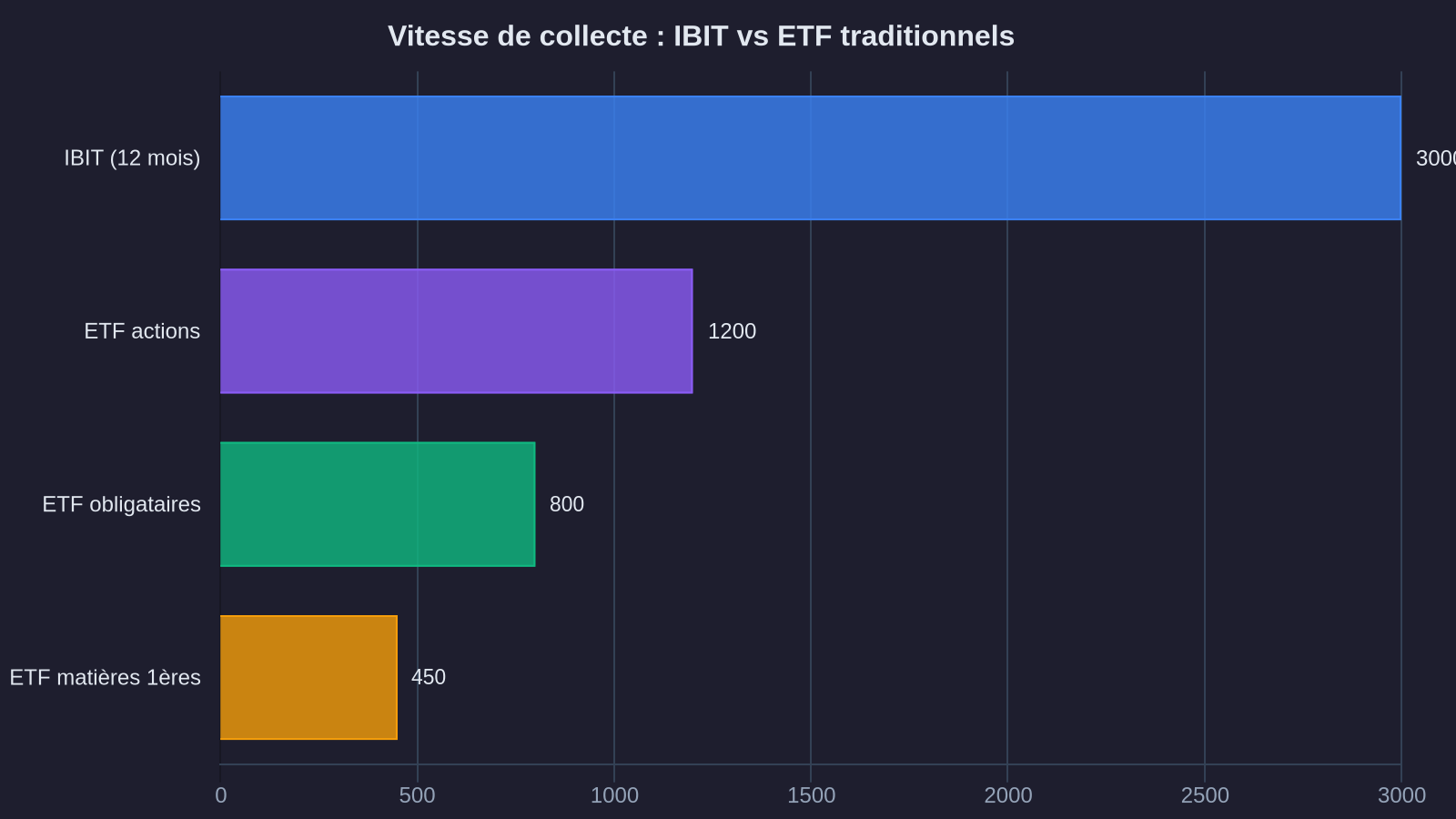
Compare this with a familiar wealth equivalent. An MSCI World equity fund typically takes 3 to 5 years to reach $3 billion in assets under management, even with brands like Amundi or Vanguard behind it. IBIT did it in 12 months. This reflects pent-up demand: institutional investors were waiting for a regulated vehicle, audited, with a reliable market maker and daily liquidity.
This institutional adoption produces two tangible effects on the market. First, a reduction in Bitcoin's relative volatility: incoming flows are less sensitive to short-term movements—they respond to long-term diversification mandates. Second, a liquidity premium for ETFs: the bid-ask spread on IBIT is around 0.02%, compared to 0.10% to 0.30% on crypto exchanges, even the most liquid ones. For a wealth investor, this spread matters: on €100,000, it represents €200 instead of €1,000 to €3,000 in implicit entry and exit costs.
Wealth comparison: Bitcoin ETF vs direct exposure
You have €100,000 to allocate to a crypto holding. You have two options: buy Bitcoin directly through a regulated platform (Coinbase, Kraken), or subscribe to BlackRock's Bitcoin ETF through your usual broker. Here's the detailed comparison, net of all fees.
Option 1: Direct exposure via regulated crypto platform
- Purchase fees: 0.50% (€500 on €100,000)
- Annual custody fees: 0% (you hold your keys or use a cold wallet)
- Exit taxation: flat tax at 30% on realized gains
- Liquidity: 24/7, but with variable spreads depending on market conditions
- Counterparty risk: minimal if you self-custody your keys, moderate if you leave assets on the platform
Option 2: BlackRock Bitcoin ETF (IBIT)
- Purchase fees: 0 to 0.30% depending on your broker (€0 to €300)
- Annual management fees: 0.25% (€250 in the first year on €100,000, then proportional to assets)
- Exit taxation: standard personal income tax at 30% on gains, identical to direct exposure
- Liquidity: US market hours (3:30 PM-10:00 PM Paris time), but with very tight spreads (0.02%)
- Counterparty risk: BlackRock, rated AA, with asset segregation and external audit
Over a 3-year horizon, assuming an average annual Bitcoin return of 15% (conservative given the last 10 years), here's what you get:
Direct exposure: €100,000 initial, minus €500 purchase fees, valuation after 3 years at €150,658 (pre-tax). You pay 30% on the gain of €51,158, or €15,347. Net after tax: €135,311.
BlackRock ETF: €100,000 initial, minus €300 purchase fees, minus 0.25% annually in management fees (approximately €750 cumulative over 3 years with compounding). Valuation after 3 years: €150,195. You pay 30% on the gain of €50,745, or €15,224. Net after tax: €134,971.
The net difference after 3 years is €340 in favor of direct exposure. Marginal. The real difference plays out elsewhere: in administrative simplicity (monthly reporting integrated into your securities account for the ETF), in operational risk (no private key management), and in allocation flexibility (you can swap the ETF for stocks or bonds in one click without leaving your tax-advantaged account).
Impact on diversification and risk-adjusted returns
Integrating Bitcoin into a diversified wealth allocation only makes sense if it improves the overall return-risk ratio. Bitcoin's correlation with equities (MSCI World index) is historically low to moderate: between 0.2 and 0.4 depending on the period. This means Bitcoin doesn't systematically rise when stocks rise, nor fall when stocks fall. It's precisely this low correlation that makes it a diversifying asset.
Let's take a typical €500,000 wealth portfolio split 60% global equities, 30% government and corporate bonds, 10% listed real estate (SCPIs or REITs). The average annual return observed over 10 years for this type of allocation is around 6 to 7% net of fees, with annual volatility (standard deviation) around 8 to 10%.
You decide to introduce 5% Bitcoin via the BlackRock ETF, funded by proportional reductions elsewhere (3% from equities, 1.5% from bonds, 0.5% from real estate). Your new allocation: 57% equities, 28.5% bonds, 9.5% real estate, 5% Bitcoin ETF.
Over 2020-2024, such an adjustment would have lifted your portfolio's average annual return from 6.8% to approximately 9.2%, while increasing volatility from 9% to 10.5%. The Sharpe ratio (excess return divided by volatility) improves from 0.65 to 0.78. In other words: you're improving return per unit of risk taken. This is exactly what you expect from a diversifying asset.
But beware: this improvement is only observable over a minimum horizon of 3 to 5 years. Over 6 months or 1 year, Bitcoin can experience corrections of 30 to 50%, as seen in 2022. The 5% allocation limits the impact to 1.5 to 2.5% portfolio loss, which remains manageable in a long-term wealth strategy. Beyond 10% Bitcoin allocation, you move out of diversification logic into directional betting. It's no longer wealth management—it's structured speculation.
What BlackRock's arrival concretely changes for you
BlackRock's entry into the Bitcoin ETF market is more than a legitimacy signal. It transforms three operational dimensions of crypto investment for a family wealth portfolio or holding company.
First, tax and accounting simplification. A Bitcoin ETF listed on a regulated market generates a single tax statement (IFU) at year-end, like any stock or bond position. You don't have to manually calculate crypto gains, track each transaction, or justify fund sources to your bank. For an entrepreneur or executive optimizing their time, this administrative simplicity has real economic value.
Second, banking acceptability. French and Swiss private banks, historically reluctant to accept flows from crypto platforms, have no issue with a BlackRock ETF held in a Société Générale, BNP Paribas, or UBS securities account. You can integrate this line into a discretionary management mandate, into Luxembourg life insurance, into a PEA-PME if eligible (not yet the case for IBIT, but other European vehicles are coming). The asset becomes bankable, opening possibilities for pledging, lombard credit, estate planning optimization.
Third, institutional liquidity. If you hold €500,000 in Bitcoin directly and need to liquidate urgently (cash needs, investment opportunity, succession), you go through a crypto platform with a 2-5 business day transfer delay, sometimes KYC blocks if amounts are large. With an ETF, you sell at 4 PM, you're credited the next morning to your cash account. For a holding managing treasury carefully, this fluidity has non-negligible opportunity costs.
However, what BlackRock doesn't change is market risk. A Bitcoin ETF tracks the Bitcoin price. If Bitcoin falls 40%, your ETF falls 40%. The institutional wrapper doesn't protect from the underlying asset's intrinsic volatility. This is why the recommended allocation remains minority: between 3% and 7% of a diversified portfolio, never more than 10% unless you have an explicitly aggressive risk profile. This approach aligns with logic similar to that of tokenized financial securities progressively transforming market infrastructure.
Security and infrastructure: underlying stakes of tokenized funds
BlackRock's explosive growth in tokenized funds shouldn't obscure the infrastructure and security issues underlying this institutional adoption. Unlike direct exposures where investors manage their own private keys, tokenized ETFs rely on regulated custodians centralizing billions of dollars in digital assets.
This centralization creates potential failure points. If recent crypto history taught us anything, it's that even seemingly solid infrastructure can present critical vulnerabilities. Sophisticated attacks on blockchain infrastructure are multiplying, targeting both protocols and user behavior.
For BlackRock, the answer involves multiple security layers: asset segregation (Bitcoin held by the ETF is legally isolated from BlackRock's balance sheet), quarterly external audits by blockchain security specialists, and reliance on institutional-grade custodians (Coinbase Custody) applying protection standards equivalent to traditional depositary banks. The management fee premium (0.25% annually) partly funds this security infrastructure.
Conclusion: what this means for your wealth
When BlackRock collects $3 billion on a Bitcoin ETF in a year, it's not a flash in the pan. It's confirmation that crypto-assets are becoming a permanent allocation compartment in institutional asset allocation. For you, as a wealth investor, this means three concrete things.
First, you now have a regulated, liquid, tax-simple vehicle to gain Bitcoin exposure without leaving your usual banking infrastructure. The choice between direct exposure and ETF comes down to marginal fee differences (€340 difference on €100,000 over 3 years), but significantly on operational comfort and banking acceptability.
Second, a 5% Bitcoin allocation via ETF statistically improves the return-risk ratio of a classic diversified portfolio, provided you maintain a minimum 3-5 year holding horizon. This isn't a trend—it's measurable diversification optimization, comparable to tokenized equity strategies emerging in the United States.
Finally, this institutional adoption progressively reduces Bitcoin's relative volatility without eliminating it. Correction phases will remain violent, but long institutional flows create a demand floor stabilizing the market in stress periods. For a family wealth portfolio, this makes the asset less erratic over a full cycle.
Your wealth deserves better than a savings account. I show you the way, backed by numbers.```