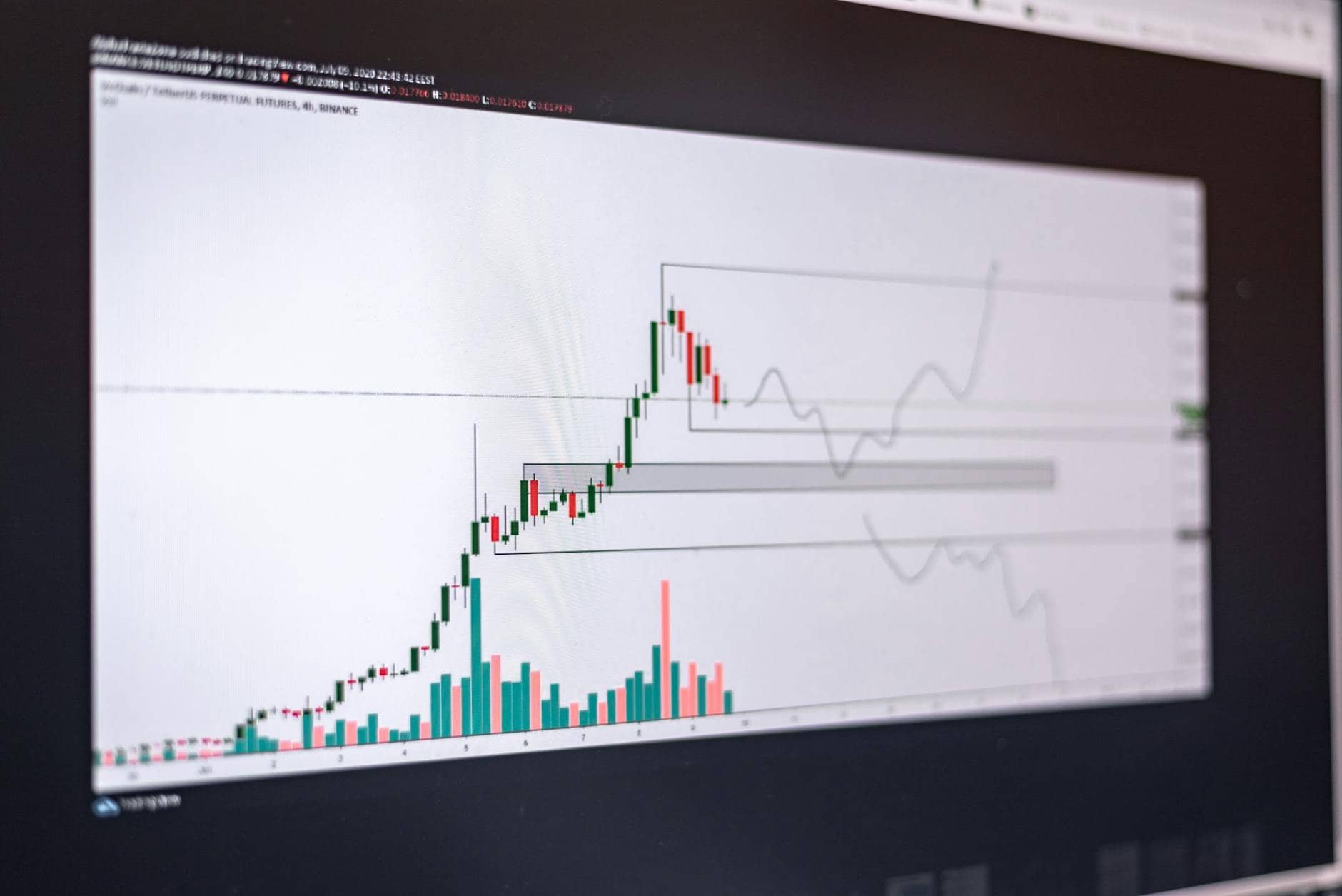
The CoinDesk 20, an index that aggregates the performance of the twenty leading cryptocurrencies by market capitalization, has just recorded a sustained decline across the board. Bitcoin Cash (BCH) is down 13%, dragging the entire index along with it. For an investor looking to integrate crypto-assets into a balanced wealth allocation, this volatility comes as no surprise. Yet it raises a fundamental question: how do you build crypto exposure without jeopardizing the stability of your overall wealth?
What we're seeing today is not a market accident. It's a reminder of a structural reality: crypto-assets, even when diversified within an index, remain highly volatile assets. Far from the marketing rhetoric that presents blockchain as risk-free revolution, wealth management requires looking at the numbers with clear eyes.
What the CoinDesk 20 decline reveals about the correlation of digital assets
The CoinDesk 20 was designed to offer diversified exposure to the crypto-asset market. Twenty different assets, varying market caps, distinct use cases. In theory, this diversification should limit the impact of an isolated drop. In practice, when Bitcoin Cash falls 13%, the entire index declines in lockstep.
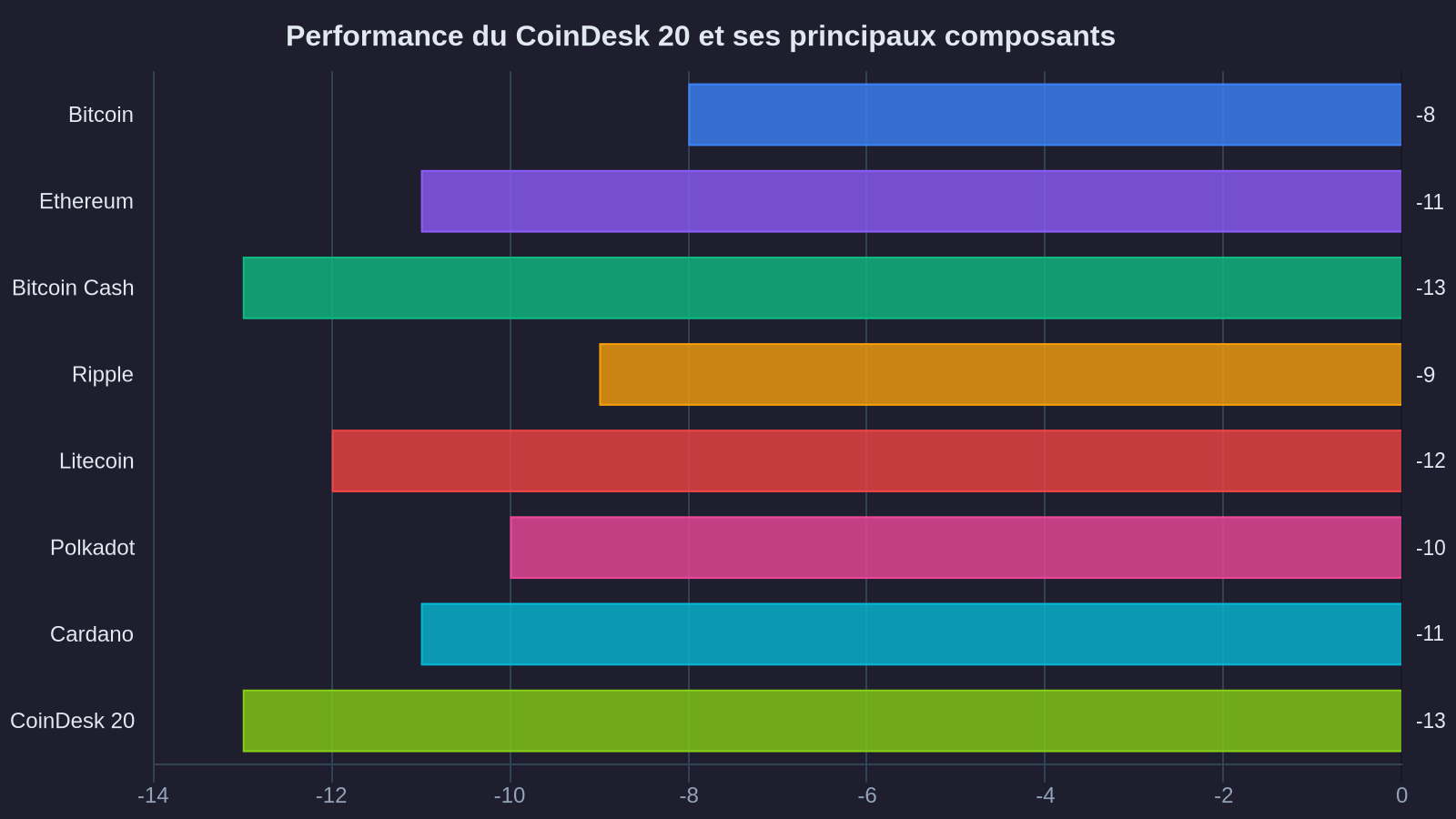
This phenomenon of near-perfect correlation among crypto assets is nothing new. It consistently appears during market stress phases, as illustrated by recent geopolitical tensions and their impact on Bitcoin. Unlike a traditional stocks-and-bonds portfolio, where bonds act as a shock absorber when stocks fall, crypto-assets tend to move in the same direction. Diversification within crypto therefore provides far more limited protection than diversification across traditional asset classes.
Take a concrete example. A 200,000€ portfolio split 60% stocks, 30% bonds, and 10% real estate has average annual volatility in the range of 8 to 12%, depending on the period. If you replace the bond allocation with crypto exposure (even diversified through an index), your overall portfolio volatility can double or even triple. Historical simulations show that over the past three years, a portfolio containing 10% CoinDesk 20 would have experienced monthly swings reaching 18 to 25%.
Bitcoin Cash down 13%: Anatomy of a decline and signals for other assets
Bitcoin Cash is not a minor asset. An heir to a Bitcoin fork in 2017, it regularly occupies a top 20 position in crypto-assets by capitalization. Its 13% drop in just days is striking because it occurs against a backdrop of relative Bitcoin stability itself.
Several technical factors can explain this disconnect. First, liquidity: Bitcoin Cash shows significantly lower trading volumes than Bitcoin or Ethereum. During periods of stress, less liquid assets experience sharper price swings. Second, positioning: BCH has always been perceived as a Bitcoin alternative, with a value proposition centered on fast, low-cost payments. Yet this promise has been diluted with the emergence of second-layer solutions on Bitcoin (Lightning Network) and low-transaction-cost blockchains (Solana, Polygon).
For a wealth-focused investor, the lesson is clear: not all crypto-assets are equal in terms of resilience. Market cap alone isn't enough. You also need to examine daily liquidity, real adoption (number of transactions, active users), and the durability of the use case over time. Building your own volume analysis tools can help you spot these signals before it's too late.
An asset that loses 13% in a few days isn't necessarily a bad asset. It's an asset whose risk profile must be measured precisely within your overall allocation.
Should you still diversify within crypto-assets, or favor concentrated exposure?
The question naturally arises: if all assets decline together, why not concentrate exposure on Bitcoin and Ethereum, which together represent nearly 70% of total crypto market capitalization?
The answer depends on your investment horizon and risk tolerance. Over a short horizon (less than three years), concentration in Bitcoin and Ethereum actually delivers better risk-adjusted returns. These two assets benefit from the deepest liquidity, most advanced institutional adoption, and regulatory infrastructure in clarification (spot Bitcoin ETFs in the US, MiCA framework in Europe).
Over a longer horizon (five to ten years), however, measured diversification can find its place. Not to smooth volatility—we've seen that doesn't work—but to capture specific innovation dynamics. A project like Chainlink (decentralized oracle) or Avalanche (blockchain infrastructure for finance) doesn't react to exactly the same catalysts as Bitcoin. Their short-term correlation is strong, but their long-term trajectories may diverge.
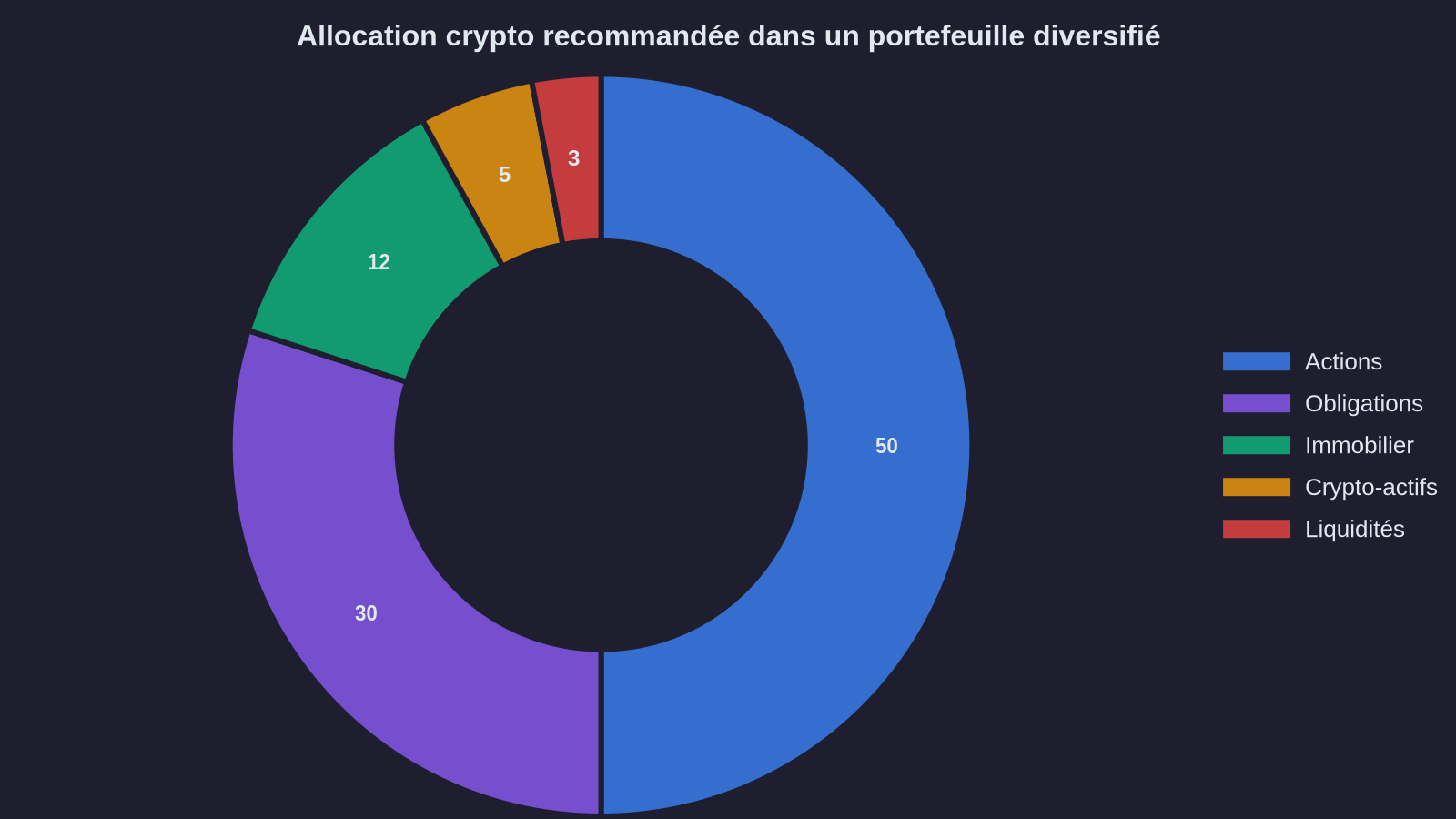
In concrete terms, for a 50,000€ crypto allocation within a 500,000€ portfolio (10% in crypto, already a significant exposure), one possible breakdown would be:
- 60% in Bitcoin (30,000€): reserve asset, deep liquidity
- 30% in Ethereum (15,000€): exposure to DeFi and NFT ecosystems
- 10% in diversified basket (5,000€): 3 to 5 high-conviction assets (alternative layer 1s, established DeFi protocols)
This structure limits exposure to second-tier assets while keeping an opportunity window open for emerging projects. But it won't protect you from a broad crypto market decline. It's the correlation with the rest of your wealth (stocks, bonds, real estate) that plays that role.
What this means for your wealth: Integrating crypto volatility without compromising your objectives
Let's return to the fundamental wealth question: what place for crypto-assets in an allocation built to last?
The numbers are unambiguous. Over the past five years (2019-2024), Bitcoin has delivered average annual returns exceeding 60%, but with annual volatility around 80%. A diversified equity portfolio (MSCI World) has delivered about 9% annually, with volatility of 15%. The return gap is spectacular, but the volatility gap is equally striking.
For wealth in accumulation phase (ages 35-45, 15-20 year horizon), crypto exposure of 5 to 10% can be justified. You accept the volatility in exchange for potential significant outperformance. You also diversify counterparty risk: facing a traditional financial system heavily correlated to central bank monetary policies, crypto-assets offer exposure to an asset class whose price determinants are partially disconnected.
For wealth in preservation phase (age 55 and above, 5-10 year horizon), crypto exposure must be rethought. An allocation of 2 to 3% maximum, concentrated in Bitcoin, can find its place as marginal diversifier. Beyond that, you're introducing volatility levels incompatible with the stability sought at that stage.
Let's simulate concretely. A 300,000€ portfolio with 10% in crypto (30,000€) experiencing a broad 30% crypto market decline (comparable to what we're seeing now) suffers a 9,000€ loss. Relative to total wealth, that's a 3% decline. Manageable, if the rest of your portfolio remains stable or grows modestly.
Conversely, if your crypto exposure reaches 25% (75,000€), the same 30% decline costs you 22,500€, or 7.5% of total wealth. At that level, crypto volatility begins weighing significantly on your financial peace of mind.
The current CoinDesk 20 and Bitcoin Cash decline doesn't challenge the case for crypto-assets in wealth allocation. It simply reminds you that these assets must be sized according to your profile, your horizon, and your real capacity to stomach volatility. Not the volatility you imagine in marketing pitches. The volatility you actually feel when your portfolio drops 15% in a week.
Your wealth deserves better than a savings account. I'll show you the way, backed by the numbers.
```