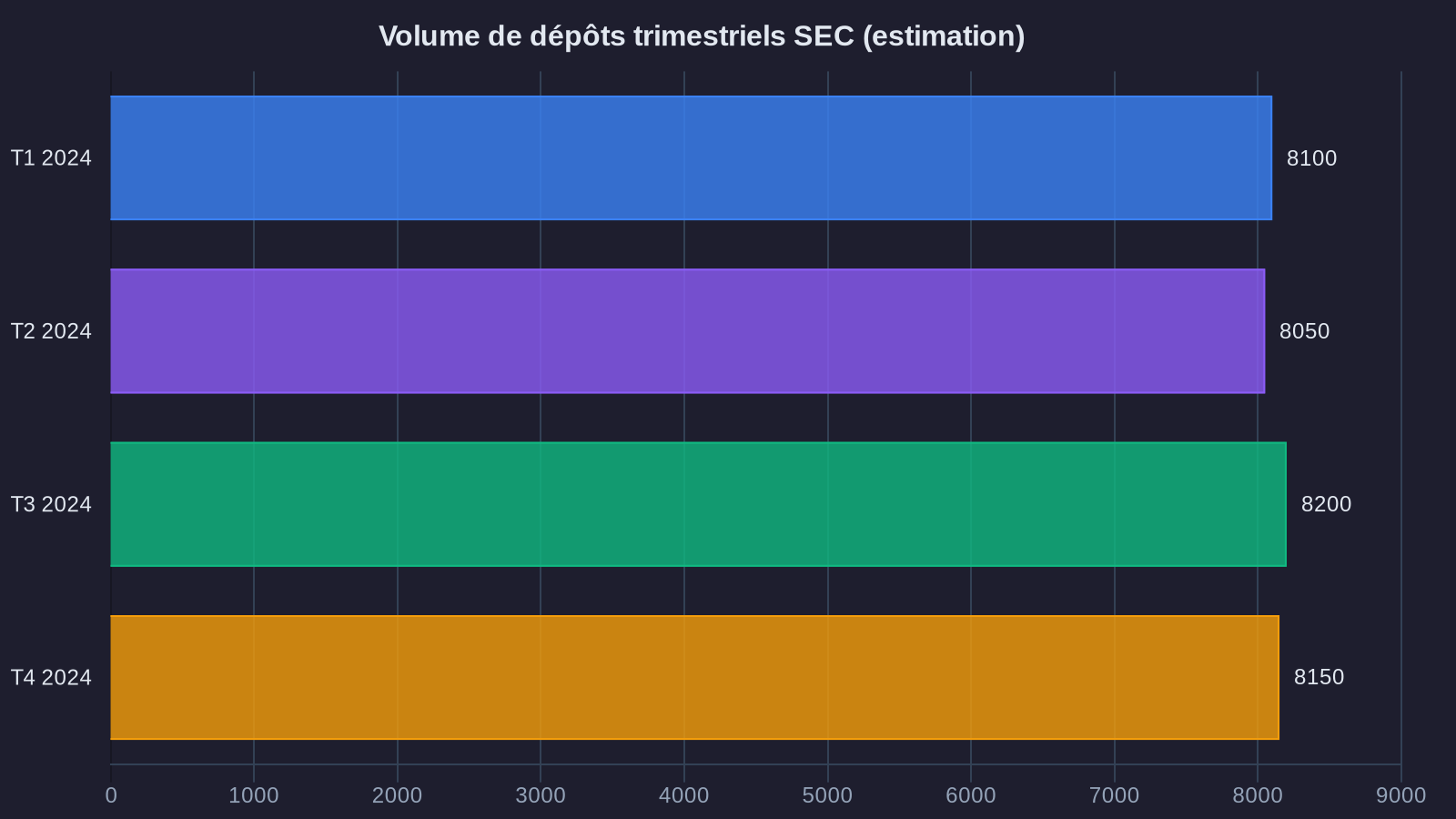
Every quarter, more than 8,000 U.S. publicly traded companies file their financial statements with the Securities and Exchange Commission (SEC). These documents — balance sheets, income statements, cash flow statements — represent a goldmine of information for any serious investor. Yet few actually tap into this wealth of data. Why? Access remains cumbersome, the format is poorly suited for analysis, and manual analysis is time-consuming.
The SEC recently opened programmatic access to its databases via a free API. Combined with a well-designed Python SDK, this interface lets you automate the extraction, cleaning, and analysis of financial fundamentals at scale. You move from a manual approach — laboriously reviewing 200-page PDFs — to an industrialized method that lets you compare, filter, and model hundreds of companies in a few lines of code.
For a long-term investor, this is a game changer. Rather than relying solely on generic screeners or analyst summaries, you can build your own selection criteria, audit the accounting quality of a position, or spot warning signals in cash flows. Let's see how to structure this approach.
Why SEC data represents a unique source of information
The SEC requires U.S. public companies to publish their accounts in a standardized format called XBRL (eXtensible Business Reporting Language). This format structures each accounting line with a normalized tag: Apple's revenue uses the same tag as Microsoft's. This standardization allows you to compare companies across different sectors without manually reprocessing the data.
Unlike the proprietary feeds from data providers (Bloomberg, FactSet, Refinitiv), SEC data is public, free, and comprehensive. It covers all U.S. publicly traded companies, including smaller-cap stocks that traditional vendors often overlook. You gain access to the same information as a sell-side analyst, without annual subscription fees of €20,000 to €50,000.
The SEC API provides access to major regulatory filings: 10-Ks (annual reports), 10-Qs (quarterly reports), 8-Ks (major events), and shareholder forms (13F, 13D). Each accounting line is timestamped, versioned, and traceable. You can go back 10 years to analyze the evolution of a ratio or detect a change in accounting method. This depth of analysis proves particularly useful for understanding the regulatory evolution of the U.S. stock market.
The Python ecosystem for leveraging SEC data
Several Python SDKs simplify querying the SEC API. The most mature is sec-api, which offers simple request handling and native rate limiting management (10 requests per second maximum, as imposed by the SEC). Other libraries like sec-edgar-downloader or python-edgar offer complementary approaches, particularly for bulk downloading raw documents.
The typical approach involves extracting financial data via the API, loading it into a pandas DataFrame, then applying ratio calculations and selection filters. Let's take a concrete example: you want to identify S&P 500 companies generating free cash flow exceeding 8% of their market cap, while maintaining a debt-to-equity ratio below 2.
With a Python SDK, this screening boils down to a few dozen lines of code. You retrieve balance sheets and income statements for all 500 companies, calculate free cash flow (operating cash flow minus capital expenditures), cross-reference with market capitalizations, and filter according to your criteria. What would take hours on an online screener takes just minutes, with full control over definitions and thresholds.
The value extends beyond simple screening. You can reconstruct 10-year historical series to analyze margin stability, cash flow progression, or changes in balance sheet structure. This temporal depth lets you identify companies going through a difficult cycle but retaining solid fundamentals — opportunities the markets often temporarily undervalue.
Building a reproducible financial analysis pipeline
Automation via Python goes beyond occasional data consultation. It lets you build a complete pipeline: daily extraction of the latest SEC filings, automatic calculation of financial ratios, alerts when thresholds are breached, and updates to a dashboard tracking positions to monitor.
In practice, you can program a script that queries the SEC API each morning, retrieves new 10-Qs published the day before, extracts relevant accounting lines (net debt, EBITDA, capex), recalculates your portfolio ratios, and notifies you if a held company shows deteriorating cash generation or abnormal debt increases.
This systematic approach avoids confirmation bias: rather than consulting only data for companies that already interest you, you monitor your entire investment universe according to objective criteria. You spot opportunities before they become obvious, and risks before they materialize in stock prices. An approach comparable to what's needed for analyzing new tokenized assets on regulated markets.
Another relevant use case involves accounting quality audits. Certain signals — strong revenue growth but stagnant operating cash flow, rapid increases in accounts receivable, divergence between net income and cash generated — can indicate aggressive accounting or masked operational difficulties. By cross-referencing multiple years of SEC data, you identify these anomalies before they become public scandals.
Limitations and points to watch
The SEC API presents technical constraints to anticipate. The 10 requests-per-second rate limit requires structuring calls efficiently, especially when querying hundreds of companies. Python SDKs typically manage this limitation, but poorly designed architecture can quickly saturate available bandwidth.
XBRL data, while standardized, isn't free from inconsistencies. Some companies use custom tags for specific accounting lines, complicating direct comparison. You must therefore plan for a data cleaning and validation layer before any analysis. A ratio calculated automatically across 500 companies requires coherence checks: outlier values, division by zero, extreme variations from quarter to quarter.
Finally, SEC data covers only U.S. publicly traded companies. If your portfolio includes European or Asian stocks, you'll need to supplement with other sources. Each regulator has its own publication format (ESEF in Europe, for example), multiplying the SDKs and data formats you must master.
One final often-overlooked point: leveraging SEC data via Python falls more into data engineering than pure finance. You must master Python basics (pandas, requests, error handling), understand data formats (JSON, XML), and know how to structure an ETL pipeline (extract, transform, load). It's not insurmountable, but it does require an initial time investment in learning. For a long-term investor managing €500,000 or more, this time is easily recouped by the quality of decisions that follow.
What this means for your wealth
Automating fundamental analysis via the SEC API transforms your asset selection process. You move from a manual approach — consulting a few companies per month, relying on analyst consensus — to a systematic approach covering hundreds of companies according to your own criteria.
For a €200,000 stock portfolio, this industrialization can represent a 1 to 2% annual gain by avoiding deteriorated values and spotting undervalued opportunities. Over 10 years, with compounding, this translates to €20,000 to €40,000 in additional performance. The cost of acquiring this skill — a few dozen hours of Python training — pays for itself many times over.
The challenge isn't replacing qualitative analysis with algorithms, but gaining efficiency on the quantitative side to spend more time understanding business models, management teams, and competitive advantages. SEC data saves you from wasting time on structurally fragile companies and lets you concentrate your attention on those deserving deeper analysis.
Your wealth deserves better than a savings account. I'll show you the way, backed by numbers.